
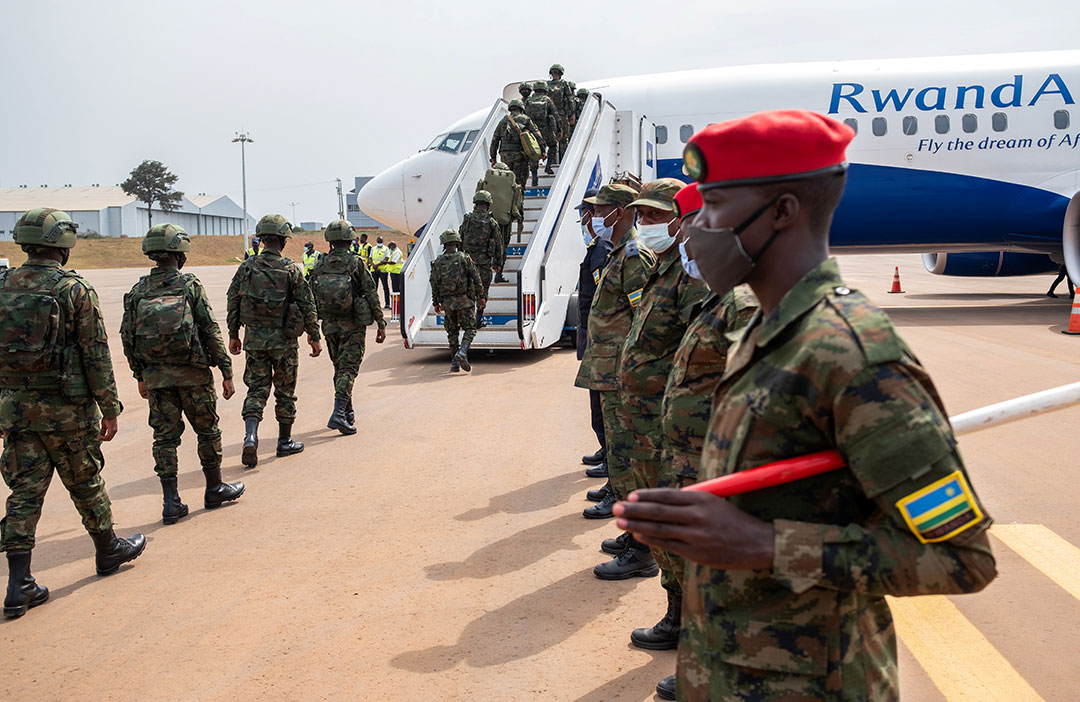
The future of Rwanda’s military deployment in northern Mozambique is uncertain, as Kigali has tied the continuation of its mission in the insurgency-plagued Cabo Delgado province to securing sustained funding.
President Paul Kagame recently warned that Rwandan forces could withdraw as early as May, when the European Union’s financial support is set to end. Rwanda is seeking long-term financial support for continuing counterinsurgency operations in Mozambique.
“It’s not that ‘Rwanda could withdraw,’” Foreign Affairs Minister Olivier Nduhungirehe said in a March 14 social media post. “It’s that ‘Rwanda WILL withdraw’ its troops from Mozambique, if sustainable funding is not secured for its counter-terrorism operations in Cabo Delgado.”
The EU in 2024 approved $23 million in assistance for the Rwanda Defence Force (RDF) in Mozambique, matching the amount it provided nearly two years earlier. The funding, under the European Peace Facility, was allocated to cover the cost of personal equipment and logistics, the European Council said. But officials told several media outlets in March that the EU will not replenish funds for Rwanda’s mission when they expire in May.
In a separate social media post, Rwandan government spokeswoman Yolande Makolo said the cost of deploying troops and police to Mozambique is at least 10 times more than the roughly $23 million disbursed by the EU.
Mozambican security expert Borges Nhamirre, a researcher with the South Africa-based Institute for Security Studies, said Rwanda’s figures are difficult to verify and include nebulous costs such as the use of state-owned RwandAir. Yet Makolo said continued deployment depends on “adequate, predictable funding.”
“Should the RDF Command assess that the work being done by Rwandan Security Forces in Cabo Delgado is not appreciated, they would be right to urge the government to end this bilateral counter-terrorism arrangement and pull out,” she wrote.
The insurgent group known as Islamic State-Mozambique has terrorized citizens throughout the country’s northernmost province. The insurgents had overwhelmed Mozambican troops, seized key areas like Mocímboa da Praia and attacked the coastal town of Palma.
Since the insurgency began in 2017, about 6,500 people have been killed and 1.3 million displaced, according to Armed Conflict Location and Event Data and United Nations figures.
After the Mozambican government requested external assistance, Rwanda in 2021 deployed around 1,000 Soldiers and police, quickly retook Mocímboa da Praia and secured other areas. Nearly five years later, the terrorist group has continued its bloody insurgency, and Rwanda’s deployment has reached more than 4,000 troops.
“The conflict highlights the limits of an approach focused primarily on military protection of infrastructure,” Nhamirre told Deutsche Welle for an April 16 article. “The root causes of violence — poverty, exclusion and lack of prospects — remain unresolved.”
Rwandan forces are highly trained and effective, and essentially are buying time for Mozambique’s armed forces to build internal capacity. A 2025 Status of Forces Agreement between Rwanda and Mozambique noted the gradual transfer of security responsibilities to Mozambique.
In 2024, Rwanda increased its presence to help fill the void left by the withdrawal of a Southern African Development Community (SADC) mission, which deployed in July 2021 and faced funding problems and other issues.
“Mozambique could invite the SADC to return as part of a multilateral mission,” geopolitical researcher Kaitlyn Rabe wrote in an April 14 analysis for The Conversation website. “It would, however, have the same logistical and political obstacles that plagued its first mission.”
The Shaf Center, an independent research organization based in Egypt, said that the EU’s decision to cut funding raises significant questions about the future of security in Cabo Delgado.
“While the EU-backed military presence has contributed to relatively containing the expansion of armed groups, scaling back this support raises genuine concerns about the emergence of a security vacuum that could be exploited by ISIS-affiliated organizations to regroup and expand their activities,” the organization wrote in an April 27 report. “The question remains open as to whether the suspension of European funding will mark a turning point toward reshaping the map of threats, or the beginning of a more complex phase of prolonged regional instability.”
Though northern Mozambique and the surrounding region remain unstable, Nhamirre and other analysts have characterized Rwanda’s possible withdrawal as more of a negotiating tool than a threat.
“The most likely scenario is that Rwandan troops will remain there in one form or another,” he said.