

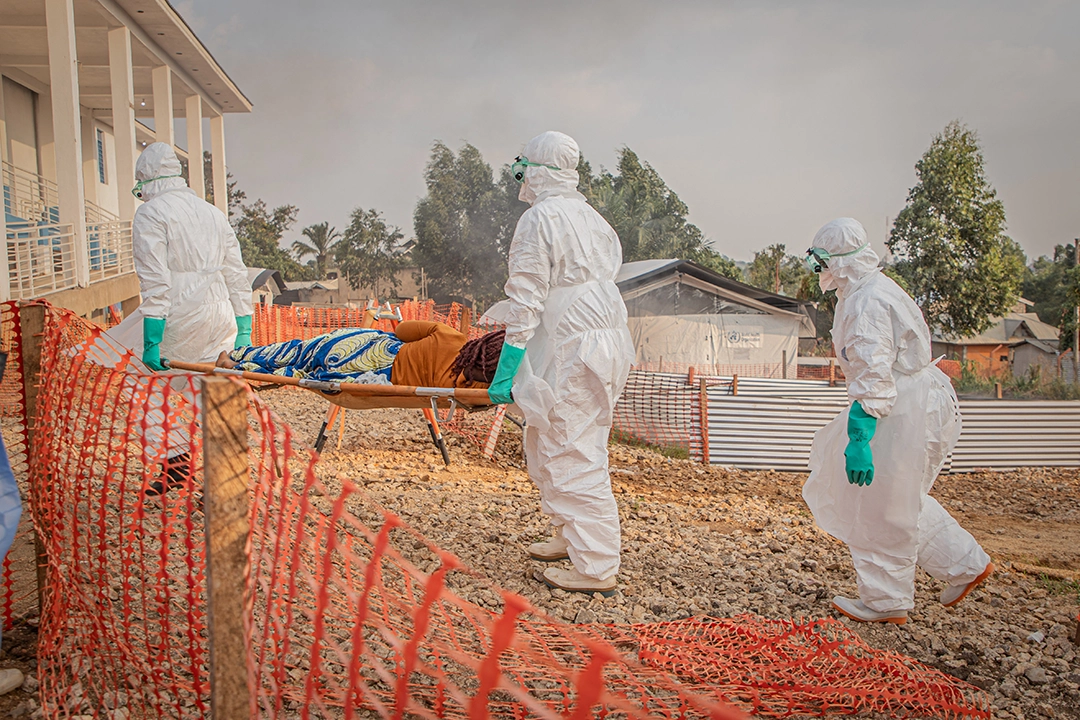
As the Democratic Republic of the Congo battles a stubborn Ebola outbreak, mistrust, violence and instability are hindering health officials’ ability to respond. But lessons learned from the past and public health best practices offer a roadmap for how to stop the spread of the deadly disease.
Experts fear the outbreak that began in May has yet to reach its peak and could last a year. “It is still in the expansion phase unfortunately,” Dr. Anne Ancia, the World Health Organization’s representative to the DRC, told reporters on July 7 according to Reuters. “We would like to say it is stabilizing, but frankly we cannot say it yet.”
DRC government data showed that confirmed cases had reached 1,708, with 580 deaths, as of July 8, Reuters reported.
Congolese authorities have confronted 16 previous Ebola outbreaks, including one in 2018 that lasted nearly two years, infected 3,470 people and killed 2,287 in North Kivu, Ituri, and South Kivu provinces.
Longstanding violence in the nation’s east, significant population displacement, scarce medical resources and food insecurity are making the tedious, but effective, work of contact tracing, containment and treatment difficult.
The current outbreak presents additional challenges. There are no approved vaccines or treatments for the rare Bundibugyo virus variant and medical personnel could not quickly confirm the illness because available tests only worked for more common strains, such as Ebola and Sudan virus. Blood samples had to be sent about 1,500 kilometers to the capital, Kinshasa, for testing and confirmation, which caused dayslong diagnosis delays and surrendered precious time to the advancing virus.
“This detection delay enabled the virus to circulate within the population and among health care workers for weeks (possibly as early as February) without Ebola-specific interventions,” according to a report by the Africa Center for Strategic Studies.
Other conditions complicating the response, according to the Africa Center, include:
- Some areas, including part of South Kivu province, are controlled by armed groups such as the M23 militia. Encountering such groups on the way to health centers deters patients and medical personnel.
- Crowded displacement camps — more than 5 million people have been uprooted in the three affected provinces — make responses difficult and the virus spread easily. Deaths have been reported at three camps hosting tens of thousands of people.
- The remote eastern DRC already had limited health resources, including too few doctors, nurses and medicines. Violence worsened those shortages. Access to clean water and hygiene also is limited.
- Food insecurity affects nearly 10 million people in the region, decreasing resilience against Ebola and other illnesses.
- The area is home to transient people who work in artisanal gold mines. Those groups attract sex workers and smugglers who could spread the disease as they move on. “Authorities in Mongbwalu, one of the main gold mining towns, believe that more than 80 people died from Ebola before the outbreak was detected.”
Perhaps the toughest challenge in fighting Ebola is overcoming mistrust. Public suspicion and ignorance were major obstacles in addressing the 2014 West African Ebola outbreak in Guinea, Liberia and Sierra Leone. That outbreak, the largest ever, sickened 28,610 and killed 11,308.
Despite its tragic outcome, the West African outbreak provided a road map for successfully engaging populations who mistrust government, face economic hardships, and hear conflicting or bad information. “Effective communication strategies, culturally sensitive health education, and involving community leaders were essential in overcoming these challenges,” according to a 2024 article, “Ebola: Ten years later — Lessons learned and future pandemic preparedness,” by Krutika Kuppalli for PLOS Global Public Health.
“Building trust and fostering community cooperation have proven to be indispensable in managing health crises,” Kuppalli wrote. “Addressing these challenges in future outbreaks requires early and continuous engagement, developing culturally appropriate communication strategies, addressing stigma, and strengthening health systems and infrastructure to ensure a robust and effective response.”
Understanding that, DRC and WHO health officials in September 2025 made community engagement central in responding to an Ebola outbreak in Kasai province. Community protection was included at every step of the response and became critical to controlling the outbreak, the WHO reported in June 2026. The outbreak infected 64 and killed 45 in three months.
Responders identified and used trusted locals to help address rumors and encourage cooperation. Seeing them alongside response teams reassured the public and built confidence in the response. Authorities also collected community feedback from several forums, including radio shows and citizen groups, and used that information to inform decisions regarding vaccinations and how to address treatment fears.
Community engagement personnel persuaded traditional leaders to help monitor and report weekly on indicators that helped with disease surveillance and improved communication between responders and the public.
Effective public relations and reliable information pave the way for effective interventions such as tracing contacts, testing people and treating the sick. It keeps health workers safe and treatment centers secure.
“Community trust is not a peripheral or ‘soft’ component of emergency response,” according to the WHO. “It is a foundational element that enables response operations to succeed and helps communities protect themselves during times of crisis.”