

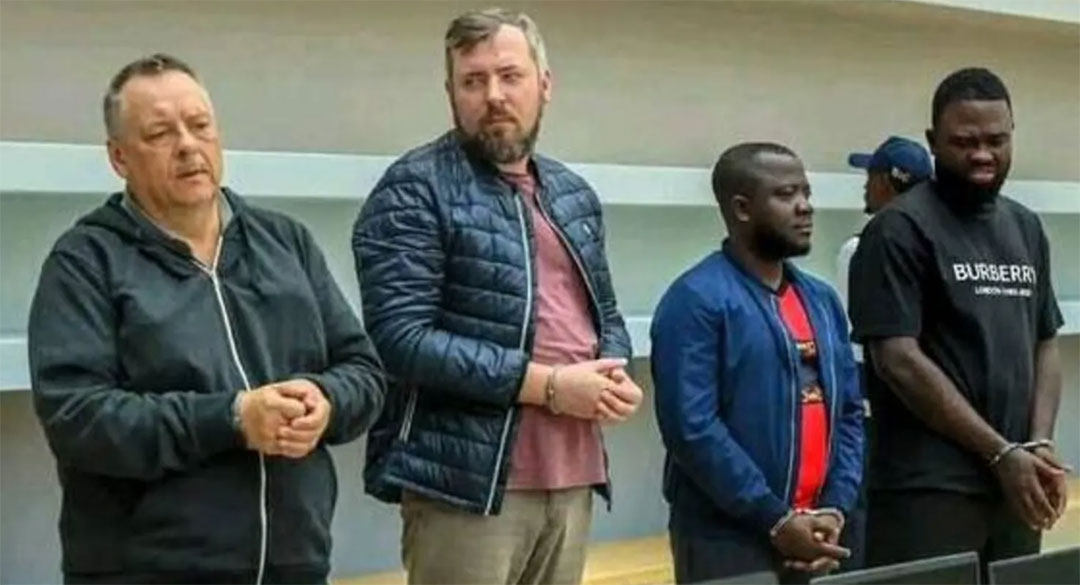
The Angolan government has charged two Russian nationals with terrorism, espionage and influence peddling as part of a false information campaign designed to fuel antigovernment protests ahead of upcoming presidential elections.
Angola is the latest African country to find itself on the receiving end of a Russian influence operation run by African Politology, a group created by the ex-leader of the organization formerly known as the Wagner Group.
Through African Politology, Russian President Vladimir Putin has sought to stir up public unrest, particularly ahead of elections, in the Central African Republic, Chad, Madagascar, Mali, Namibia and South Africa, among other places.
The goal is to put into place governments friendly to Russian interests, either peacefully through elections or by overthrowing democratic institutions.
The Angolan government claims that Russian operatives arrived in the country in 2024 under the pretense of developing a Russian cultural center known as “Russian House” in the capital, Luanda. Moscow operates 14 Russian Houses across the continent.
Observers say Moscow uses its Russian House operations to spread propaganda and to build public support for giving Russian companies access to natural resources as a way for Russia to get around international sanctions imposed after its invasion of Ukraine.
“The Russians are providing this support in exchange for either the full control or a percentage of the control from their mineral resources. That is what Russia needs: It needs funding, and it needs influence. It helps its war in Ukraine,” Irina Filatova, a senior research associate at the University of Cape Town, told CNN. Filatova is a Russian historian specializing in African history.
Luanda’s Russian House never materialized. Instead, the government says, Russian operatives paid local journalists as much as $24,000 to plant Russian-backed stories in the local media to provoke “political change.”
Maxim Shugalei, a Russian political operative with ties to the Wagner Group, and his translator, Samer Suaifan, were among the first Russian operatives to arrive in Angola as part of the influence campaign. Both men have figured prominently in similar Russian influence operations on the continent, including in Chad, where they were arrested in 2024 after an event at N’Djamena’s Russian House. They were charged with espionage and influence peddling and were deported to Russia six days later.
Before their arrest, Shugalei and Suaifan used Chad’s Russian House to spread propaganda through the local media aimed at undermining opposition leader Succès Masra’s campaign for prime minister.
Angola appears to be one of the few African nations to disrupt African Politology’s influence campaign before it could gain momentum.
Angolan authorities have charged political consultant Igor Ratchin and translator Lev Lakshtanov with 11 criminal counts. The government also indicted two Angolans — a journalist and a political consultant — on similar charges of participating in the influence campaign.
According to France’s Radio France Internationale (RFI), Lakshtanov is the founder of Farol, a nongovernmental organization that promotes cultural cooperation in Portuguese-speaking countries. He and Ratchin entered Angola on tourist visas and presented themselves as journalists making a documentary while also promoting the cultural center.
Lou Osborn with the group All Eyes on Wagner told RFI that Angola and Chad show Russia’s intention to influence African countries in ways that are discreet “but more active than ever.”
According to Alex Vines, African programme director at the European Council on Foreign Relations, the influence operation was designed to bring Angola back into Russia’s sphere of influence after the current government turned toward Europe and the West.
Angola’s ties to Russia go back decades but have weakened in recent years. The Angolan government expelled Russian diamond miner Alrosa and bank VTB as part of the international sanctions after the Ukraine invasion.
“This is indicative of Russian anxiety of the direction of travel of Angola under the Lourenço administration,” Vines told the BBC. “There’s clearly an element of Russian disinformation to try and build up more sympathy towards the Russian Federation.”