

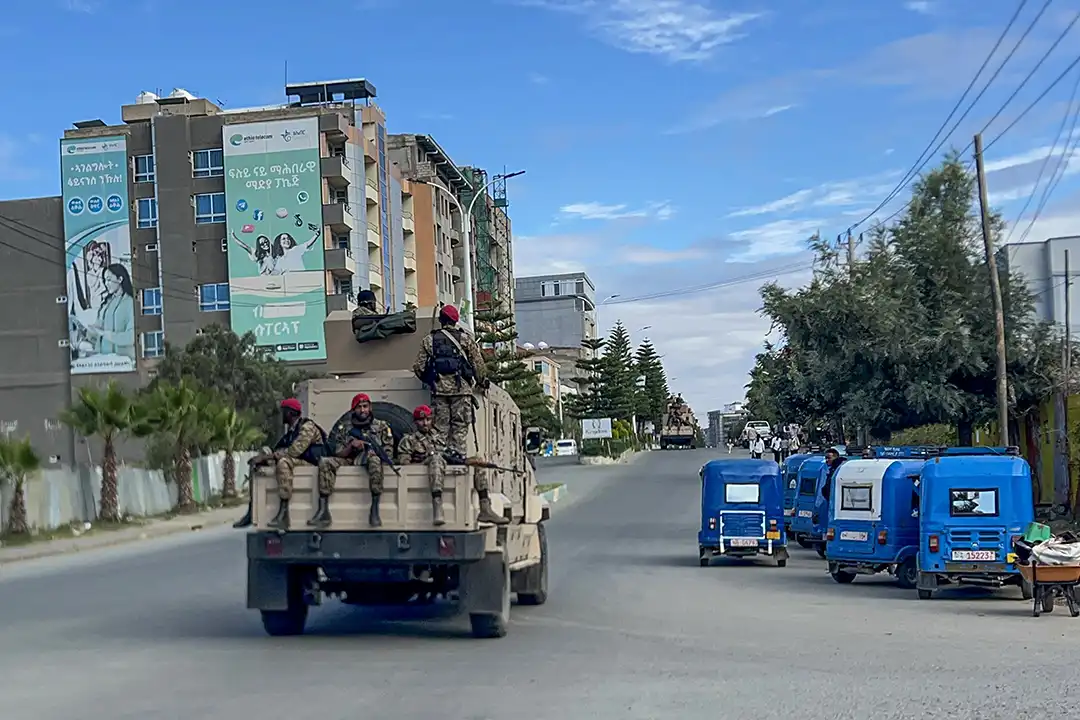
Troop movements, drone attacks and escalating rhetoric have pushed Eritrea and Ethiopia back to the brink of war. Analysts warn that, without a drastic reversal, the conflict risks costing thousands of lives and drawing in countries from across the region.
Experts are pointing to the two countries’ devastating history of border conflict and are urging a diplomatic solution.
“A standoff along the two countries’ frontier would be an ominous turn of events,” the International Crisis Group (ICG) wrote in an October 12 assessment. “The last major interstate conflict in the Horn of Africa, in which hundreds of thousands perished in trench warfare, was fought along precisely the same border.”
Witness accounts and independent monitors reported that Eritrean troops crossed the border in northern Ethiopia near the town of Zalambessa on about October 7. In a letter to the United Nations Security Council, the Ethiopian government accused its northern neighbor of sending troops 60 kilometers into its territory.
Ethiopian Foreign Minister Gedion Timothewos described the incursion as “a blatant act of aggression that engages Ethiopia’s inherent right to self-defence.”
In response, Ethiopia launched drone attacks against Eritrean military vehicles near the town of Adi Grat on October 8, according to the Armed Conflict Location and Event Data project, or ACLED. Ethiopia has also deployed forces to the north and retaken several towns that had been held by the Tigray People’s Liberation Front (TPLF), a political party and armed group that has recently aligned with Eritrea.
The tensions follow a period of weeks when several of Ethiopia’s armed groups including the TPLF and the Fano, an ethnically Amhara militia, launched attacks against Ethiopian federal government positions. Ethiopia accuses Eritrea of supporting these groups with arms and training.
Eritrea has reason to fear that landlocked Ethiopia has ambitions to invade and occupy the port city of Assab to gain access to the Red Sea. Eritrean President Isaias Afwerki appears to believe he can protect his country by arming rebels inside Ethiopia.
“For Eritrea, continued conflict inside Ethiopia reduces the threat to Assab,” Hafte Gebreselassie Gebrihet, a research fellow at the University of Oslo, wrote for The Conversation. “A federal government fighting in the Amhara, Oromia and Tigray regions has fewer troops, less money and less political space to pressure Eritrea.”
The tensions come nearly four years after the signing of the Pretoria Agreement which formally ended Ethiopia’s civil war with the TPLF. However, Hafte writes, the agreement has not been implemented in a way that would guarantee lasting peace. The disputed territory of Western Tigray has not been returned to Tigrayan administration, the northern region of Tigray has not been reintegrated into federal politics, and the promised disarmament of militias has stalled.
The failure of Pretoria makes groups less likely to disarm and gives outside actors like Eritrea an opening to form alliances and destabilize Ethiopia, Hafte argued.
“Peace in Tigray depends on making implementation more valuable than continued uncertainty,” Hafte wrote.
In an article written for the New Humanitarian, journalist Daniel Berhane wrote that there are three possible scenarios for the conflict in northern Ethiopia and Eritrea.
- Armed groups proliferate: Eritrea stops sending troops across the border but continues to support armed groups like the TPLF and Fano.
- A stalemate: the northern region continues to be a proxy-conflict with insurgents controlling parts of the countryside and the federal government controlling population centers.
- Interstate war: Ethiopia and Eritrea return to war over unresolved border issues and control of the port of Assab. The war would likely draw in regional nations and Gulf states.
Experts are urging deescalation, noting that a million people are still displaced from the last conflict and four million require aid. The humanitarian toll of a return to conflict could be much worse.
“Pulling Ethiopia and Eritrea back from the brink of war should be the priority for all those interested in preventing a deadly chain of interconnected conflicts from snaking across the Horn of Africa and Red Sea regions,” the ICG wrote.