
The Tigray People’s Liberation Front (TPLF) was one of seven armed Ethiopian groups that recently formed an alliance aiming to topple the federal government led by Prime Minister Abiy Ahmed. The new association is called the Ethiopian Peoples’ Forces Alliance for Survival, or Alliance for Survival.
Some of these groups have clashed in the past, and territorial disputes remain but have been tabled, alliance representatives said. The pact was announced on September 20 amid ongoing Tigray region violence.
“We just formed an alliance, we are collaborating with several groups, and our objectives are to remove the regime and facilitating a transitional government,” TPLF Vice President Amanuel Assefa told Agence France-Presse (AFP). “We think we will be successful; we have been talking with each other for more than a year.”
A senior TPLF official was asked whether the announcement was a declaration of war. “We are at war now, aren’t we?” the official said in an Al Jazeera report.
Analysts have warned that ongoing hostilities in Tigray could trigger a return to a full-blown war. The TPLF led Ethiopia for nearly three decades before Abiy took office in 2018. The Tigray war that ended in 2022 began after Abiy sidelined the TPLF and replaced it with the Prosperity Party. About 600,000 people died during the conflict.
Besides the TPLF, the new alliance includes the Amhara Fano National Movement, which has fought federal forces in the Amhara region since 2023, and the Oromo Liberation Army, or OLA, which has fought federal forces in the Oromia region since 2018. According to Al Jazeera, the other four groups are smaller. They are the Afar Revolutionary Democratic Unity Front, or Ugugumo; the Benishangul Peoples’ Liberation Movement; the Gumuz Peoples’ Democratic Movement; and the Ogaden National Liberation Front, or ONLF.
An alliance statement accused Abiy of running an administration that has pushed Ethiopia “to the margins of regional and international political, economic and diplomatic affairs, deprived of its voice and influence.” The group also said it seeks to start a new chapter “in which the human and democratic rights of all Ethiopians can be guaranteed in full, without diminution.”
Fano leader Zemene Kasse will chair the alliance, although the groups’ statement did not name a commander for joint operations against the government.
Critics have questioned the alliance’s potential effectiveness.
The groups have “no shared political objective,” Jawar Mohammed, an Oromo politician and former Abiy ally, told Al Jazeera. “They don’t even have a shared tactical objective.”
Kjetil Tronvoll, a regional specialist at Oslo New University College in Norway, noted the federal military’s drone capabilities. Tronvoll predicted that clashes between federal forces and the alliance would be akin to “a sacrificial war for the rebels.”
“If they coordinate as a military command, it may make a difference; it is a potential four to five fronts that the government will have to deal with, it might be a challenge,” Tronvoll told AFP.
Tronvoll also questioned what might happen after a takeover, considering the different ideologies among the alliance’s groups and their histories of contention. Fano, for example, fought alongside Ethiopian federal forces during the recent Tigray war.
“We will sit at the table later to solve our problems peacefully,” Amanuel told AFP.
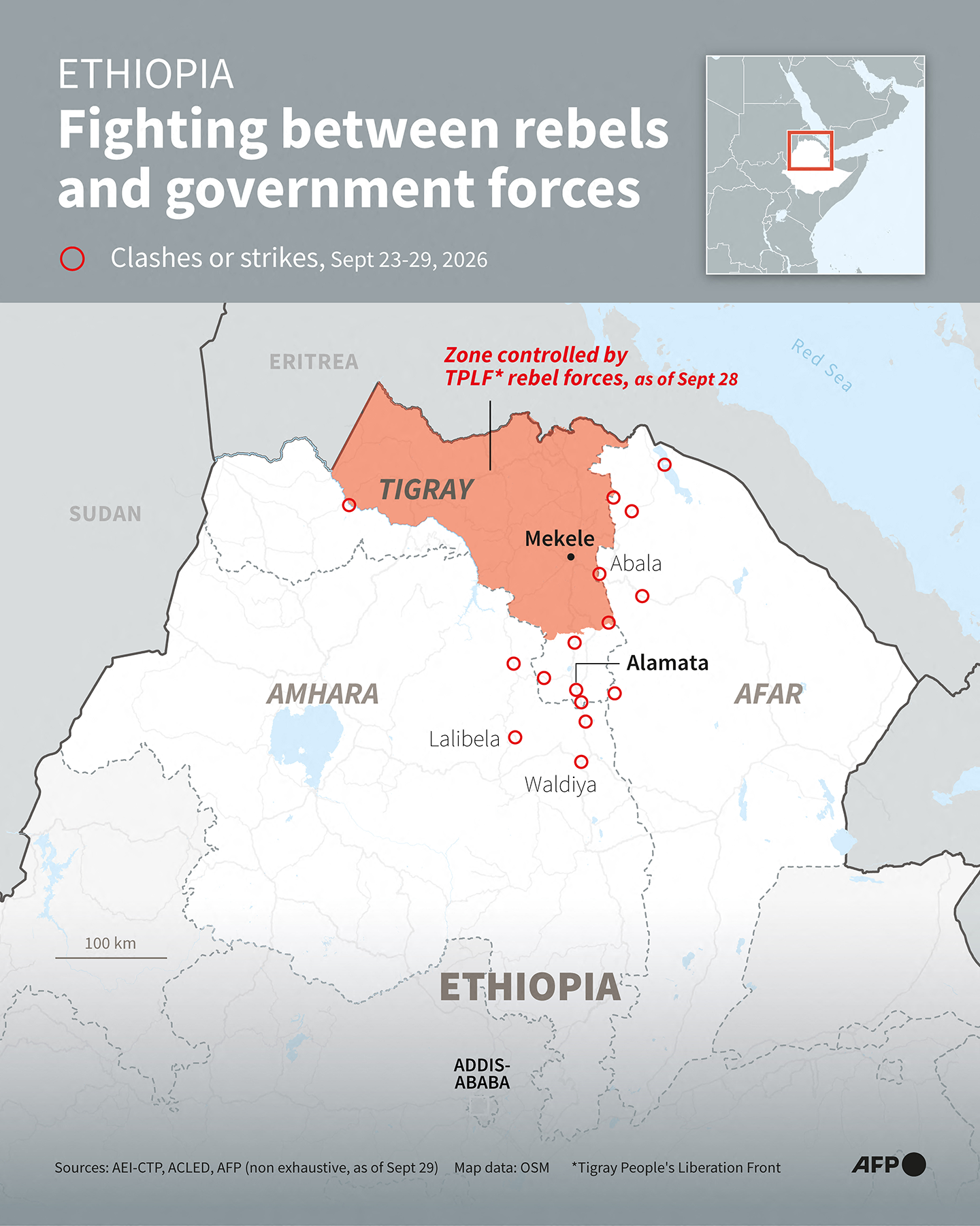
Three days after the alliance was announced, fighting between Ethiopian federal forces and the TPLF erupted in the Afar region, which borders Tigray. The rebels said in a Facebook post that it was responding to intensive bombardments by federal forces’ aircraft, drones and artillery. A former TPLF senior official said the rebels gained control of six towns in Afar.
The next day, Ethiopia’s military said it “launched a counter-offensive that inflicted heavy personnel and equipment losses on the TPLF.”
“We are in the situation of full-blown war now,” Amanuel said in a report by German broadcaster Deutsche Welle.