
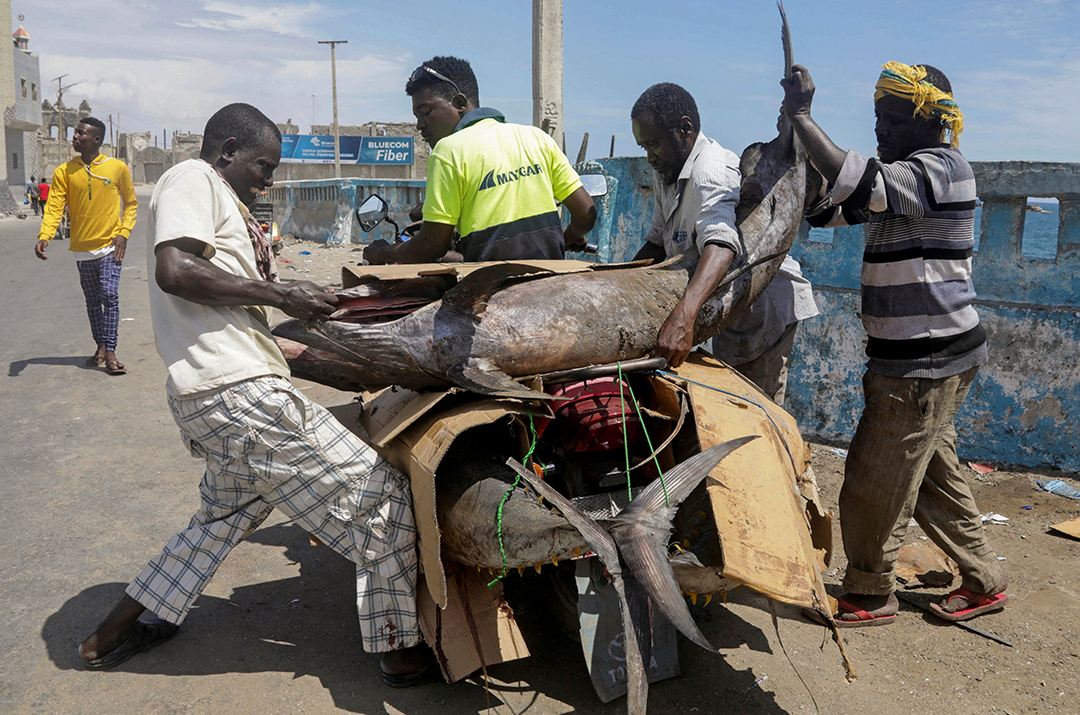
A recent fish trade agreement between Somalia and China is being billed as a job-creating initiative that will boost the country’s Blue Economy. But analysts warn that key details of the agreement remain unknown and, without proper oversight, it could devastate Somalia’s fish stocks and the long-term health of its artisanal fishing industry.
The deal, inked in July, allows Somali exporters to sell fish to China’s more than 1.4 billion consumers without having to pay import duties.
But observers warn that China’s history in the region warrants skepticism about the deal.
“The grim reality is that everywhere China makes fisheries-related agreements, the marine environment is degraded, governance is undermined, the integrity of supply chains diminishes, local fishers are put out of business, coastal communities find themselves in hard times and fisheries-oriented coastal culture is destroyed,” maritime security analyst Ian Ralby, president of Auxilium Worldwide, told ADF.
Ralby added that while the deal may provide short-tern economic relief, “the long-term demise of the marine environment means that the state is paying for that agreement far beyond its economic value.”
Chinese deals also are notoriously opaque, and Ralby was not aware of Beijing having equivalent fish trade agreements with other countries.
“China is well known for being creative in leveraging different aspects related to resource supply chains to sweeten deals that often provide China with tremendous benefit and the other state with tremendous long-term harm,” he said.
China’s distant-water fishing fleet, the world’s largest, has plundered waters in Somalia and around the continent for decades. This has resulted in severe fish stock declines, particularly yellow tuna. Chinese regulators also adhere to strict international quality standards, and Somalia lacks modern fish processing facilities.
“Access to the Chinese market … does not by itself guarantee an immediate expansion in exports,” Somali news website Goobjoog News wrote in an editorial. “Somali producers will need to meet Chinese requirements on food safety, quality, processing, traceability and export certification. The country will also need reliable cold chains and transport links to prevent losses between landing sites and export points.”
Somalia’s 90,000 artisanal fishermen for years have struggled to earn a living due to rampant illegal, unreported and unregulated (IUU) fishing, which costs the country $300 million annually. Much of the scourge is driven by China, which is by far the world’s worst illegal fishing offender, according to the IUU Fishing Risk Index.
Chinese vessels commit many fishing violations, including bottom trawling, which involves dragging a net along the seafloor and indiscriminately scooping up all manner of marine life. This kills juvenile fish, leading to declining fish stocks, and destroys ecosystems critical to marine life.
Beijing’s vessels also commonly fish illegally in countries’ exclusive economic zones and abuse local rules to enter African fishing registries under local flags. This is known as “flagging in,” or flying a “flag of convenience.” It helps a vessel’s owners dodge financial charges and other regulations. These are all violations the Mombasa Declaration is meant to combat.
The problem is so extreme that IUU fishing has been cited by Somali fishermen as justification for piracy. In late November 2024, a band of armed and angry Somali fishermen seized the Liao Dong Yu 578, a Chinese fishing trawler with the Liao Dong Yu fleet. Hijackers released the vessel and its 18-man crew in mid-January 2025 for a reported $2 million ransom. The Liao Dong Yu 578 was hijacked again by Somali pirates in January 2026 and released in March — after China paid a ransom of $1.2 million to $1.5 million.
Beijing has not signaled any attempts to curb illegal fishing. In June, China refused to sign the Mombasa Declaration, an agreement meant to improve efforts to combat illegal fishing. Seven African countries — Cameroon, The Gambia, Ghana, Guinea, Liberia, the Republic of the Congo and Somalia — signed the agreement in Kenya.