

Plans are underway in Morocco to build the Africa Multidomain Training and Experimentation Center, which promises to be a beacon for the present and future of security and military training on the continent.
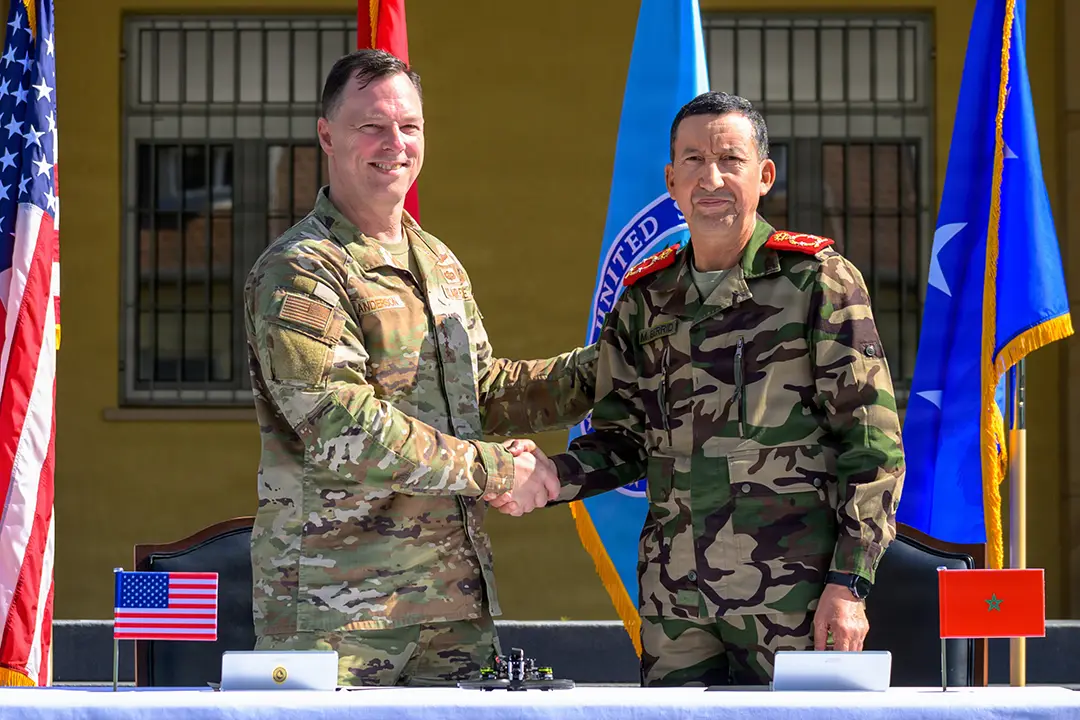
Scheduled to open in Tan-Tan by 2030, AMTEC will consist of three elements: a multidomain training area, a drone academy, and an innovation and experimentation center. Morocco’s Royal Armed Forces (FAR) and U.S. Africa Command signed a memorandum of understanding at AFRICOM headquarters on July 13.
“Morocco’s readiness — demonstrated by our existing facilities and skilled personnel — ensures rapid progress from concept to operational reality and provides the Morocco and U.S. industries with a reliable and capable partner for joint innovation and export opportunities,” FAR Gen. Mohammed Berrid, commander of the Southern Zone, said in a statement.
Col. Michael Gacheru, head of AFRICOM’s Regional Engagement Division, said the plans to establish AMTEC signal another step forward in Morocco’s longtime partnership with the U.S., as the two countries share a commitment to countering terrorism and forging stability across the continent.
“AMTEC embodies decades of collaboration between Morocco and the United States,” he told Moroccan news website Le360 for a July 14 article. “This resource-sharing partnership exemplifies peace through strength, shared responsibility, and joint progress in the industrial and technological fields. Our shared goal of creating a stable environment conducive to prosperity forms the foundation of this new phase.”
The multidomain training area will offer a range complex to prepare Soldiers to use weapons systems, defensive systems and communications platforms. It will give Soldiers the ability to operate in the full electromagnetic spectrum using radio, microwave, infrared, visible light, X-ray and high-energy frequencies to test and train on offensive and defensive operations, gather intelligence and connect weapons systems.
The drone academy will train operators, instructors and planners from Morocco and other African nations to enhance their capabilities against West African terrorist threats. Students will gain the skills and knowledge to integrate drones into broader operations with a focus on airspace deconfliction, multidomain integration, strike capabilities and intelligence, and surveillance and reconnaissance synchronization.
The innovation and experimentation center will develop, test and evaluate emerging capabilities with a focus on low-cost, scalable solutions for counterterrorism and regional security operations. The center aims to partner with academia, embedding experts and institutions into cross-functional design teams.
“The Africa Multidomain Training and Experimentation Center will increase readiness and advance capabilities of both nations,” AFRICOM Commander Gen. Dagvin Anderson said. “This partnership represents a great opportunity for U.S. and African defense industrial bases as well as academic institutions to experiment, innovate and develop scalable, adaptable solutions across emerging technologies.”
AMTEC seeks to pioneer new network capabilities in remote and underserved areas, supporting security and economic development while offering Moroccan and U.S. defense industry developers opportunities to test and experiment. Gacheru expects that AMTEC will serve as a testing ground for future wireless and sensing technologies.
“AMTEC is not merely a military tool, it represents a future engine of economic growth and technological progress for Morocco, the United States, and the entire region,” he said. “The center will offer an ideal environment for the defense, technology, and academic sectors of both countries to test, evaluate, and improve emerging technologies by integrating experts and academic institutions alongside military operators in multidisciplinary design teams, thereby fostering innovation and collaboration.”
The annual African Lion exercise, hosted in Morocco, will serve as a proof of concept for AMTEC in its 2027 iteration. The exercise has become a proving ground for integrating high-tech systems into operational environments, where industry partners work with service members to test artificial intelligence-enabled systems, autonomous platforms and advanced communications tools.
Because the Sahel has become the global epicenter of terrorism, partnerships and collaboration are essential, Gacheru said. As African countries come together to face the rising threat of terrorism, Morocco expects to play a key role as a defense industry leader.
“AMTEC will provide a collaborative space where relationships of trust can be built, along with the capabilities that will enable African nations to ensure their own territorial security and prevent terrorist groups from expanding, recruiting, and conducting operations,” he said.