

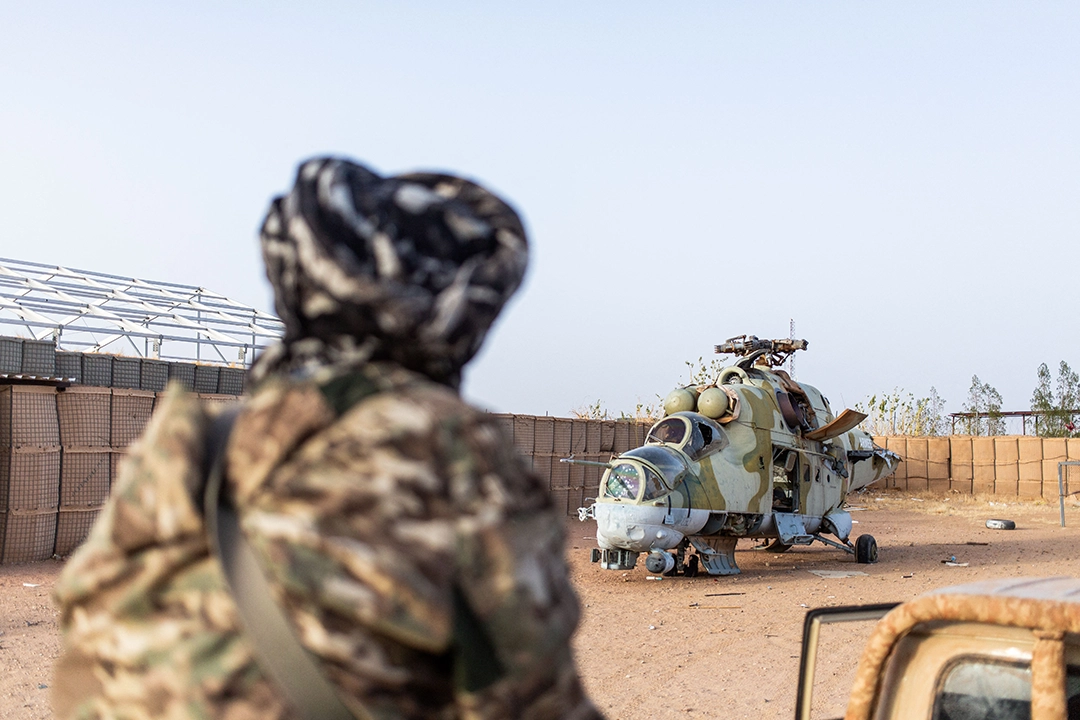
The al-Qaida-affiliated Jama’at Nusrat al-Islam wal-Muslimin (JNIM) terror group on June 18 attacked Diori Hamani International Airport in Niamey, Niger’s capital, killing 11 soldiers and two civilians.
Witnesses reported gunfire and explosions in the battle with security forces. Authorities said they killed 22 terrorists.
The airport is a strategic hub that hosts military bases, the headquarters of the Niger-Burkina Faso-Mali Joint Force and a uranium stockpile. JNIM’s rival, the Islamic State Sahel Province (ISSP), attacked a military base near the airport in late January. Authorities said soldiers killed 20 terrorists and arrested 20 others. The attack wounded four soldiers and damaged an aircraft.
The attacks in Niger and other recent assaults on Sahel urban centers demonstrate both groups’ ability to launch complex operations beyond the rural, underserved areas they historically have terrorized. Both groups are known to attack civilians, state forces and Russian Africa Corps mercenaries. They also battle each other.
JNIM is considered the dominant Sahelian terror group. Last year, it began a siege on Bamako, Mali’s capital, blockading major roads and attacking fuel convoys, causing significant fuel shortages and power outages. Experts say the strategy is economic warfare designed to disrupt life in the capital and undermine faith in the ruling junta.
In April, JNIM and the Azawad Liberation Front (FLA) rebel group launched coordinated attacks on several Malian cities and towns, including Bamako; Gao, which was partially taken; and Kidal, which the groups seized.
“The JNIM coalition’s targeting of primary commercial routes and fuel trucks seeks to sever Bamako from its lifelines while simultaneously asserting control over population centers and regions adjacent to the capital,” analyst Daniel Eizenga wrote for the Africa Center for Strategic Studies. “Without fuel, commodities, and other goods, households and businesses in the most populous regions of the country will face growing hardships. This replicates a similar encirclement strategy observed in Burkina Faso.”
JNIM and the FLA followed the April attacks with an early July onslaught that targeted several military and pro-government positions in the northern towns of Anefis, Aguelhoc and Gao, Sévaré in central Mali, and Kenioroba, which is south of Bamako.
Daniele Garofalo, an expert on Sahel terrorism and counterinsurgency, thinks these recent attacks indicate that JNIM’s battlefield strategies are progressing.
“The organization is evolving from a predominantly rural insurgent movement into a hybrid armed actor capable of integrating guerrilla warfare, coordinated large-scale assaults, drone-enabled operations, strategic communication, local governance, and cognitive influence into a coherent operational approach,” Garofalo told ADF in an email.
The ISSP also is improving its military tactics by asymmetrical means, analyst Wassim Nasr wrote for The Soufan Center. In February 2026, the group used a suicide car bomb to attack Malian and Russian forces in Ménaka, Mali. ISSP and JNIM battled for control of the Ménaka region before JNIM abandoned the effort in 2023.
The ISSP attacked Ménaka in the wake of the April JNIM-FLA assaults. The ISSP now controls most of the Ménaka territory bordering Niger, where the group has kidnapped foreign travelers and abducted miners and truck drivers.
Due to an uptick in attacks by ISSP and JNIM, Niger’s western Tillabéri region emerged last year as the central Sahel’s deadliest area for civilians. According to the Armed Conflict Location and Event Data (ACLED) project, more than 1,200 of the 1,939 violent deaths recorded in Niger last year were in Tillabéri. The ISSP accounted for the largest number of fatalities from attacks on civilians.
Fighting between ISSP and JNIM has been sporadic since 2019.
“Niger is a territory of competition between them,” Nasr told The Associated Press. “If JNIM loses the upper hand in Niger against the Islamic State, it will jeopardize its upper hand in Mali and Burkina Faso. … You have an open space like the Wild West, where each is looking to mark its territory.”
The ISSP in early April attacked a JNIM position in the Tillabéri region. The ISSP said it killed 35 JNIM operatives in retaliation for a JNIM attack. Héni Nsaibia, ACLED’s senior analyst for West Africa, said violence between the two groups underscores the lack of state control throughout much of the Sahel.
“This competition will likely continue to fuel recruitment, expansion, and violence, making the jihadist insurgency increasingly difficult to contain,” Nsaibia told Reuters.