

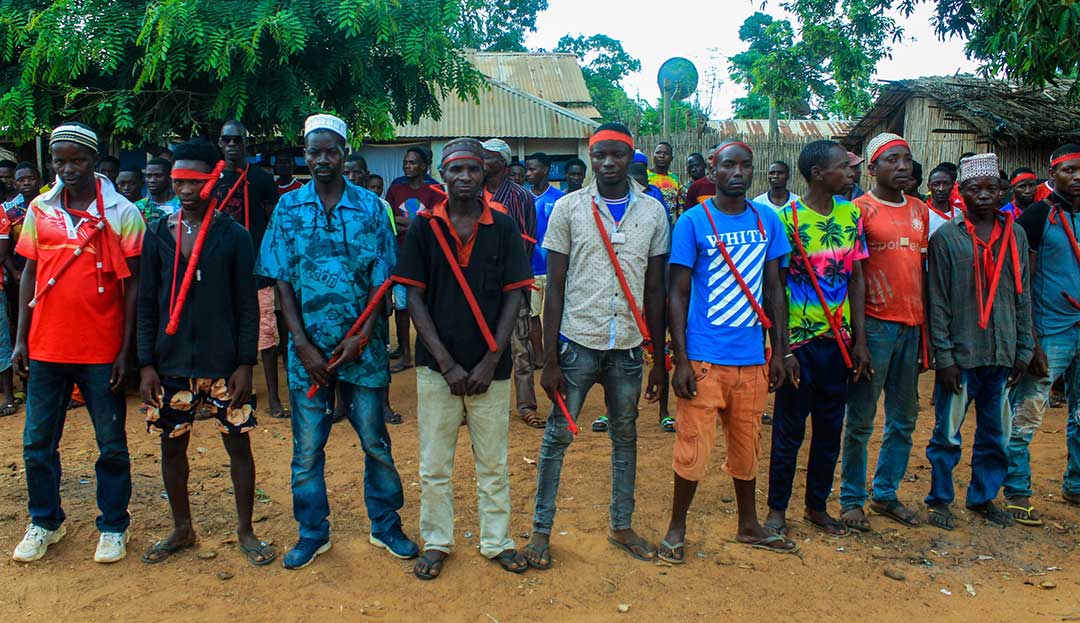
Decades after Mozambique’s Naparama fighters became famous during the country’s civil war, a new generation of fighters carrying the same name have emerged to confront the threat from Islamic State group terrorists in the country’s north.
The original Naparama fighters were a regional militia that fought on the side of the government in the late 1980s and early 1990s during the Mozambican civil war. Naparama fighters followed a set of rules that included refusing to use firearms in favor of bladed weapons or bows and arrows.
The modern Naparama militia emerged in November 2022 and has embraced many of the practices of the original. Members fight IS in communities where government forces are scarce.
Analysts have noted that Naparama’s battle tactics this strategy puts its fighters at a significant disadvantage against armed IS terrorists.
“For the Naparama, bravery does not compensate for the deficit in weaponry,” analyst Marie Dubois wrote for HiWars, an online research platform dedicated to current and historic military activity.
In mid-May, dozens of Naparama fighters died after clashing with Islamic State Mozambique (ISM) terrorists who had set fire to the village of Messanja in the Chiúre district of southern Cabo Delgado province.
The 12-hour battle took place in the dense forests of Katapua administrative post. Eventually, the terrorists fled across the Megaruma River. Surviving Naparama fighters buried 27 dead fighters in a mass grave in the forest.
Residents later told Zitamar News that the total number of Naparama fighters buried was 42. Witnesses reported that three ISM fighters died in the battle.
The lopsided result raises concerns about Naparama fighters’ capacity to effectively counter ISM terrorists in areas with little to no military presence, according to analysts.
“Despite the Mozambican and Rwandan military having bases in Ancuabe, the only resistance the group [ISM] has met so far has been from residents and Naparama militia, neither of which has firearms,” analysts with the Armed Conflict Location and Event Data project (ACLED) noted in a report about ISM’s expansion in Cabo Delgado.
The Katapua fight was the deadliest clash between Naparama and ISM in a year. In 2025, Naparama fighters lost more than 30 militia members during two clashes with ISM near the Melija and Ocua communities.
The clash between Naparama fighters and ISM takes on an additional dimension because most Naparamas are from the inland Makua ethnic group while ISM fighters come largely from the coastal Mwani group.
Messanja was the culmination of several weeks during which ISM advanced across southern Cabo Delgado, burning villages and killing residents. In at least one community, ISM fighters separated Christians from Muslims, witnesses told ACLED.
The Mozambican Armed Forces (FADM) and their supporters from the Rwanda Defence Force have been unable to slow ISM’s advance, according to ACLED. As of the end of May, ISM remained in Chiúre, ACLED reported, adding “their motivation to be there remains unclear.”
Naparama fighters have fought alongside the FADM, but a lack of coordination has complicated their ability to counter ISM effectively.
The national military did not participate in the battle at Messanja despite being deployed to protect the district headquarters in the nearby town of Chiúre. Without more support from the Mozambican military, the Naparama and the communities they’re trying to protect will continue to be ISM victims, potentially building resentment against the government, Dubois added.
“The temptation will be to present the Naparama as a courageous local solution,” Dubois wrote for HiWars. “It is, but only up to a certain threshold. … It cannot become the cheap infantry of a war against mobile and better-armed jihadist units.”