

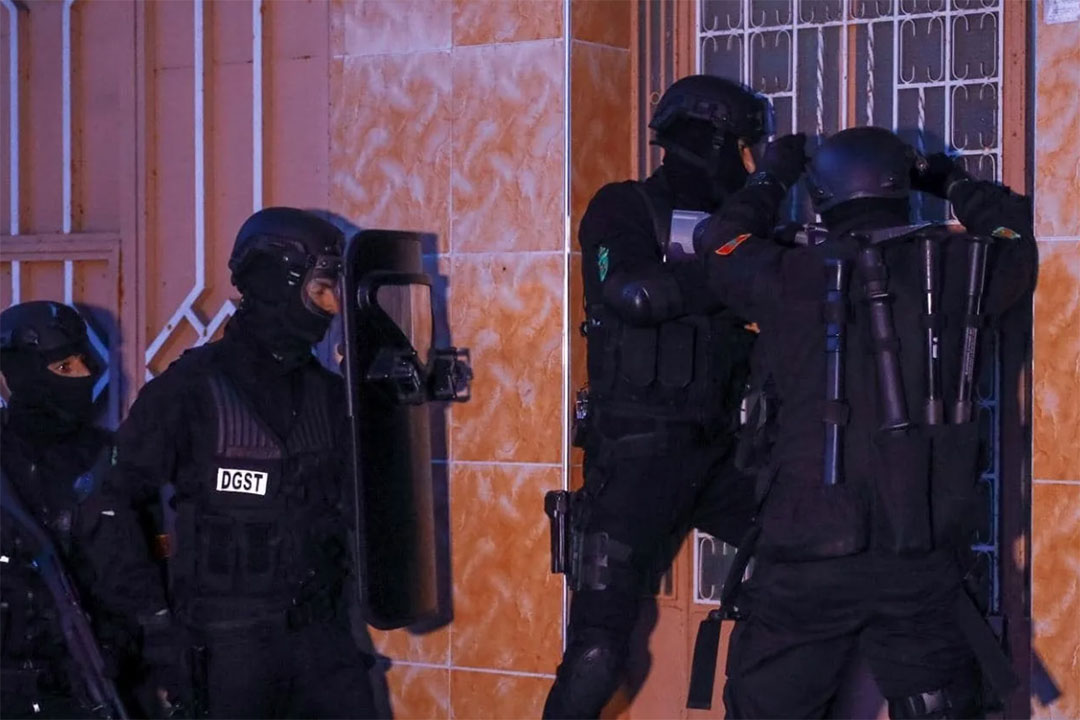
In February 2025, Morocco’s Central Bureau of Judicial Investigations arrested 12 men connected to Islamic State-Sahel Province during raids across the country, disrupting a terror plot to bomb financial and tourist sites.
The raid turned up Islamic State flags, cash, nail bombs, dynamite, guns and knives. It also uncovered evidence that the plot had been inspired and financed by a member of Islamic State-Sahel Province (ISSP), which seeks to expand beyond its base in the Liptako-Gourma region where Burkina Faso, Mali and Niger meet.
In recent years, the central leadership of Islamic State (IS) has shifted its attention and resources away from its historic base in Syria and Iraq and toward its African affiliates, taking advantage of porous borders, economic frustration and ethnic tensions to recruit new members.
“The significance of Africa for IS cannot be [overstated],” analyst Lucas Webber wrote for the Soufan Center.
The Sahel region’s chronic instability and weak governments have created an opening for the ISSP to build a framework for future operations, including those that reach beyond its historic borders into Europe and North America. That framework includes an extensive online propaganda network and an encrypted communication system that, as demonstrated in Morocco, spreads radical messages and instructions for terror attacks across international borders.
“Despite having much less insurgent capacity and territory compared to its rival, the Sahel’s al-Qaeda-affiliated group Jama’at Nusrat al-Islam wal-Muslimin (JNIM), ISSP has emerged as a formidable entity in the global and African jihadist landscape, leveraging sophisticated strategies to internationalize its operations and expand its reach,” Webber added.
The Lakurawa terrorist group in northwestern Nigeria recently swore allegiance to ISSP, giving the group a foothold with which it can expand its collaboration with Islamic State West Africa Province (ISWAP) operating in northeastern Nigeria and the Lake Chad Basin.
ISSP and ISWAP have boosted their collaboration through ISWAP’s regional headquarters, Maktab al Furqan, possibly based in Nigeria. The relationship has so far consisted of ISWAP sending fuel, weapons and fighters to support ISSP in Burkina Faso and Mali. ISWAP also provides ISSP with money via hawala, the informal financial system used across the Middle East and North Africa.
The relationship is likely to go deeper in the future, according to analysts Miles Charles and Liam Karr.
“IS has also shown a clear intent to use ISSP and its trans-Saharan networks to support attack cells in North Africa and Europe and support the movement of foreign fighters to West Africa,” Charles and Karr wrote for the American Enterprise Institute’s Critical Threats website.
Islamic State’s shift toward its Sahelian affiliates means governments outside the Sahel need to pay more attention to a group that is quickly expanding beyond its status as a regional threat. The 2025 raid in Morocco, which shares a border with Spain, is a case in point, according to Webber and analyst Paweł Wójcik.
“Policymakers have long treated Sahelian violence as a local insurgency best handled by regional partners,” they wrote in Foreign Policy. “But the global hub of jihadism is shifting, and as ISSP attracts foreign fighters, facilitates plots in Morocco and Spain, and integrates more tightly into the Islamic States’ command structure, its reach is expanding.”