

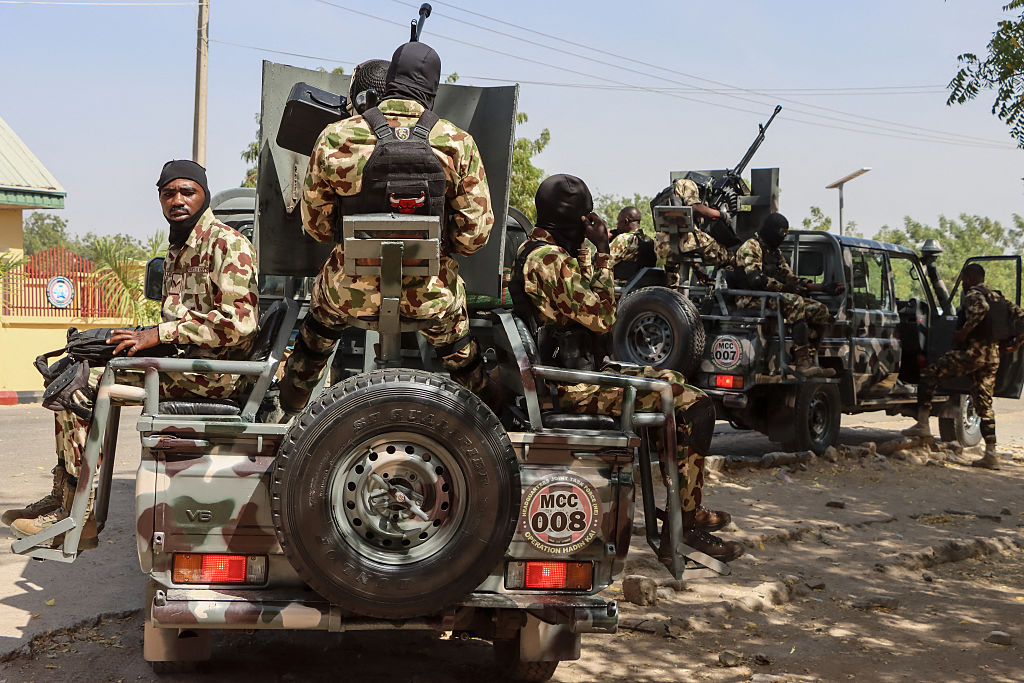
As they seek to exert more control over portions of northeastern Nigeria, terrorist groups have attacked military outposts across the region and killed dozens of Soldiers.
On April 13, terrorists from Islamic State West African Province (ISWAP) attacked a military base in the Borno State community of Monguno. Among the dead was the base commander, Col. I.A. Muhammed, along with four Soldiers. A week earlier, an attack on a base in Benesheikh, also in Borno, killed an unconfirmed number of Soldiers along with the base’s commander, Brig. Gen. Oseni Omoh Braimah.
The attacks were the latest in a string of more than a dozen terrorist attacks on military outposts in Borno and Yobe states since the beginning of 2025. The attacks have killed dozens of Soldiers and multiple high-ranking officers. Terrorists have also launched deadly assaults on civilians across the region.
Chigozie Ubani, a fellow at the Institute of Security Nigeria, recently told Nigeria’s Punch News that the attacks are part of an attempt by Boko Haram and its rival, ISWAP, to regain control over territory lost to the military during the ongoing Operation Hadin Kai.
“Their goal is to take over our territories,” Ubani said. “When they take over, everybody there will submit to their religious authority. That’s what it is.”
During some recent attacks against bases, terrorists have burned buildings and destroyed vehicles. The base attacks, paired with assaults against civilian communities, are designed to drive people from their homes, leaving space that terrorists can then fill, according to Ubani.
“Their target is to terrorize, maim and displace people. Once they displace them, of course, they occupy the space. So, for as long as that is not achieved, they can only retreat and come back,” he added.
Terrorists have taken heavy casualties during the late-night raids on bases. At least 60 fighters died when the military repelled at attack on Bita military base in Gwoza Local Government Area of Borno State in May 2025.
Kabiru Adamu, CEO of Beacon Security and Intelligence Limited, told the BBC he sees the recent attacks as part of an effort by Boko Haram and ISWAP to receive more attention and, by extension, more support from the larger al-Qaida and Islamic State organizations.
In February, Islamic State praised another of its affiliates, Islamic State Sahel Province, for attacking a Nigerien Air Force base at the airport outside Niger’s capital, Niamey in late January.
“This has encouraged the branches of the organization in different countries to seek recognition, assistance, and greater acknowledgment from the central organization,” Adamu told the BBC.
Retired Nigerian Brig. Gen. Peter Aro told Punch that the terrorists’ recent success in attacking bases and killing commanders reveals gaps in preparedness, intelligence and equipment.
The military must adapt to counter the asymmetric approach Boko Haram and ISWAP use. A military that appears predictable, slow to adjust, or held back by institutional inertia is giving terrorist groups an advantage, Aro added.
“Asymmetric warfare demands flexible tactics, well-equipped small units, effective surveillance, counter-IED capabilities, and rapid response systems,” Aro said. “What we are witnessing is not merely a resurgence of terrorist activity, but a reflection of how adaptive insurgent groups can be when state responses fail to evolve at the same pace.”