

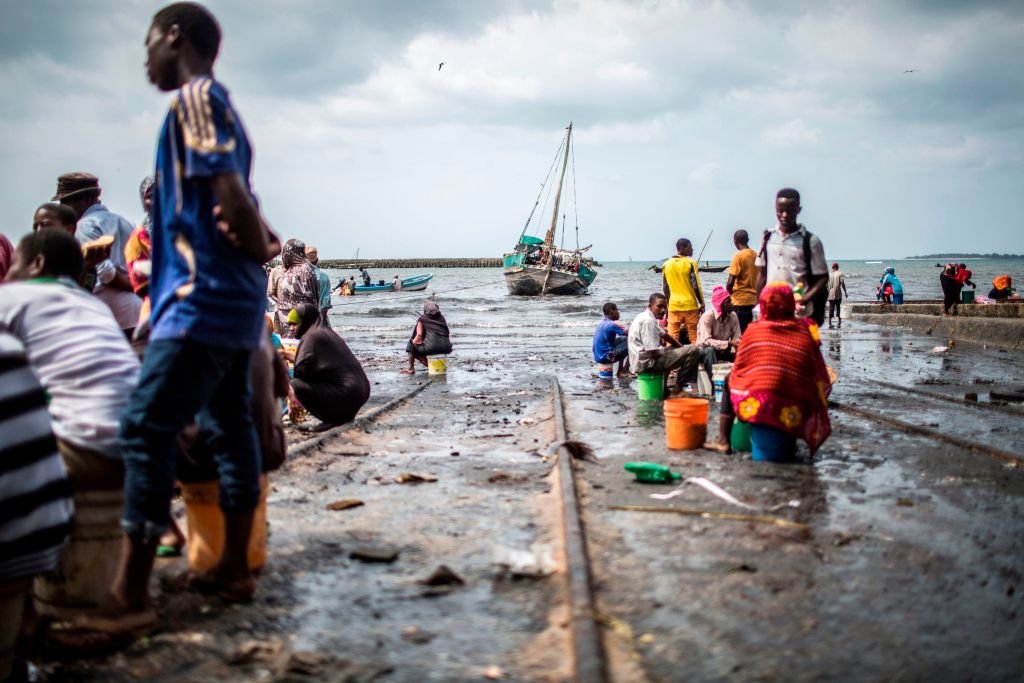
Since seven East African nations agreed to launch The Jahazi Project in September 2025, authorities have strengthened protections against illegal, unregulated and unreported (IUU) fishing.
Named after the Swahili word for a dhow, a traditional wooden sailing ship, the project aims to protect the ocean and unlock the potential of the region’s blue economy, which is estimated to reach $405 billion by 2030. The World Bank defines blue economy as “the sustainable use of ocean resources for economic growth, improved livelihoods and jobs, and ocean ecosystem health.”
“At its core, the initiative is about restoring balance between economic opportunity and environmental stewardship,” Michael Mallya, the project’s spokesperson, wrote for Tanzanian website The Chanzo. “This begins with tackling the crisis of IUU fishing by working alongside governments, regional security forces, and international partners to strengthen maritime surveillance, close regulatory loopholes, and protect vital fish stocks.”
Launched by Ascending Africa, a pan-African organization committed to fostering sustainable development, the project has moved the issue beyond technical fisheries management toward a broader dialogue about sovereignty, development and shared responsibility, according to Kenyan newspaper The Star.
Participating nations include Comoros, Kenya, Madagascar, Mauritius, Mozambique, Seychelles, Tanzania and the Tanzanian archipelago of Zanzibar. Illegal fishing costs the region an estimated $415 million annually, fueling food insecurity and mounting pressure on 3 million people in the region who depend on the sea for their livelihoods.
The project also aims to support sustainable fishing cooperatives, create opportunities for alternative livelihoods and engage policymakers at national and regional levels to integrate economic growth with environmental sustainability. Educating young people about the potential of region’s blue economy is another goal.
Rampant overfishing by foreign industrial trawlers, many from China, exacerbates the challenge. China commands the world’s largest distant-water fishing fleet and is the world’s worst illegal fishing offender, according to the IUU Fishing Risk Index. Of the top 10 companies engaged in illegal fishing globally, eight are from China. Due to the practices of Beijing’s trawlers, West Africa is now the world’s hot spot for illegal fishing.
In Tanzania, which loses $142.8 million annually to illegal fishing, an investigation by the Environmental Justice Foundation revealed human rights abuses on Chinese trawlers and systemic illegal fishing practices. They include shark finning, a brutal practice in which a live shark’s fins are cut off and the body thrown back into the ocean.
“[The fin] was put in a separate freezer in the captain’s [room],” crew members told the foundation. “It was obvious that we hid it, we had to keep it hidden. Because when we were heading to Mauritius, there was an inspection so we had to hide it very well […] because sharks are protected animals.”
Chinese trawlers employ an array of other illegal tactics, including fishing with explosives; using illegally sized nets; fishing with lights; committing “saiko,” the illegal transshipment at sea; and bottom trawling, which involves dragging a huge net along the ocean floor, indiscriminately scooping up all manner of marine life. The practice kills juvenile fish, leading to declining fish stocks, and destroys ecosystems critical to the survival of marine life.
In Tanzania, diminishing fish stocks near shore have forced 75% of the country’s artisanal fishermen much farther from shore, increasing costs and risks. During a September 2025 roundtable discussion organized by The Jahazi Project in Dar-es-Salaam, Baraka Sekadende of Tanzania’s Ministry of Livestock and Fisheries, said illegal fishing is not only a fisheries issue but also a human development issue.
“When fish stocks decline, food security weakens, household income falls, and economic opportunity narrows,” Sekadende said in a report by The Star.
Matthew Silas of Tanzania’s Deep Sea Fishing Authority noted the region’s increasing surveillance capacity, including vessel monitoring systems and satellite tracking.
“However, technology alone cannot close coordination gaps between jurisdictions,” Silas said.
Other participants in the discussion emphasized challenges, including vessel registration systems that are not fully interoperable, differing penalties for illegal fishing across countries, and inconsistent real-time intelligence sharing.
According to Mallya, the project’s first phase will focus on coastal areas near Kenya, Mozambique and Tanzania. Tasks will include establishing community-driven marine conservation zones and supporting joint surveillance patrols.
“The long-term vision is clear: A thriving East African coastline where marine ecosystems are healthy, economies are resilient, and cultural heritage is preserved,” Mallya wrote for The Chanzo. “By invoking the spirit of the dhow, The Jahazi Project seeks not only to protect the ocean but also to inspire ownership and pride among the very people who depend on it most.”