

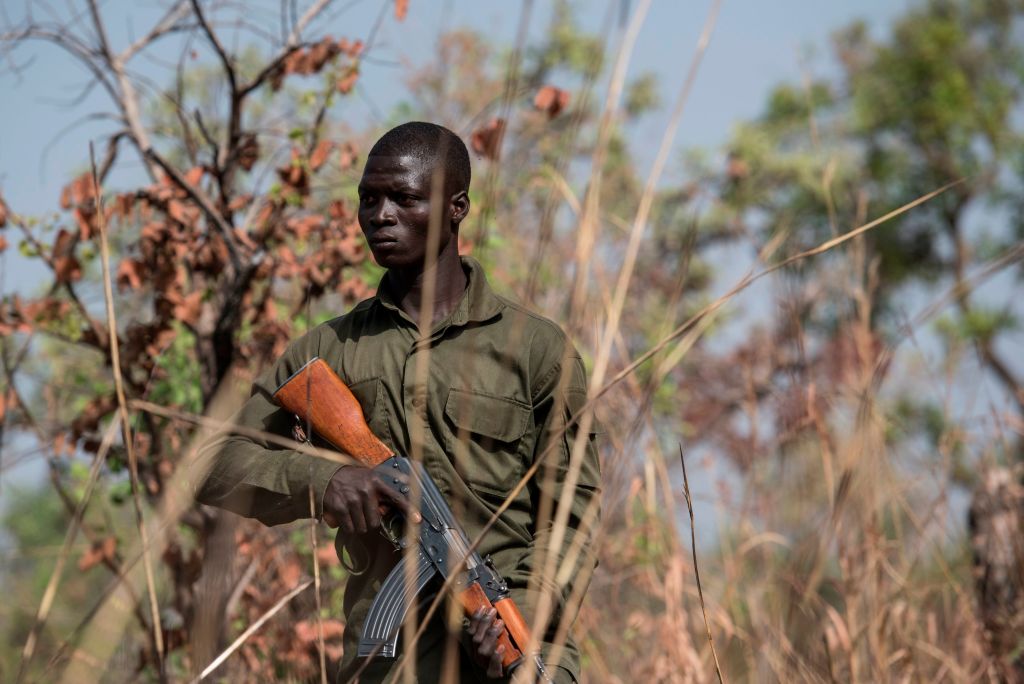
An attack on a military outpost in Kofouno, Benin, in early March was the latest demonstration that terrorists with Jama’at Nusrat al‑Islam wal‑Muslimin (JNIM) want to expand their reach into coastal West Africa from their base in the Sahel.
The attack in Benin’s northeastern Alibori department killed 15 Soldiers and wounded five others. It followed a larger JNIM assault on military outposts in Wara and Bessassi in 2025 that killed dozens.
Like other sites of JNIM attacks in Benin, Kofouno sits near the W-Arly-Pendjari park complex shared by Benin, Niger and Togo, which has become a haven for JNIM and other terrorist groups.
JNIM has taken control of large portions of southeastern Burkina Faso and southwestern Niger and has begun to spread into the northern reaches of Benin and Togo as well as northwestern Nigeria.
That expansion began in Benin in 2021. The number of attacks in northern Benin grew from 22 in 2021 to 176 in 2024, and the number of deaths doubled from 52 to 131 between 2022 and 2024, according to the Armed Conflict Location and Event Data group.
Analysts say that the effort to stop JNIM is faltering because of strained relations between coastal countries and their Sahelian neighbors. The juntas that overthrew elected governments in Burkina Faso, Mali and Niger broke away from the Economic Community of West African States (ECOWAS) in January 2025, crippling the region’s ability to share intelligence about terrorist groups.
“The militant advance beyond the Sahel, particularly into northern Benin and Togo, has become a major security concern for these states,” analysts with the International Crisis Group think tank wrote in a report. “Yet, for JNIM, expansion presents a dilemma.”
But the terror group also may be overextending its reach. By expanding, JNIM is stretching itself thin and opening itself to attacks from its regional rival, Islamic State Sahel Province (ISSP). The two groups have staked out territory across Burkina Faso, Mali and Niger. In the Liptako-Gourma region, where those three countries meet, JNIM and ISSP are competing for territory and revenue from illegal taxation, cattle rustling and resource smuggling.
High-profile attacks have helped JNIM recruit new members. However, the groups’ numbers remain only a few thousand — enough to terrorize rural communities, but not enough to control a city or province, according to experts.
“Expansion is not the main priority for the group, whose leaders are concerned that pushing outward too fast could fragment the movement’s ranks,” the International Crisis Group analysts wrote. “So far, JNIM’s leaders have viewed coastal countries as secondary to their domain in the Sahel.”
Despite that, JNIM’s ground-level fighters are eager to expand, making them a threat to coastal countries, according to the International Crisis Group.
The different attitudes between JNIM’s leadership and its rank and file are creating tension within the organization. Leaders want to keep strategic decision-making centralized and the ground-level fighters want to operate with autonomy.
“While the organization has so far preserved its unity, decisions related to taking new territory are among those that most severely test its cohesion,” the Crisis Group wrote. “These diverging interests could explain why JNIM’s sallies into coastal West Africa have been less aggressive than observers feared in the late 2010s.”
Where JNIM has taken hold, its fighters exert control over local populations by threatening them against cooperating with government security forces. They also tilt the local economy toward their specific needs through smuggling and illicit trade in fuel and other supplies.
JNIM’s expansion isn’t inevitable but countering it will require a more substantial investment in local security and cross-border cooperation, wrote Crisis Group analysts.
“To keep the militants at bay, each state should identify the factors that make it vulnerable and develop its own strategy, while also contributing to mounting a regional response, without which no lasting solution is possible,” they added.