
Russia’s war in Ukraine has drained its weapons supplies, including some slated for export to Africa. China has filled this vacuum by supplying low-cost weapons to countries with a track record of human right abuses and other offenses.
In 2024, China eclipsed Russia as the largest exporter of arms to Sub-Saharan Africa. Beijing’s People’s Liberation Army (PLA) and Chinese private security companies facilitate the flow of arms. Chinese deals are not governed by International Traffic in Arms regulations, and Beijing is known to include weapons to sweeten other deals or improve diplomatic and trade relations as it makes new allies and expands influence.
Alessandro Arduino, an associate fellow at the United Kingdom’s Royal United Services Institute, said China is recasting its role as “an increasingly consequential security actor.”
Katarina Djokic, a researcher with the Arms Transfers Program at the Stockholm International Peace Research Institute, said China now accounts for 26% of West African arms imports.
“China’s exports to West African states have been generally on the rise and in 2020-2024 reached the highest level ever,” Djokic told the South China Morning Post. She noted that China’s increased arms sales to Burkina Faso and Mali came after recent coups, “but it also has to do with conflicts in these countries and the fact they are buying arms more than ever before.”
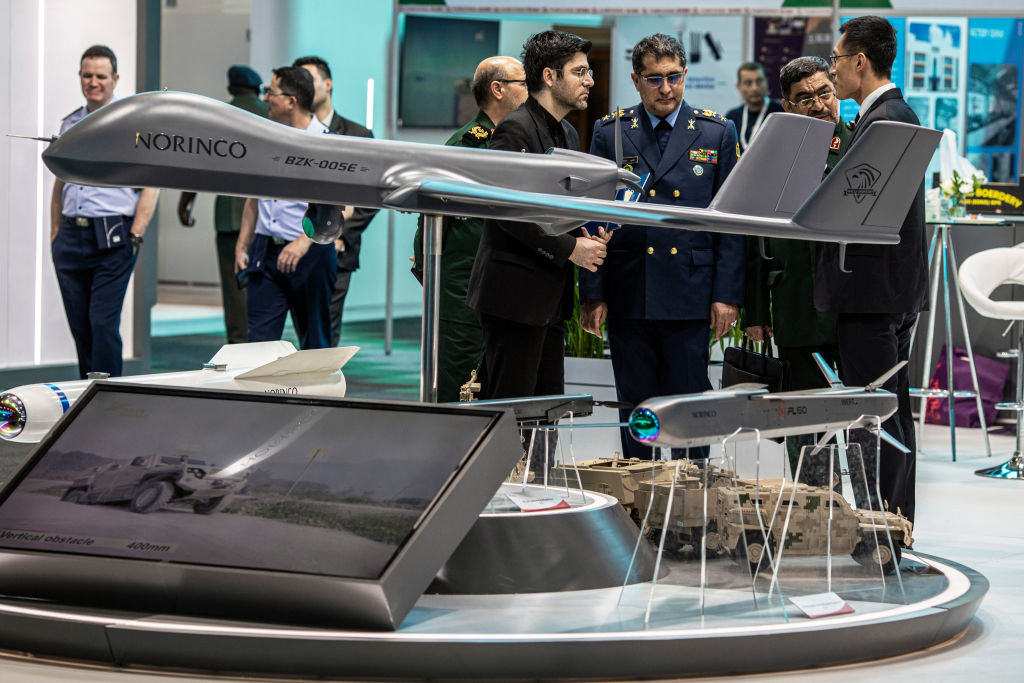
In Mali, Chinese weapons fall into the hands of the Malian military and the Jama’at Nusrat al-Islam wal-Muslimin (JNIM) terror group, perpetuating a conflict that began in 2017. Propaganda videos and footage produced by the terror group show substantial stockpiles of weapons produced by China North Industries Corp. Ltd. (Norinco), including machine guns, assault rifles and rocket-propelled grenade launchers equipped with high-explosive anti-tank projectiles, according to the Jamestown Foundation think tank.
Chinese weapons have been used in continental conflict zones for years, including in the Democratic Republic of the Congo (DRC), Ethiopia, Nigeria, South Sudan and Sudan. In the DRC, Chinese weapons have wound up in the hands of M23 fighters who want to topple Kinshasa’s government. In recent years, Rwanda, on the DRC’s eastern border, also has bought artillery systems and other arms produced by Norinco, China’s largest weapons supplier, and other Chinese firms.
In 2019, Nigeria signed a $152 million deal with Norinco to provide weapons needed in the fight against Boko Haram. Some analysts claim Beijing’s arms are lower in quality and reliability, but Chinese materiel has become a feature in Nigeria’s counterterrorism response. Norinco now has offices in Angola, Nigeria, Senegal and South Africa.
“Perhaps more significant than arms sales is the attention China is giving to training African military personnel, holding joint military activities such as the recent Brics Plus naval exercise in South Africa, and enlisting African support for its Global Security Initiative,” David Shinn, a professor at George Washington University’s Elliott School of International Affairs, told the South China Morning Post.
Shinn added that, unlike Russia or the United States, “China’s security relationship eschews kinetic military support.” Beijing’s reluctance to engage in combat limits its ability to meet some security requests, he said.