
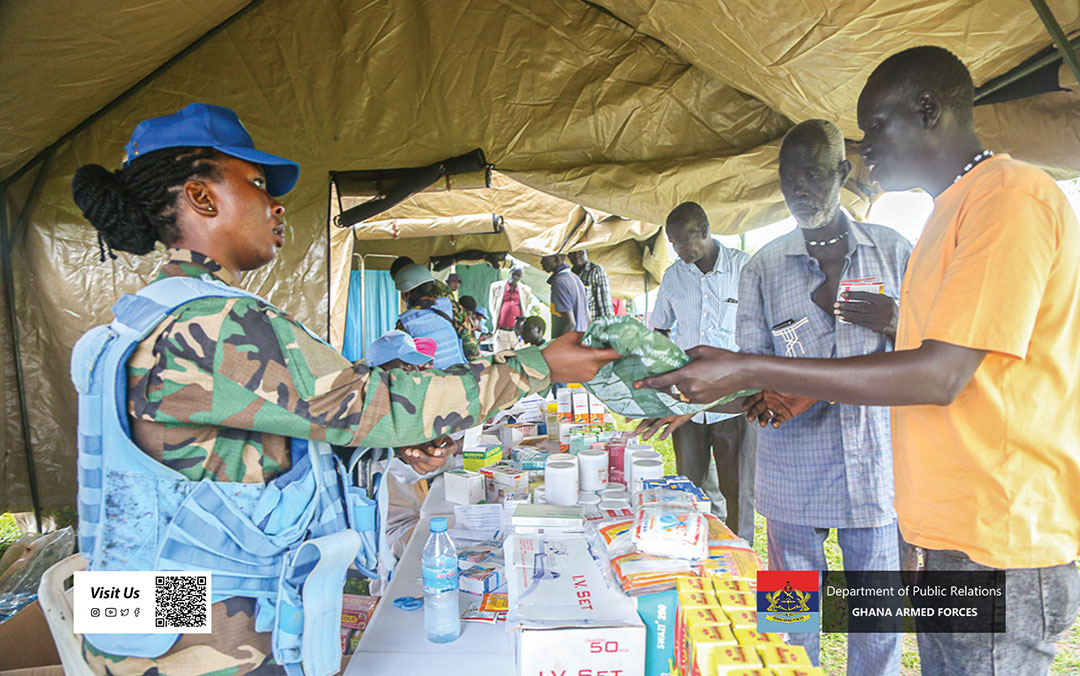
United Nations peacekeepers have responded to cholera cases in the contested Sudan-South Sudan border regions of Abyei and Kadugli. They have launched health-focused initiatives across the mission’s area of operation aimed at protecting peacekeepers and local communities.
Peacekeepers with the U.N. Interim Security Force for Abyei (UNISFA) worked with local health authorities to establish a cholera isolation center. The facility provided treatment and isolation services for affected people. Pakistani peacekeepers distributed medicine, masks, sanitizer, raincoats, mosquito nets and clothes to support prevention.
In another sector, Ghanaian peacekeepers promoted community awareness campaigns. These included hygiene promotion and medical outreach to support vulnerable groups. The peacekeepers provided clean water education, distributed purification tablets and spread hygiene messages. They also ran clinics to offer screening and basic treatment.
Ghanaian peacekeepers in another sector set up an isolation center for cholera vaccinations and treatment for local residents and peacekeepers. This dual approach safeguards host communities and mission personnel, highlighting UNISFA’s commitment to health security and operational readiness.
As Abyei confronts the twin challenges of public health risks and regional instability, UNISFA’s health interventions underscore the evolving role of peacekeepers. They continue to act as protectors and partners in times of crisis.
The U.N. approved the mission in mid-2011 after security problems in the Sudanese region of South Kordofan. The Ethiopian Army was the only troop contributor until 2022, when the U.N. reconfigured the mission into a multinational force with the arrival of a Ghanaian battalion. Since then, countries including Nepal and Vietnam have contributed troops.