
Since its inception in 2002, Boko Haram has become the second-deadliest terrorist organization in Africa, just behind al-Shabaab. The group has skillfully leveraged clusters of terrorists and their families and a strong sense of community to thrive and maintain significant influence. These clusters serve as robust bases of militant support.
With al-Qaida backing its agenda, Boko Haram has moved beyond rhetoric, engaging in abductions and raids to firmly impose its demands for an exclusive Islamic state governed by a strict interpretation of Islamic law.
Boko Haram consistently responds to the government’s kinetic counterinsurgency approach by declaring itself a “marginalized voice” in a secular society that has failed its citizens. It frames its struggle as a battle between Islamic civilization in the north and Western civilization, citing the jihad of Usman Dan Fodio (1804-1808) to argue that Western education undermines Islamic values.
By positioning itself as marginalized, Boko Haram exploits media channels to portray the government as the true oppressor. Meanwhile, countless citizens in the Lake Chad region and in countries such as Cameroon, Chad, Niger and Nigeria are paralyzed by fear, leaving their voices largely unheard.
Since its designation as an international terrorist organization in November 2013, Boko Haram has relentlessly denounced Western governments and accused Cameroon, Chad, Niger and Nigeria of complicity and submission to Western pressures. In propaganda videos, it boldly challenges the legitimacy of democracy, the use of modern technology and the rule of law. It firmly attributes the corruption of Islamic values to Western education and its detrimental influences, such as secular music.
Boko Haram views the government as an aggressor that has harassed, arrested and killed its members and their families since its inception. The militants target and execute government officials while attacking public institutions. They also employ fear tactics, strategically releasing violent videos and threats on social media to amplify their message.
In conjunction with other splinter groups like the Islamic State West Africa Province and Ansaru, alongside new actors such as Lukarawa and the Mahmuda group, these militants relentlessly target the Nigerian state, engaging in continuous violence, imposing taxes on farmers and kidnapping people. They portray themselves as victims and depict the government — encompassing the executive branch, judiciary, legislators and armed forces — as perpetrators.
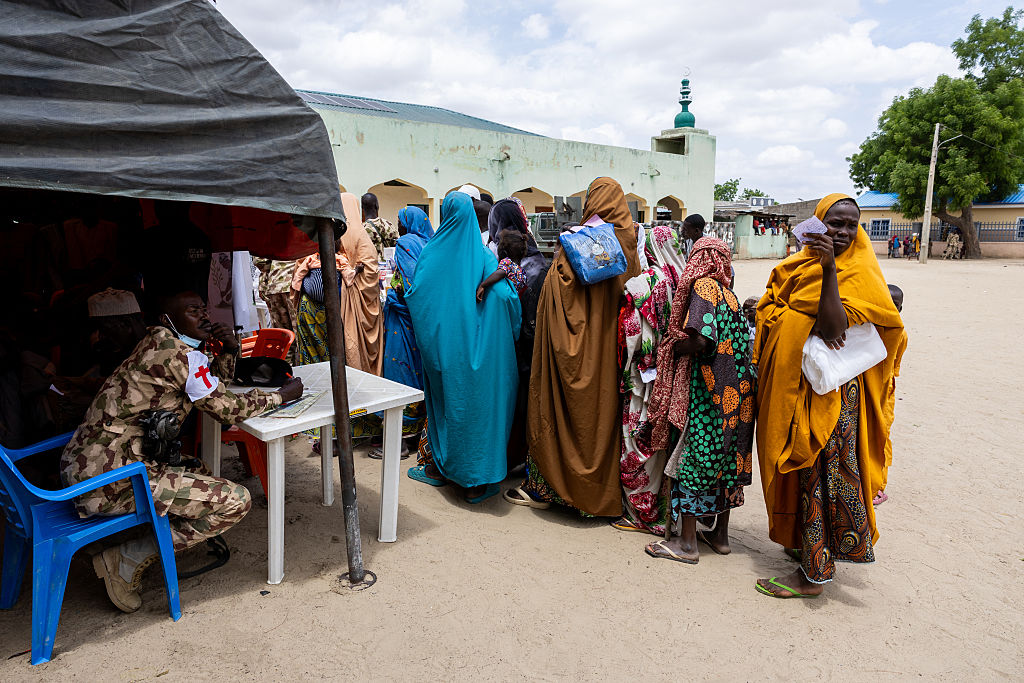
Despite Boko Haram members claiming marginalization, at the core of the complex dynamics surrounding the insurgency are more than 8 million internally displaced people, the highest number in West Africa, according to the United Nations High Commissioner for Refugees. They have been transformed into silent, overlooked and marginalized figures.
Local communities, feeling increasingly isolated from broader society, openly criticize the insurgents for their heinous actions, which include the widespread displacement of families, rape, the murder of innocent civilians and the abduction of schoolchildren.
The stark differentiation between the aggressors and those suffering under their reign of terror underscores the urgent need to focus on the lived experiences and struggles of the displaced.
Given the fluid dynamics of community identity among governments, local populations and insurgent groups, it is crucial to address the prevalent issues of marginalization. Adopting Afrocentric principles — truth-telling, communal cooperation and constructive dialogue — is essential. These ideals are vital tools for mitigating the rising tension and conflict in the region.
The Nigerian government, alongside its citizens, residents and the governing bodies of the Lake Chad region, should endeavor to create its own interconnected clusters of community engagement. By doing so, they can amplify the often-overshadowed voices of civilians and security agencies responsible for conducting counterterrorism operations. This inclusive approach can improve communication and foster a shared understanding, which is essential for a cohesive response to ongoing conflicts.
About the author: Justine John Dyikuk is a doctoral researcher in journalism, media and communication at the University of Strathclyde in Glasgow, Scotland, and a lecturer in mass communication at the University of Jos in Nigeria. A Senior Fellow for Religious Freedom Policy at the Religious Freedom Institute in Washington, D.C., his research focuses on Boko Haram’s messaging and the Nigerian government’s counterinsurgency efforts.