

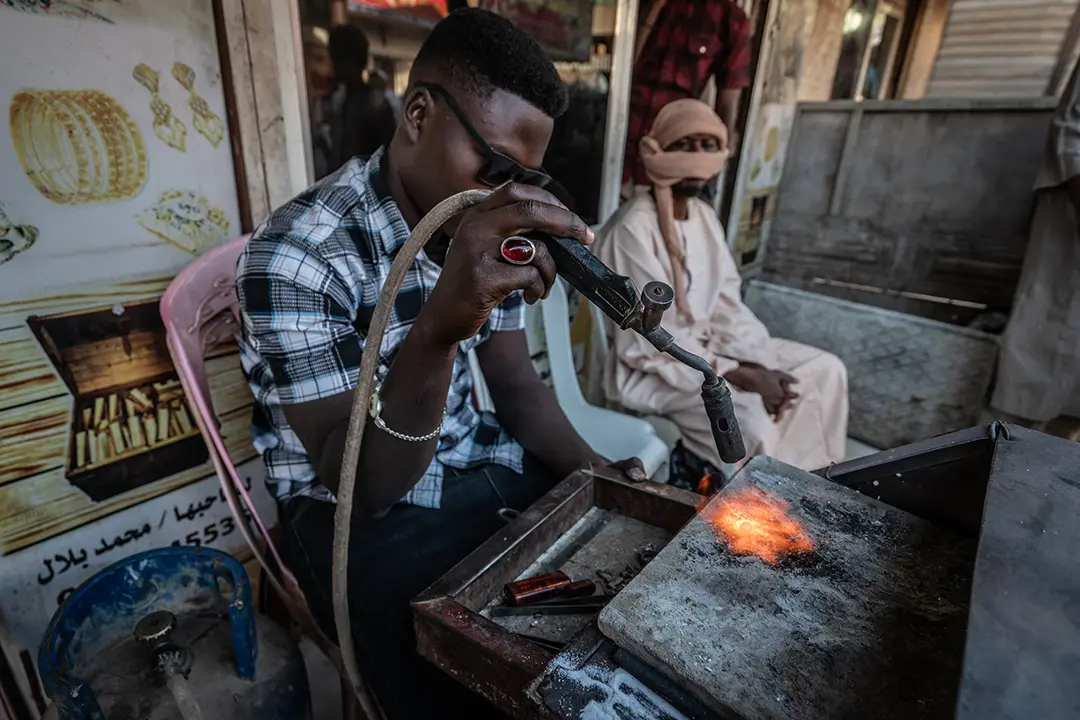
Authorities are struggling to halt illegal gold mining, which costs the continent more than $30 billion annually.
Armed groups, terrorists, Chinese companies and other actors are exploiting weak governance, local grievances and limited security to steal critical minerals and perpetuate conflict.
Hellen Abatoni Muzungu, a sub-Saharan Africa specialist at business risk consultant Rane, says the illicit gold trade allows criminals to fund their other operations, particularly after they become established in an area.
Gold “fits that need well because it is valuable, easy to carry, and can be sold through informal networks,” Muzungu told Saudi-owned news journal Al Majalla. “Sudan, Mali, Burkina Faso and eastern DRC (Democratic Republic of Congo) all follow this pattern.”
In Sudan, the paramilitary Rapid Support Forces (RSF) controls most of the gold deposits in the western Darfur region. The United Arab Emirates is accused of financing and arming the RSF, which is embroiled in a grinding civil war with the Sudanese Armed Forces. The RSF is suspected of selling hundreds of millions of dollars’ worth of gold through the UAE. Some of Sudan’s gold is smuggled through eastern Libya, run by Khalifa Haftar, an RSF ally who is backed by the UAE.
When the junta-led countries of Burkina Faso, Mali and Niger left the Economic Community of West African States in January 2025 to form their own bloc, it emboldened terror groups such as Jama’at Nusrat al-Islam wal-Muslimin and the Islamic State Sahel Province. The gold rush across the three countries could result in new sources of financing, recruitment and territorial influence for armed groups, according to Héni Nsaibia, West Africa Senior analyst with the Armed Conflict Location & Event Data (ACLED) project.
“Mining areas attract armed groups for reasons that go well beyond access to mineral resources as a source of financing,” Nsaibia wrote. “Artisanal mining areas, in particular, concentrate economic activity, mobile populations, transport links, equipment, and commercial supply chains that can support militant operations.”
The Islamic State in Mozambique (ISM) aims to fund its operations by controlling gold mining in a country that suffers from corruption, underperforming state institutions and inadequate security, according to Al Majalla.
“Measures to improve oversight of the mining sector that supports artisanal and small-scale miners are necessary,” ACLED said in January. “Recent attempts at extortion by ISM point to weak support and protection by the state.”
ISM increased its gold mining as gold prices skyrocketed last year.
“It doesn’t need to hold the mines permanently,” Muzungu told Al Majalla in reference to ISM. “It can tax or extort miners, seize gold, kidnap miners for ransom, and exploit the movement of people and gold in these areas. It tends to come and go through repeated incursions.”
This year, Cameroon took sweeping measures to take back control of industrial and artisanal gold mining from Chinese companies that dominate the sector. Cameroon reported 953 kilograms of gold production in 2023 but only 22.3 kilograms officially exported. Importing countries, however, reported receiving 15.2 metric tons (15,200 kilograms), which is nearly 680 times more.
Mining companies now are required to meet minimum monthly production targets, transition to closed-circuit processing systems within six months and pay an up-front environmental bond of more than $112,000.
“These measures aim to restructure the sector not only to control production and increase state reserves and revenue, but also to combat illegal mining, which causes significant losses to the Cameroonian economy through smuggling,” the country’s Ministry of Mines, Industry and Technological Development said.
Efforts to counter illegal gold operations must also address issues throughout the gold supply chain and not simply miners or mine sites, according to Muzungu.
“Governments need to tighten licensing and oversight of artisanal mining and give miners legal places to sell their gold,” Muzungu told Al Majalla. “They also need better traceability and closer cross-border cooperation to go after the traders, exporters, financiers and armed groups that profit from it.”
Corruption, including the collusion of officials and security forces, exacerbates the challenge.
“Internationally, major trading and import hubs such as the UAE need stronger due diligence and origin checks so conflict gold doesn’t enter legitimate markets,” Muzungu said. “Enforcement should also avoid criminalising artisanal miners. Their livelihoods depend on the mining sector, and punitive treatment could push them toward armed groups or informal markets. The priority should be dismantling the networks that profit from the trade while offering miners real legal alternatives.”