
Gold mining, a major funding source for the war in Sudan, has spread into some of the country’s agricultural areas, poisoning crops, livestock and people with toxic byproducts.
In River Nile State, north of Khartoum, farmers report dramatic drops in the production of staple crops such as wheat and fava beans. At the same time, cattle farmers are seeing birth defects and indications that adult livestock are being poisoned, possibly with mercury.
Even more troubling, miscarriages and birth defects are rising among women in the region, according to local doctors.
River Nile State has long been among Sudan’s most active gold mining regions. Mining there and elsewhere across Sudan has expanded as the Sudanese Armed Forces (SAF) and the Rapid Support Forces (RSF) rely on gold exports to fund their operations.
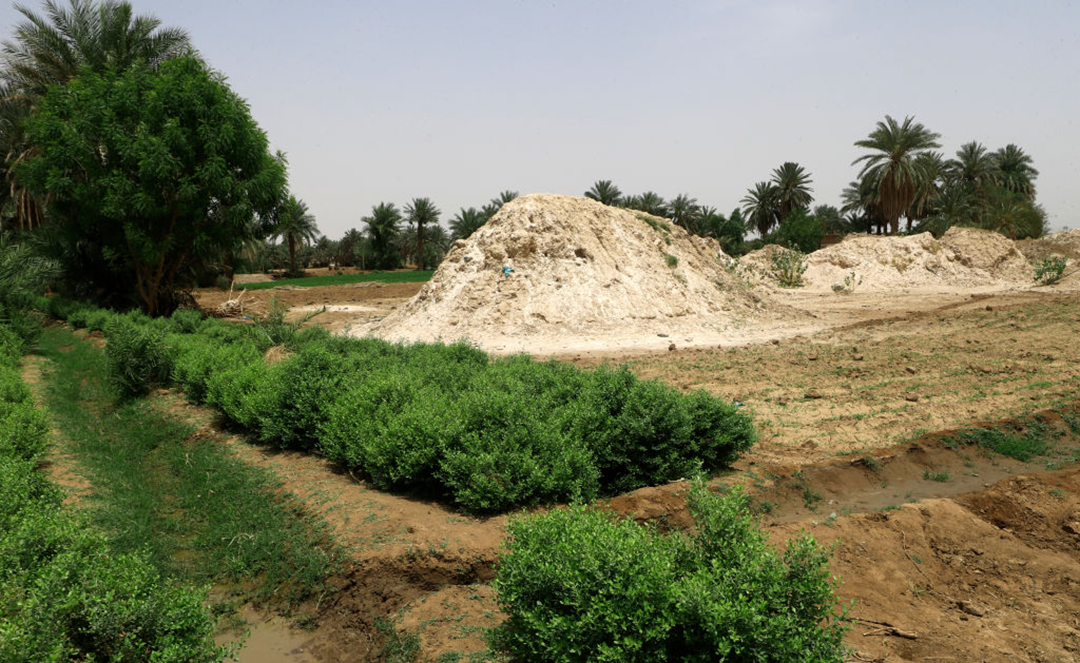
The agricultural community of Abu Hamad, which is in SAF-controlled territory, has become one of Sudan’s largest hubs for artisanal gold mining. It’s also the epicenter of health and environmental problems connected to hundreds of mounds of tailings — the mix of rocks, soil and toxic chemicals left behind by mining operations — that surround the community.
Artisanal mining makes up more than 90% of Sudan’s gold industry. Miners use mercury and thiourea to extract gold from rock. The process leaves as much as 70% of extractable gold in the tailings, which state-controlled processers then treat with mercury and cyanide to remove up to 95% of the remaining gold. The process allows toxic water to seep into the ground.
“In short, artisanal miners use mercury indiscriminately while the state promotes processing by franchise companies who only increase the risk, in large part under the influence of its elites,” researcher Abdelrahman wrote in a 2022 report by the Sudan Transparency and Policy Tracker think tank.
Sudan is Sub-Saharan Africa’s biggest importer of mercury, according to the United Nations. Official reports claim that Sudan imports about 36 metric tons of mercury a year. According to Sudan Transparency and Policy Tracker researchers who observed miners in the field, the actual amount could be nearly 20 times that — about 626 metric tons per year.
The difference could represent the amount of smuggling and undeclared mercury imports, according to Abdelrahman.
According to The Guardian, the number of tailing mounds around Abu Hamad has grown to more than 700 since mining started in the region in 2008.
Farmers around Abu Hamad rely on irrigation canals fed by the Nile River. In August 2022, flash floods inundated River Nile State, sweeping tons of contaminated tailings into the river.
A 2022 study found that as much as 20% of the region’s drinking water already was tainted with mercury.
“The government of Sudan has failed to tightly control the operations of importing, transporting, storing, using, and disposing of mercury due to its failure to exercise control and enforce minimum standards to safeguard the health of its citizens and the environment, with tragic consequences for both,” Abdelrahman wrote.
Farmer Mohamed Fathi al-Rahman al-Khalifa told The Guardian that the destruction caused by gold mining pollution has devastated food production around Abu Hamad. An orange grove that once produced four truckloads of fruit now produces less than a quarter of a truckload, he said.
Al-Khalifa warned of a looming catastrophe that extends far beyond River Nile State.
“Food security is no longer merely a local issue affecting Abu Hamad,” al-Khalifa said. “It has become a national issue that concerns Sudan as a whole.”