
The late August mutiny against Niger’s ruling junta raised questions about its dependence on Russia’s Africa Corps for security, growing discontent among front-line soldiers, and the apparent weakness of the country’s defense alliance with Burkina Faso and Mali.
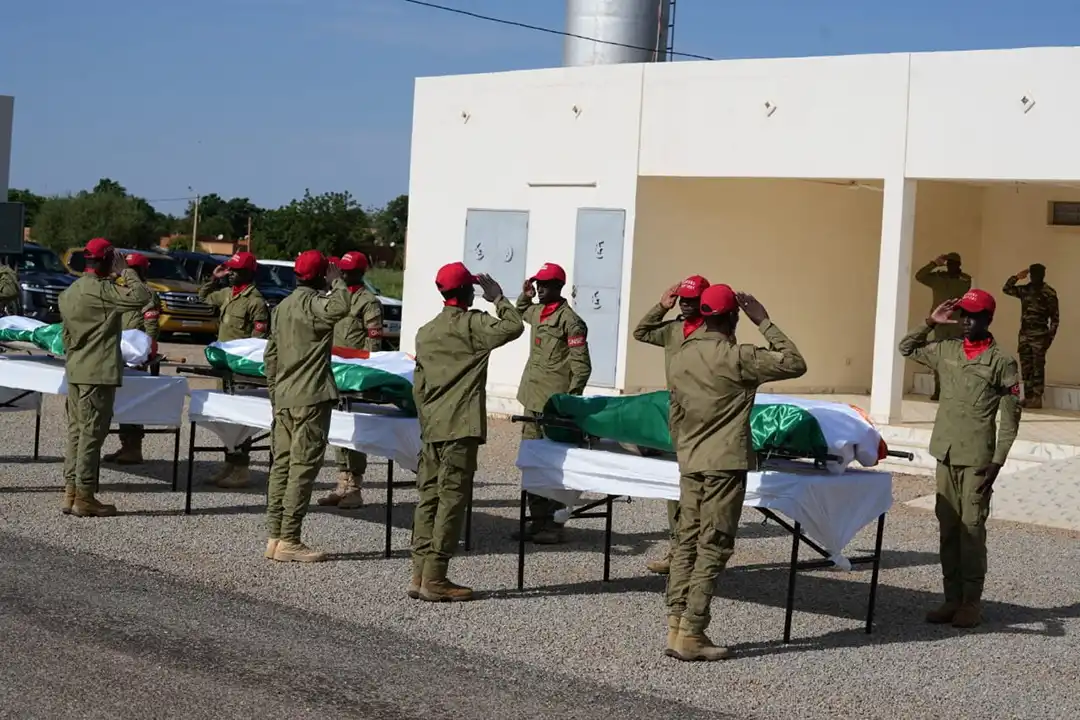
Violence broke out in and around the Nigerien capital around 1 a.m. on August 29 as dozens of soldiers opened fire on the presidential palace while attempting to take control of Niamey’s international airport and the adjoining Air Base 101. Many of the rebelling soldiers were part of missions to fight terrorists in the south and west of the country. Air Base 101 is Niger’s primary military outpost and the headquarters of Africa Corps’ 200- to 300-person contingent in the country. The August mutiny was the third attack on the airport this year.
Africa Corps fighters found themselves briefly held hostage by the attack. Eventually, they responded by using weapons and kamikaze-style drones to help retake the airport after the presidential guard struggled to do so.
Russia’s role in putting down the mutiny revealed weaknesses that are likely to create more problems for the junta led by Gen. Abdourahamane Tiani, said Yvan Guichaoua, a senior researcher at the Bonn International Centre for Conflict Studies in an interview with RFI .
“The Russians’ involvement and their decisive role in retaking the base [Air Base 101] make the regime dependent on Russia,” he said. “Tiani now owes the Russians something.”
Russia’s involvement was a reminder that, as in other Sahelian nations, Africa Corps’ primary role is protecting the ruling junta, Wassim Nasr, a senior researcher at the Soufan Center, told ADF.
Analysts say the mutiny also exposed divisions within the military between senior members, including the presidential guard, and junior soldiers fighting terrorists. The terrorists include Jama’at Nusrat al-Islam wal-Muslimin (JNIM) and Islamic State Sahel Province (ISSP) in the south and west of the country along with Islamic State West African Province in the east.
Tiani led the presidential guard before overthrowing democratically elected President Mohamed Bazoum in 2023. Since then, discontent has grown as senior military members serve in safer areas with higher pay than poorly paid junior members who face deadly attacks and increasingly harsh living conditions in hostile territory. Those front-line soldiers often find themselves facing terrorists equipped as well if not better than they are, Ryan Cummings, head analyst at Signal Risk, told Al Jazeera.
In June, at least 85 Nigerien soldiers died when ISSP attacked military bases in Inates and Banibangou near the border with Mali. ISSP also destroyed or stole dozens of military vehicles during the attack. ISSP fighters have attacked Inates and other border posts repeatedly as they seek to drive security forces from the area. Since the 2023 coup, ISSP has consolidated control over large parts of Niger’s Tahoua and Tillabéri regions, according to the American Enterprise Institute’s Critical Threats Project.
Inates and Banibangou are key forward operating positions for Nigerien forces in the Liptako-Gourma region, a hotbed for terrorist violence where Burkina Faso, Mali and Niger meet. JNIM and ISSP are competing for control across the region.
Burkina Faso, Mali and Niger have formed the Alliance of Sahelian States, a mutual defense pact. It failed to produce support from Niger’s partners during the mutiny. Neither Burkina Faso nor Mali sent troops while the attack was underway. Mali sent some soldiers after calm was restored, as did Libya.
Romane Dideberg, a research analyst at Chatham House’s Africa Program, told Al Jazeera that the lack of a response to the Nigerien mutiny echoed the lack of a regional response to attacks by JNIM and the Azawad Liberation Front in Mali in April.
“What the security response says about the cohesion of the Alliance of Sahel States might be one of the most telling elements of the mutiny,” Dideberg said. “This mutiny calls the effectiveness, but also, to an extent, the sincerity, of the mutual assistance pact into question.”