

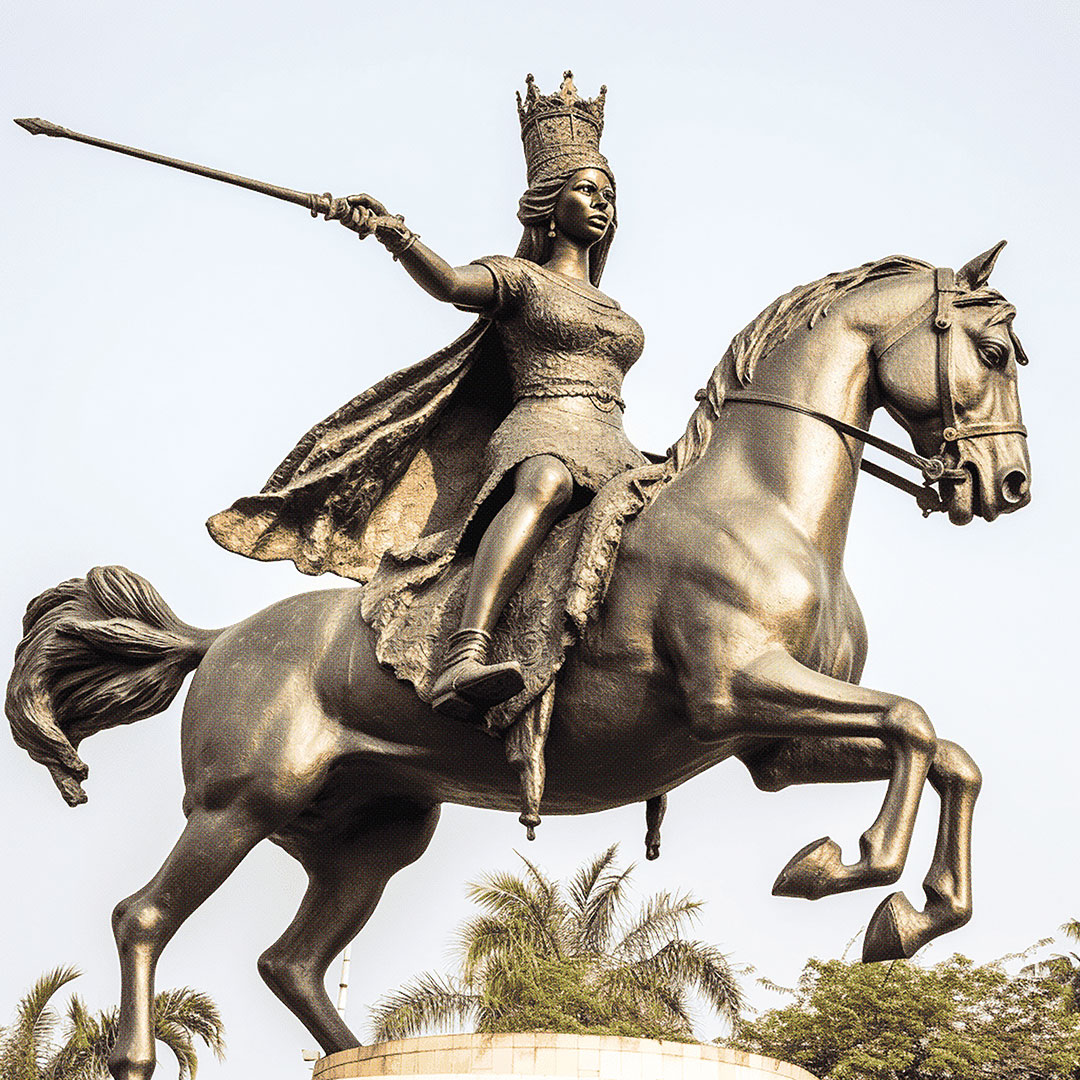
Amina of Zazzau was born a princess, raised in wealth and privilege. But her mother and grandfather saw to it that she also was trained as a warrior. Today she is remembered as one of West Africa’s great military leaders.
The princess was born about 1533 in Zazzau, one of seven original states of the Hausa Kingdom, in what is now Nigeria. Even in her early years, her grandfather recognized her intelligence and bearing. He trained her along with his soldiers, and she accompanied him to state meetings. Her mother gave her responsibility for a section of the capital city, and Amina convened daily councils.
She was the oldest of three royal siblings, but males traditionally inherited the throne in the Zazzau kingdom. Her brother Karama became the ruler in 1566, during a time of peace and prosperity. During Karama’s 10-year reign, Amina continued her military training and established herself as the head of his cavalry. When her brother died, she succeeded him.
As queen, she understood the importance of military strength. Her campaigns would become a constant of her 34-year reign. She led an army of 20,000 men in expanding the Zazzau territory and made conquered rulers swear allegiance to her.
A key to Amina’s power was the trade routes connecting what are now Sudan and Chad with Egypt in the northeast and Niger and Mali to the north. She ensured safe passage for her traders and often used trade as justification for war with surrounding kingdoms that threatened friendly merchants.
Her kingdom was advanced, even before she took power. Although most of the people in the neighboring territories were farmers, the Zazzau people also were skilled in the industrial arts of tanning, weaving and advanced metalworking. Metalworking allowed Amina to equip her soldiers with helmets and chain mail, making her one of the first to introduce armored warfare to West Africa. It proved to be a tremendous military advantage.
She also was responsible for building fortified earthen barriers known as Ganuar Amina — Amina’s Walls — around conquered encampments. Some of those camps evolved into villages and towns. A few of the walls still exist, including a 15-kilometer structure that surrounds the modern-day city of Zaria, Nigeria.
Historians say that Amina’s industrial skills transformed her kingdom’s hierarchy into one based more on competence and merit than on social standing and tradition.
She died about 1610, possibly during a military campaign. She is honored throughout Nigeria with statues and other memorials. One statue, showing her in battle, stands at the National Arts Theatre in Lagos.
The Nigerian Defence Academy in Kaduna unveiled another statue of Amina in battle in April 2025, according to Nigeria’s National Accord newspaper.
“Queen Amina of Zazzau at the height of her reign occupied a territory of about 400,000 kilometers square, which is about 40 to 50% of the territory we now call Nigeria,” said Maj. Gen. John Ochai, commandant of the academy, during the statue’s dedication. “You can imagine the magnitude of the area she controlled and this was as a result of her determination and leadership.”