

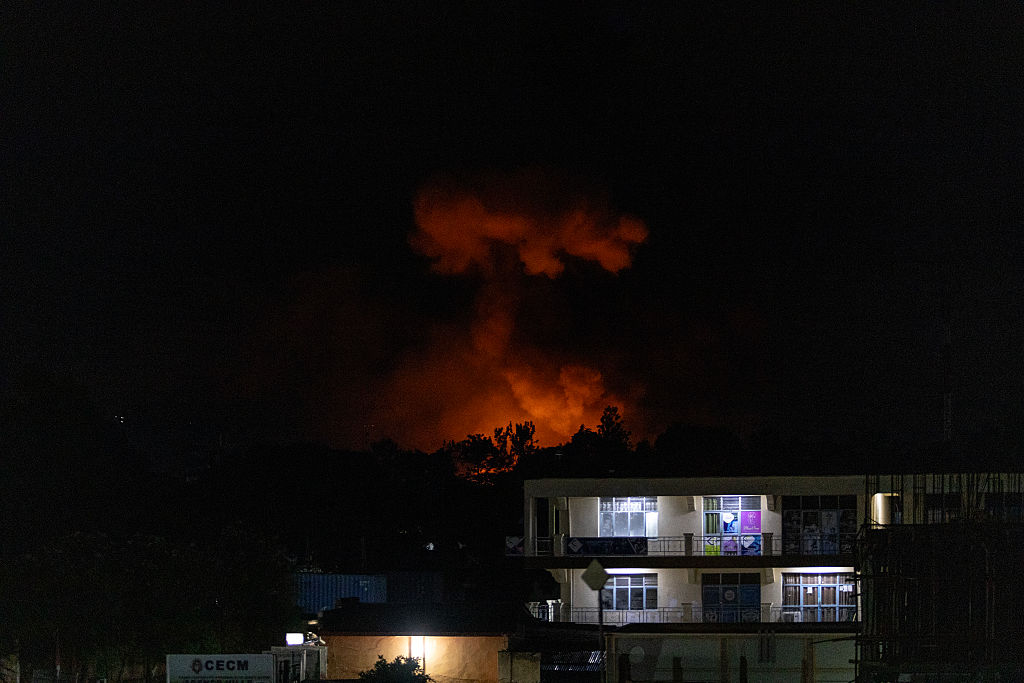
A series of explosions in Bujumbura, Burundi’s economic capital, began around 6:15 p.m. on March 31 and did not end until about midnight. The blasts killed at least 13 people and wounded 57 more, including three Burundian Soldiers.
Officials said the explosions, which sent projectiles raining down on nearby neighborhoods and plumes of smoke rising above the city were sparked by an electrical accident at the main ammunition depot of the Burundi National Defence Force (FDNB) main ammunition depot in the densely populated suburb of Musaga. The fire spread quickly and triggered a wave of explosions felt well beyond the base.
“Houses were damaged in various neighborhoods as well as private vehicles,” FDNB spokesperson Gen. Gaspard Baratuza said in a statement. “Military equipment and facilities burned and were destroyed.”
A senior police officer at the site said a water shortage hampered firefighting efforts. He said in a joint report by Agence France-Presse (AFP) and Reuters that the “massive inferno” left the base camp “reduced to ashes.”
One survivor told the Reuters they saw a young woman die.
“She was in front of me,” the witness said. “I saw her falling as she was running in a group of people. After a short while I came to know she was violently hit by a bomb.”
The Musaga depot is next to the Higher Institute for Military Cadres, as well as major army logistics depots, the Muha military camp and the central Mpimba Central Prison, where one woman told BBC Great Lakes that one of her relatives was killed. Numerous other inmates were also reportedly wounded.
In the aftermath, Burundian authorities urged citizens to report unexploded munitions by phone, warning: “Be careful and DO NOT TOUCH.”
Unplanned explosions at munition sites are a constant concern at and near military sites across the continent and around the world. According to the Small Arms Survey, such explosions killed or injured 31,489 people worldwide from January 1979 through December 2024. Of the 674 explosions in that period, six of the top 10 with the most casualties were in Africa, including the top two incidents, the Survey reported.
In January 2002, a fire at a market in Lagos, Nigeria, spread to the nearby Ikeja Military Cantonment, igniting ammunition and triggering explosions of bombs and artillery rounds, sending shells and mortars into thousands of homes. The incident killed more than 1,000 people, many of them children, and displaced more than 12,000 people, according to the International Federation of Red Cross and Red Crescent Societies.
A March 2012 blast at a depot in Brazzaville, Republic of the Congo, killed about 300 people, injured more than 2,300 others and left 17,000 homeless, according to AFP. Authorities charged 32 soldiers in the incident, convicting six and acquitting 26. A corporal was sentenced to 15 years of hard labor for willfully setting fire to the depot.
The most recent such incident in Africa was in June 2024, when an arms depot outside N’Djamena, Chad, exploded, killing nine and injuring 46 others.
Handling errors and inappropriate work practices caused a fifth of these incidents, according to the Small Arms Survey. Other significant causes included failure to account for external and environmental influences, improper storage, armaments deterioration and poor security.
Nicolas Florquin, the Small Arms Survey’s head of data and analytics, has said best practices include conducting a proper risk analysis when storing ammunition. Writing for The Conversation, Florquin said fire safety precautions and protocols for the proper handling of ammunition are critical, as is surveillance of the ammunition’s chemical stability.
Experts say military authorities must be mindful of ammunition depots’ proximity to cities and population centers. The depots must also be adequately built, fortified, and secured inside and out to prevent theft, trespassing and fire.