

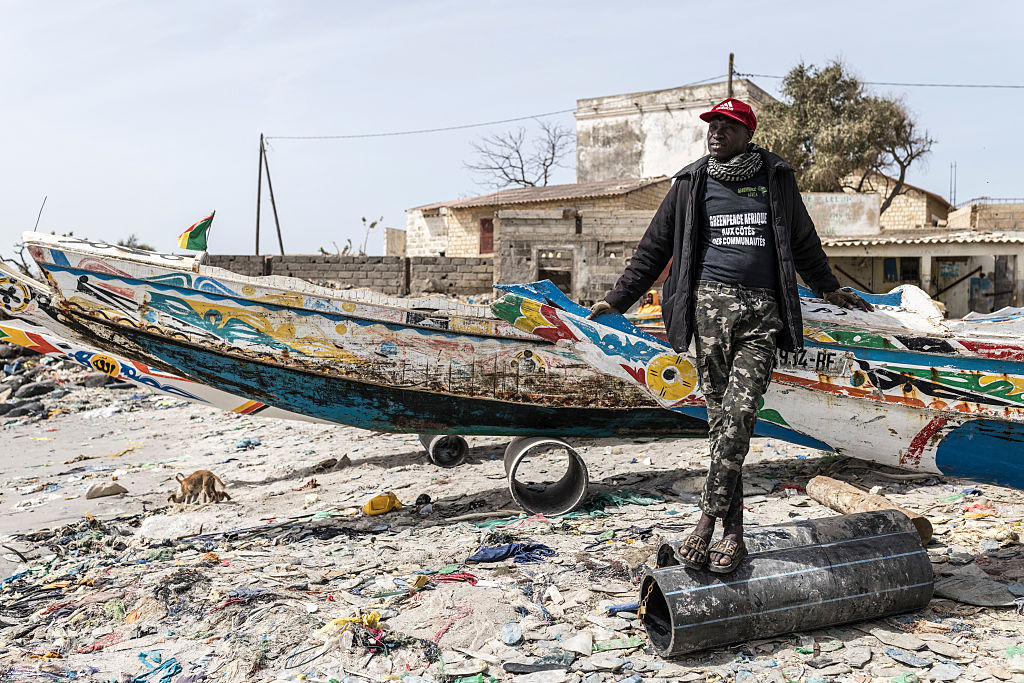
Artisanal fishing had sustained Ibrahima Mar’s family for generations. But Mar, a resident of Rufisque, a suburb of Dakar, has seen the country’s fish stocks reduced gradually but drastically over the last 15 years.
This is due to foreign industrial trawlers, particularly those from China, that are robbing Senegalese waters of a critical food source while threatening the jobs of more than 1.3 million people who work in the country’s fisheries sector. Mar’s heart aches for the loss of fish, his livelihood and one of his sons, who tried to travel to Europe several years ago in a desperate bid to find work but has not been heard from since.
Now 55, Mar told Agence France-Presse (AFP) that the country’s fish, especially small pelagic species such as sardinella and horse mackerel, were “taken from our path. So, there’s no hope left.”
Many of the foreign vessels engage in illegal, unreported and unregulated (IUU) fishing. China commands the world’s largest distant-water fishing fleet and is the world’s worst illegal fishing offender, according to the IUU Fishing Risk Index. Of the top 10 companies engaged in illegal fishing globally, eight are from China.
In Senegal and around West Africa, foreign trawlers employ an array of illegal tactics, including fishing with explosives, using illegally sized nets, fishing with lights and committing “saiko,” the illegal transshipment at sea. They also engage in bottom trawling, dragging a huge net along the ocean floor, indiscriminately scooping up all manner of marine life. The practice kills juvenile fish, leading to declining fish stocks, and destroys ecosystems critical to the survival of marine life.
Foreign fishing boats are also notorious for abusing local rules to file a foreign-owned and operated fishing vessel onto an African registry and fish in local waters. This is known as “flagging in” or flying a “flag of convenience.” It helps a vessel’s owners dodge financial charges and other regulations.
Illegal fishing costs Senegal nearly $300 million annually, while West Africa loses an estimated $10 billion per year. The Financial Transparency Coalition found that the region attracts 40% of the world’s illegal trawlers. In Senegal, 57% of exploited fish populations are in a state of collapse, according to the Environmental Justice Foundation.
“What a [local] pirogue used to catch in two months, now that same pirogue can fish for six or seven months to catch the same amount, which is a problem,” Mamadou Diouf Sene, president of the Fishing Wharf Revenue Commission of Rufisque, told AFP.
Due to the lack of local fish, Aissatou Wade is one of the remaining small-scale fish processors left in Joal-Fadiouth, a coastal town in central Senegal, where the trade is all but dead.
“Without fish, we have no money to send our children to school, buy food or get help if we fall ill,” Wade told The Guardian.
Even with help from Senegal’s military, surveilling the country’s waters is “very difficult,” Cheikh Salla Ndiaye of Senegal’s directorate of fisheries protection and surveillance told AFP, while Sophie Cooke, a fishing vessel analyst with Greenpeace, said the high seas were once considered “like the Wild West because there was no way to see what was happening out there.”
However, technologies such as tracking devices, satellite radar and smartphones, which fishermen can use to take pictures and pinpoint trawlers’ locations, are improving surveillance capacity. Mar, who recently spent time on a Greenpeace ship with other local fishermen, said he intended to take these tools back to Rufisque.
Senegal’s government has taken steps to fight illegal fishing. In 2022, the country launched a program to promote transparency in the nation’s fisheries sector by publishing up-to-date license lists and vessel registries online. Two years later, Dakar began publishing a list of vessels authorized to fish in the nation’s waters. However, in November 2024, the European Union elected not to renew its fisheries agreement with Senegal after it was flagged for as a non-cooperating country in the fight against illegal fishing, due to weaknesses in monitoring and traceability systems.
In March 2026, Senegal and Spain signed a memorandum of understanding on maritime fisheries cooperation and the fight against illegal fishing. The partnership will focus on resource sustainability, training, research and governance in the fisheries sector. It also includes Spanish support to strengthen Senegal’s capacity in monitoring, inspection, traceability and enforcement of IUU fishing rules, according to Ecofin Agency.