

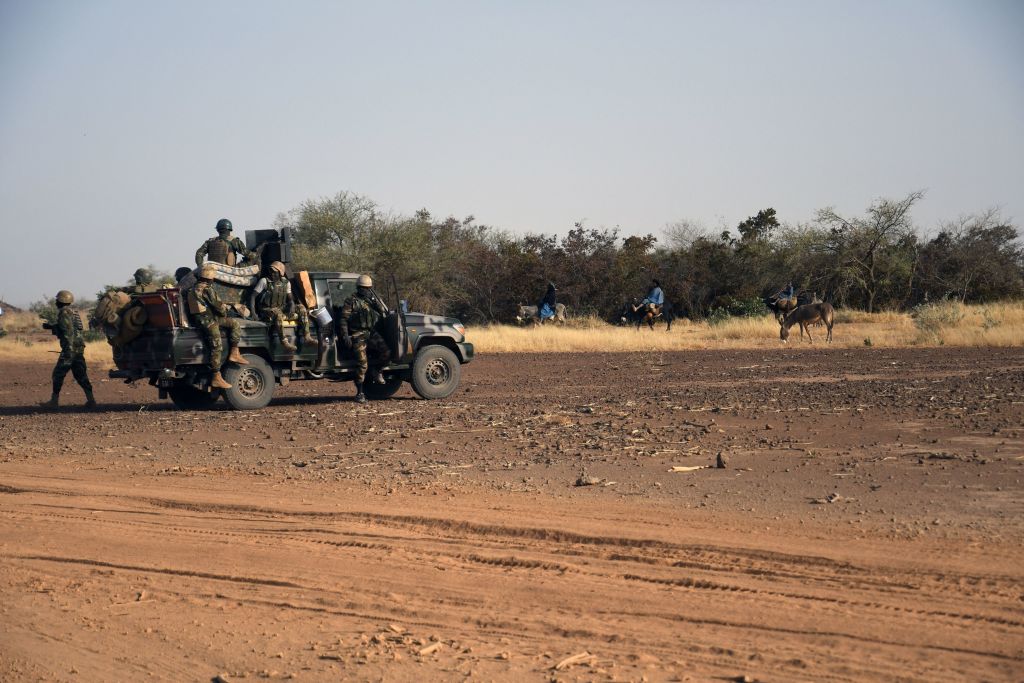
Niger’s western Tillabéri region has emerged as the deadliest area in the central Sahel for civilians due to an uptick in attacks by terror groups such as the Islamic State Sahel Province (ISSP) and Jama’at Nusrat al‑Islam wal‑Muslimin (JNIM),
According to the Armed Conflict Location & Event Data (ACLED), more than 1,200 of the 1,939 deaths recorded in Niger last year were in Tillabéri. The ISSP accounted for the largest number of fatalities from attacks on civilians, followed by operations by the Nigerien military and JNIM, which is affiliated with al-Qaida.
“Violence in Tillabéri was geographically widespread across many of the region’s departments, illustrating its growing significance for jihadist militancy and competition,” ACLED researchers wrote. “Tillabéri also stood out in terms of civilian harm since it recorded the highest level of civilian targeting among all regions in the three central Sahel countries over the past year.”
Situated along Niger’s borders with Burkina Faso and Mali, Tillabéri surrounds the capital district of Niamey and has become a place where terrorists “kill, loot and extort,” Amadou Arouna Maiga, coordinator of the Union of Tillabéri for Peace and Security, told Agence France-Presse.
Tillabéri’s Tera department, which borders Burkina Faso to the west, experienced the highest level of violence last year. The region also connects several overlapping conflict theaters, including the Liptako-Gourma region, which spans the border regions of Burkina Faso, Mali and Niger; the W-Arly-Pendjari Complex spanning Benin, Burkina Faso and Niger; and the Malian regions of Dosso, Menaka and Tahoua.
Niger’s military junta, led by Gen. Abdourahamane Tchiani, vowed to improve security and combat terrorism when it took power in July 2023. That has not happened, and researcher Caitlyn Ripazel Namora recently argued that Niger was in a comparatively stronger position than its Sahelian neighbors before the coup. According to ACLED data, there was no dramatic escalation in terrorist attack frequency in the period immediately preceding Tchiani’s takeover.
“Niger before the coup was pursuing a strategy that was, by realist standards, coherent: building a balance of power through alliances and managing threats with available capacity,” Namora wrote for the journal Modern Diplomacy. “The junta dismantled that strategy, triggered a new security dilemma, and worsened the very conditions it claimed to be remedying.”
It did this by expelling western forces and turning to Russian mercenaries — first the Wagner Group, now Africa Corps — for security assistance. Both Nigerien forces and Russian mercenaries have since been accused of killing civilians as well as human rights abuses and massacres.
According to the Global Centre for the Responsibility to Protect, Tchiani’s troops stepped up counterinsurgency operations in December 2025 and declared a “general mobilization,” granting sweeping powers to requisition civilians and resources to reinforce operations. However, the ISSP on January 29 launched an unprecedented attack on the international airport and military air base in Niamey. This involved the first reported use of drones by the group in Niger.
An Islamic State media outlet shared video of the attack in which IS militants spoke Kanuri, a language more commonly used in the Lake Chad basin. ISSP militants come from diverse areas, but this could mean that more experienced drone operators from Islamic State West Africa Province played a role in the attack, according to Ladd Serwat, a senior analyst at ACLED.
On March 24, the ISSP killed seven Nigerien Soldiers and stole a military vehicle after attacking the Tillabéri village of Wanni. Locals said the terrorists arrived around 9 a.m. and rustled cattle before leaving. The Nigerien Soldiers were ambushed while in pursuit, Nigeria’s Daily Post newspaper reported.
ACLED researchers predict that Tillabéri will continue to be defined by cross-border dynamics and militant mobility.
“Current conflict dynamics suggest that without significant changes in the region’s security conditions, Tillabéri is likely to remain a flashpoint of violence in the coming year,” the researchers wrote in January.