

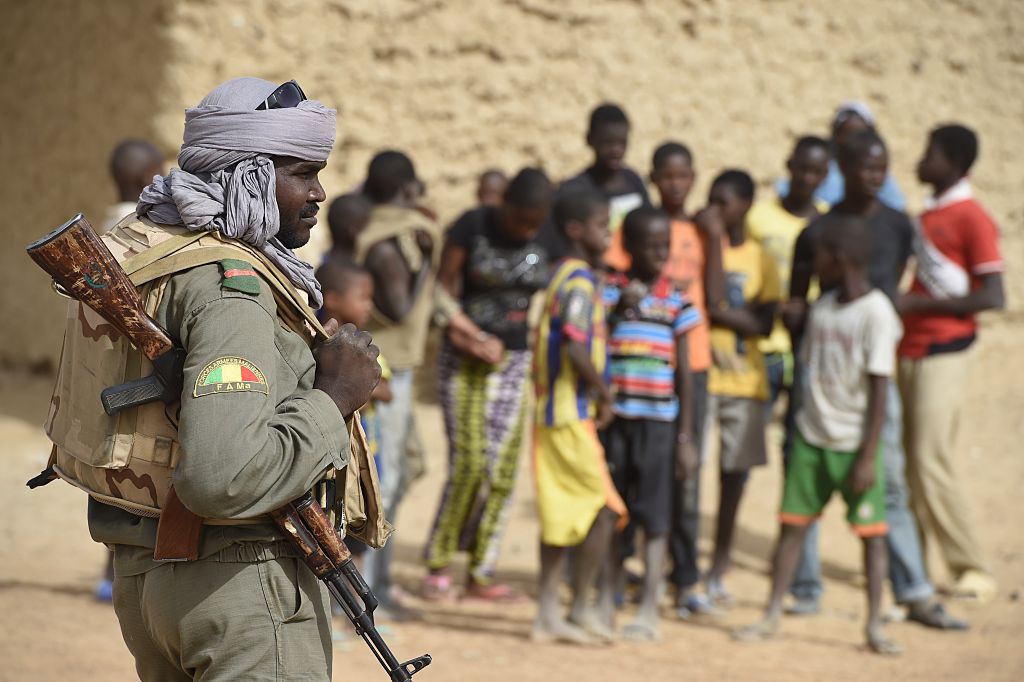
Nine months after Russia replaced and rebranded its mercenaries in Mali as Africa Corps, the mercenaries’ involvement in counterterrorism there has dropped off dramatically, leaving Malian soldiers to carry more of the burden.
According to the Armed Conflict Location and Event Data project (ACLED), battles involving Russian fighters in Mali dropped from 537 to 402 between 2024 and 2025, a reduction of more than 33%. ACLED reported just 24 incidents per month since the beginning of 2026.
Russia’s shrinking battlefield footprint coincided with the deployment of Africa Corps and its more hands-off approach compared to Wagner’s frequent use of brutal tactics against extremist groups and their suspected supporters.
Between January 2024 and Wagner’s exit in June 2025, Wagner and Malian soldiers caused more than 1,440 civilian casualties. That was four times the number of deaths and injuries tied to terrorist group Jama’at Nusrat al-Islam wal-Muslimin (JNIM) during the same period.
As a private military contractor, Wagner largely had free rein to carry out missions as it saw fit. In Mali, as in other African countries, Wagner was invited into Mali to train local security forces, but its mercenaries often took part in ground operations such as the attack on Moura that left more than 300 civilians dead.
Despite the change in strategy, Africa Corps fighters continue to conduct summary executions and other brutality, just on a smaller scale, according to witness reports.
The Malian junta that overthrew the country’s elected leader and expelled France’s long-running Operation Barkhane and United Nations peacekeepers, justified their actions by blaming the civilian government’s inability to stop violence by JNIM and Islamic State Sahel Province terror groups and Tuareg separatists.
But civilians have not benefited from the new alliance. Mali remains the fifth-most terror-affected country globally with large swaths of the country under terrorist control.
“The results have been catastrophic for civilians. Documented massacres. Mass displacement. Zero improvement in territorial security. The jihadist groups that Wagner was supposed to defeat have actually expanded their operational territory since the Russian arrival,” Nigeria-based analyst Isaac Idemeto recently wrote in an essay published on his LinkedIn page.
After the death of Wagner leader Yevgeny Prigozhin in 2023, Russia’s Ministry of Defense took control of the group and rebranded it as Africa Corps. The government also changed Africa Corps’ approach, keeping its fighters close to their bases where they operated drones and trained Malian soldiers. Decision-making became centered in Moscow rather than on the ground in Mali.
“Because of the political consequences, Africa Corps weighs risk-taking more heavily than its predecessor,” Lou Osborn, an investigator with the website All Eyes on Wagner, told The Africa Report. “The Russians go into combat less often, which is viewed poorly by the Malian side. Their more institutional mode of operation is starting to resemble what Mali rejected with the French Operation Barkhane.”
Idemento notes that Mali’s decision to side with Russia and to break away from regional security missions such as the G5 Sahel Joint Force damaged West African countries’ ability to collaborate on counterterrorism.
Meanwhile, JNIM and other groups have gained ground, taking control of large parts of Mali and its Sahelian neighbors, while taking its first steps into coastal countries such as Benin, Côte d’Ivoire and Togo.
“The security vacuum created by the collapse of regional cooperation mechanisms is pushing instability southward toward the West African coast — toward the countries with the largest populations, the most developed economies, and the most to lose,” Idemeto wrote.