

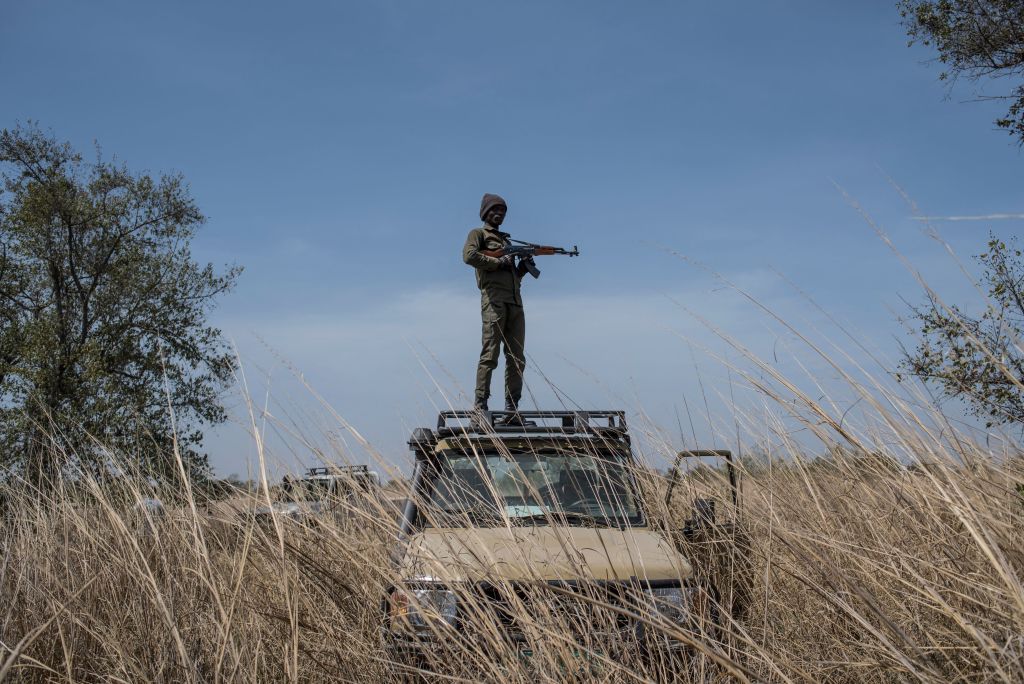
Sahel terror groups have long used forests to hide, stock up on natural resources and establish bases. Increasingly, these groups are using forests for recruitment, financing, smuggling, logistics and organizing parallel governance, according to the Observer Research Foundation (ORF).
Analysts say the use of forests has led to the rapid expansion of terrorist violence across the Sahel and into new areas in West Africa from groups such as the al-Qaida-linked Jama’at Nusrat al-Islam wal-Muslimin (JNIM), the Islamic State Sahel Province (ISSP) and Boko Haram. In February, the Boko Haram-affiliated Jama’atu Ahlis Sunna Lidda’awati wal-Jihad, or JAS, terror group killed nearly 200 people in an attack in the town of Woro in western Nigeria’s heavily forested Kwara State. Woro is just south of Kainji National Park, a 5,341-kilometer forest reserve that borders Niger State.
“The attack reflects the growing strength of jihadist groups around Kainji National Park,” wrote Nnamdi Obasi, an analyst with the International Crisis Group.
The Kainji reserve has become known as the new Sambisa, after northeastern Nigeria’s Sambisa Forest. For years, Sambisa has been a base for diverse armed groups and extremist groups, including the Ansaru, Lakurawa and Mahmuda groups. JNIM also recently announced it was operating in the area where victims of the 2014 Chibok schoolgirl kidnappings were held.
“Forests are no longer mere hideouts; they are deliberately selected strongholds that allow armed groups to withstand military pressure while embedding themselves within local economic and social systems,” wrote Samir Bhattacharya, an associate fellow at the ORF, and Shrestha Medhi, a research intern at the foundation. “Therefore, contrary to popular opinion, this phenomenon reflects strategic choice rather than accidental exploitation of ‘ungoverned spaces.’”
According to Bhattacharya and Medhi, forests offer terrorist groups several advantages. They are guarded by lightly armed rangers who prioritize conservation over counterinsurgency. Dense vegetation and weak infrastructure let them conduct ambushes more rapidly than in urban environments. Terrorists also can insert themselves into longstanding illicit and informal economies, such as fuel smuggling, artisanal gold mining, cattle grazing and poaching.
Terrorist groups and criminal gangs also frequently use the W-Arly-Pendjari (WAP) complex, which spans Benin, Burkina Faso and Niger. All three countries share the W Park. Arly is in Burkina Faso, and Pendjari is in Benin. More than 120 Soldiers were killed near the complex’s “triple point,” an extensive area where the three countries meet, between 2021 and 2024.
In January 2025, nearly 30 Soldiers were killed near the triple point in northern Benin. Four months later, JNIM killed at least 54 Beninese Soldiers in an attack in northern Benin, near the borders with Burkina Faso, Niger and Nigeria. After that attack, Wilfried Léandre Houngbédji, Benin’s government spokesperson, decried the lack of cooperation with the country’s neighbors in the fight against extremist groups.
“The points where these attacks of April 17 took place are on the border, so you can understand that if, on the other side of the border, there was a force like ours, these attacks would not take place in this way or would not even occur,” Houngbédji said in a joint report by Africanews and The Associated Press.
Violence has afflicted the WAP complex for about a decade, according to Papa Sow, a researcher at The Nordic Africa Institute.
“Due to the steady encroachment of non-state armed groups, the conflict is threatening to engulf the reserve,” Sow wrote in The Conversation. “Forest resources are being plundered and people who live near the protected areas are being displaced.”
ISSP and JNIM have used the WAP complex to recruit fighters and supporters from groups with diverse linguistic and cultural identities in the borderlands, including Fulani, Gourmantche, Djerma and Bariba.
As JNIM consolidated its presence around the complex and along the Niger River, recruitment broadened to populations living around the parks and along the Niger and Mekrou rivers, according to Héni Nsaibia, an analyst with the Armed Conflict Location and Event Data project. Both groups also co-opted local bandits to expand their manpower.
“The control over illicit trade routes, especially fuel smuggling connecting northwestern and north-central Nigeria with riverine communes in Niger and Benin, and other areas surrounding the WAP Complex, has linked local livelihoods and economies to militant presence,” Nsaibia wrote.
Other regional forests and reserves terrorists use include those in northern Koulikoro and western Segou in Mali, where JNIM controls vast areas; southwest Niger’s Dosso region, where ISSP and JNIM operate, particularly near the Benin and Nigeria borders; and on southern Burkina Faso’s border with Côte d’Ivoire, where JNIM controls illegal gold mining operations.