

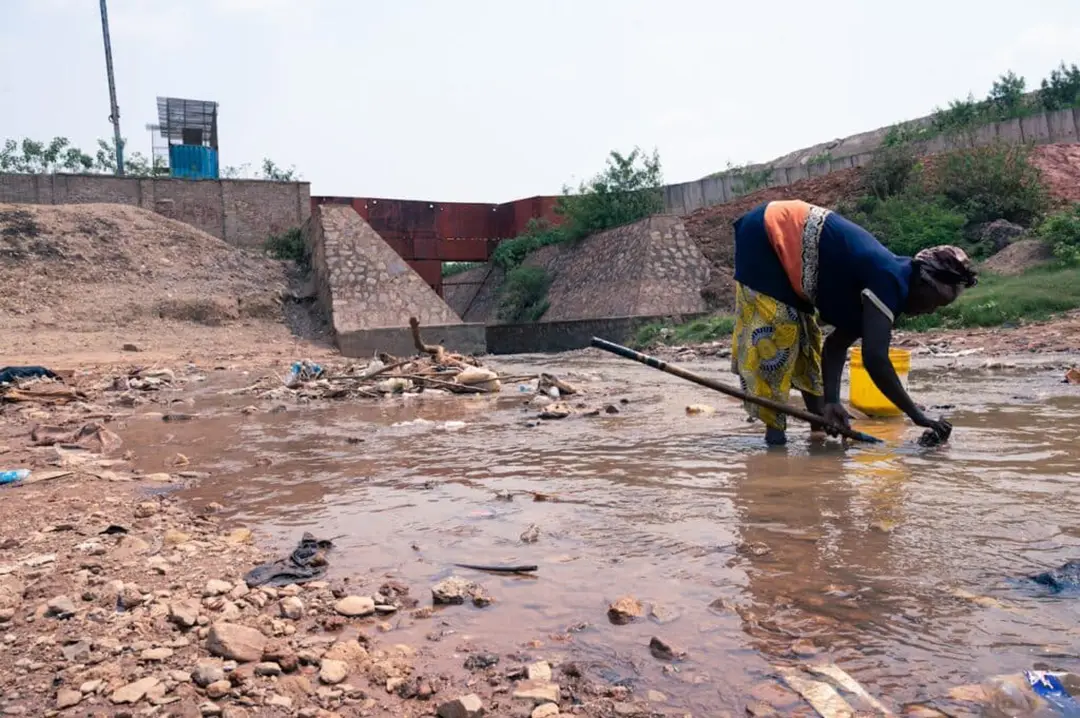
In the city of Kolwezi, the mining capital of the Democratic Republic of the Congo, open-pit cobalt and copper mines are a common sight woven into dozens of neighborhoods. Also common are complaints from residents of nosebleeds, headaches, skin rashes and coughing that many blame on the mines.
A group of 27 Kolwezi residents, including eight children, are suing Compagnie Minière de Musonoie Global (COMMUS), owned by Chinese mining giant Zijin, for environmental pollution. They’re also suing the Congolese government and its environment agency for failing to enforce its laws.
One of the claimants, a mother of eight children, bought land in Kolwezi in 2008 and built a home two years later. The COMMUS mine opened in 2015, and she has seen dramatic changes.
“Before that, we lived well,” she said in a November 3 statement. “There used to be a small stream flowing from the lake towards our neighbourhood. We used to fish there, and there were fish. Certain vegetables also grew naturally along the banks of the stream. But when COMMUS arrived, it polluted our small stream. Then it blocked the stream and diverted it elsewhere.
“Later, they installed pipes to take water from the lake to their factory. They also installed other pipes to carry water from the factory back into the lake. When the water from the factory flows back into the lake, it is no longer possible to find fish because that water contains acid. The vegetables that used to grow naturally around the lake no longer grow there either.”
Residents of the neighborhood, she said, use that water for washing and cooking. Some have stopped after developing skin problems.
“If you come here to our neighbourhood at around five in the afternoon, or in the morning between seven and eight, you will notice vapour rising from COMMUS’s storage area,” she said. “It looks like steam coming from a pot on a fire. At around five in the afternoon, there is usually a pleasant breeze. But when you go outside to enjoy the fresh air, you feel something irritating your face.”
Two environmental advocacy organizations, Lubumbashi-based African Resources Watch (AFREWATCH) and British charity Rights and Accountability in Development (RAID), commissioned research that was published in June showing severe air pollution near some of the mines as well as polluted groundwater.
On November 3, in the first hearing before the Commercial Court of Kolwezi, the plaintiffs said they are seeking $1.3 million in compensation and $5 million for environmental restoration.
AFREWATCH and RAID said the case promises to be an important test of the DRC’s 2018 mining code, in which companies can be held liable for environmental damage, rehabilitation of mining sites and the conservation of forest resources.
“If successful, the case could pave the way for other communities living near industrial mines to seek justice,” AFREWATCH and RAID said in a November 3 joint statement.
Emmanuel Kasongo, a lawyer representing the claimants, said previous efforts to seek relief from COMMUS and from the Congolese Environment Agency were ignored.
“Members of these communities have repeatedly reached out to authorities and even to COMMUS through correspondence and formal appeals, specifically to draw attention to this pollution, which was destroying their health and even their living environment,” he told France 24 in an interview broadcast on November 4.
“In concrete legal terms, what we are pursuing is, first and foremost, redress for rights that have been violated by COMMUS. What are these rights? They include, first, the right to a healthy environment, which is guaranteed by the constitution. There is also the right to health, which is likewise guaranteed by the constitution.”
Zijin has a majority ownership stake in COMMUS. The copper mine has a production capacity of more than 120,000 metric tons a year, while the cobalt mine can produce 2,000 metric tons annually, according to the company.
The DRC is the world’s largest producer of cobalt, a critical mineral used in lithium-ion batteries. The country is the second-largest copper producer.
About 1,500 Kolwezi children attend the Galaxy School, located less than 500 meters from a mining-waste dump linked to COMMUS. In September, an air quality monitor installed at the school recorded sustained, dangerous levels of fine particulate pollution — more than five times the World Health Organization’s recommended daily limit.
“With independent scientific evidence to support their concerns, residents are taking their fight for justice to court,” AFREWATCH Human Rights Director Jean Pierre Lwamba said. “They want pollution cleaned up and further harm prevented. They should not have to accept contamination as the inevitable price of mining.”