
Locals in Ethiopia’s embattled Tigray region say Eritrean troops have entered border areas, raising concerns about a return to war. Infiltrations come amid a feud between the countries over Red Sea access and Asmara’s alleged support of the Tigray People’s Liberation Front (TPLF), the region’s ruling party.
Ethiopian Prime Minister Abiy Ahmed also has accused Eritrean troops of committing mass killings while fighting alongside Ethiopian troops in the war that ended in 2022.
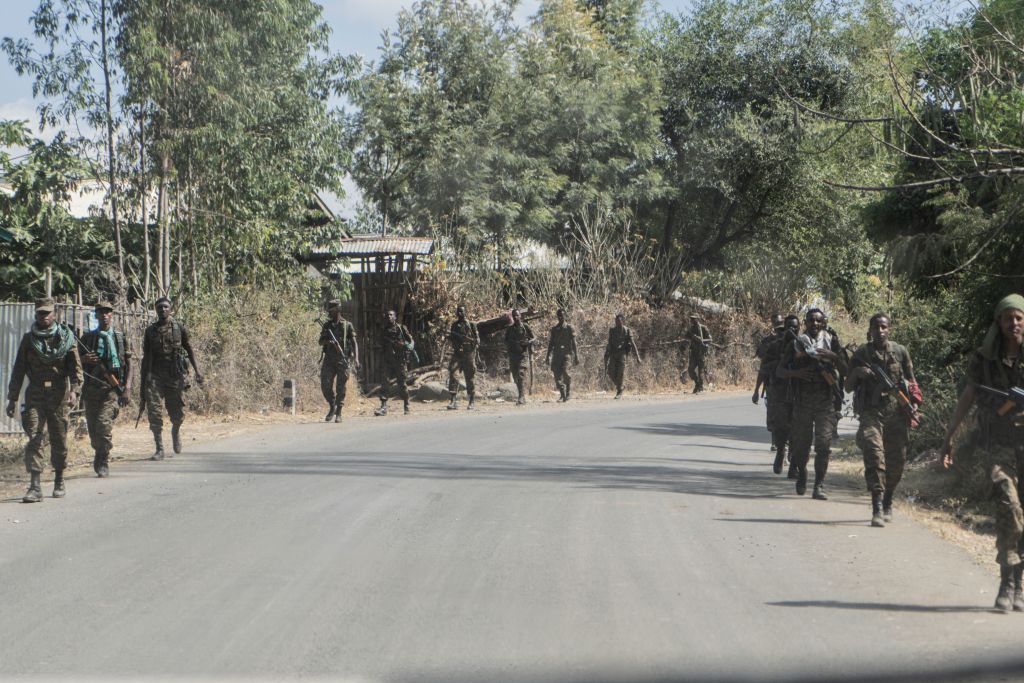
A military source anonymously told The Africa Report magazine that Eritrean forces are visible along sensitive routes in the porous border areas.
“They have entered through Tigray now,” the source said. “In Tigray, they have come as far as Mekelle, Adigrat and Zalambessa. On the Humera side, they infiltrate by posing as residents, especially through Hamdayet, a Sudanese town near Humera.”
Hamdayet has become a transit point for military movement and logistics. Residents say military vehicles move back and forth along routes linking Eritrean positions with TPLF-controlled areas in Tigray.
The Eritrean troops “disguise themselves as [Ethiopian troops] and we catch them frequently,” the military source told The Africa Report. “But those wearing their own uniforms and appearing as soldiers have entered from Mekelle to Adigrat and Zalambessa.”
The military source said Eritreans and TPLF associates in Tigray are coordinating among themselves.
“Their shared goal is to dismantle the country,” the source said. “Right now, they are leveraging internal chaos. Their main mission is to create obstacles so the government remains distracted and cannot focus on development or organizing citizens. They will not hesitate to destabilize us.”
Ethiopia Accuses, Eritrea Denies
In a February 7 letter to his Eritrean counterpart, Ethiopian Foreign Minister Gedion Timothewos accused Asmara of supporting militant groups operating in Ethiopia. Gedion demanded that Eritrea “withdraw its troops from Ethiopian territory and cease all forms of collaboration with rebel groups.” He called the alleged actions “not just provocations but acts of outright aggression.”
Two days later, Eritrea’s Ministry of Information said the claims were “patently false and fabricated,” describing them as part of a “spiral of hostile campaigns against Eritrea for more than two years.”
“The government of Eritrea has no appetite for, or desire to, engage in meaningless acrimony to add fuel and exacerbate the situation,” the statement said.
Despite Eritrea’s denial, the Ethiopian Army has moved large amounts of troops and weaponry toward Tigray’s borders. Locals told Agence France-Presse that they feared a return to civil war. The previous Tigray conflict killed at least 600,000 people between 2020 and 2022.
TPLF Tensions
Tensions between Abiy and the TPLF run high. The TPLF is embroiled in a power struggle with the Tigray Interim Administration, appointed by Abiy in 2023 as part of the Pretoria Agreement that ended the previous war.
The Tigray Defence Forces (TDF) on January 26 entered the disputed northwestern Tigray territory of Tselemt, clashing with federal troops and militias from the neighboring Amhara region. Three days later, the TDF moved into Korem and Alamata in southern Tigray’s contested Raya district without apparent federal resistance, the International Crisis Group reported. The federal government then canceled all flights to the region and on January 31 conducted two drone strikes in central Tigray.
Leftover animosity from the civil war drives this crisis. When the war broke out in 2020, Amhara militias seized western Tigray, where hundreds of thousands of people were forced to flee. A few thousand people returned to their Tigray homes in 2024, but many faced intimidation and abuse from Amhara militias. Abiy also has stonewalled the TPLF’s demands to give control of disputed territories from Amhara back to Tigray.
Ethiopia’s destabilization holds significant security concerns for the Horn of Africa, which is experiencing armed conflict in Somalia, South Sudan and Sudan. Egypt, Ethiopia and Sudan also have argued over Addis Ababa’s Grand Ethiopian Renaissance Dam, a hydroelectric dam on the Nile River, since 2011.
During the previous Tigray war, conflict between Ethiopia and Sudan was renewed over the fertile border region of Al Fashaga, where governance rights have been contested since the early 1900s. The continuous dispute was exacerbated by Sudan’s support for the TPLF, according to the Global Conflict Tracker.