

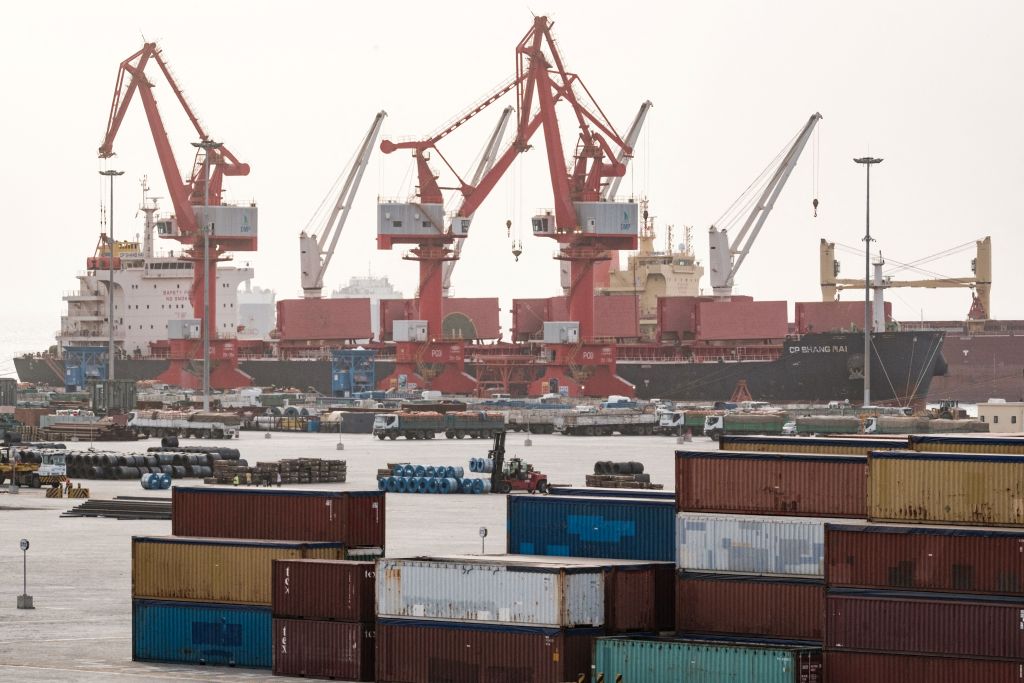
Chinese companies are present in more than one-third of all African port developments. As noted by the Africa Center for Strategic Studies, these companies in some cases dominate the entire port development process from finance to construction and operations. Sometimes, they share ownership.
Port development is part of Beijing’s Belt and Road Initiative (BRI). Beijing has either financed, built, has a stake in or controls operations of about 78 trade ports in Africa.
“African ports matter to China for one simple reason. They sit at the choke points of trade,” Irina Tsukerman, president of Scarab Rising Inc. and fellow at the Arabian Peninsula Institute, told Kenya’s The EastAfrican newspaper. “Most African exports and imports still move by sea, and the fastest way to shape that flow is to shape the ports where cargo is cleared, stored, priced, and routed onward.”
Analysts say Chinese involvement in African ports raises concerns about military use, because Beijing-backed ports are suitable for both commercial and military applications.
“At least seven Chinese-backed ports in Africa have design features that make them capable of berthing Chinese naval facilities although they may not have been created specifically for this purpose,” Paul Nantulya, research associate at the Africa Center, told Engineering News-Record magazine.
For example, he said, the Angolan port of Luwanda can host any major Chinese surface combat vessel, the Namibian port of Walvis Bay can house up to eight Chinese guided missile destroyers and the port of Victoria in Seychelles can also host up to two Chinese corvettes, which are modern littoral combat-oriented warships.
Satellite images of the port of Mombasa, Kenya, show that its 245-meter-long military-grade dock could berth two corvettes and any surface combat vessel up to certain guided-missile destroyers.
China is ensuring that a significant amount of its port construction is being completed to a “dual port use specification to avoid Western suspicion of naval buildup,” according to a 2024 research paper by the United Kingdom’s Royal United Services Institute. “Chinese-funded ports are built to accommodate commercial trade, but can — with significant risks and complications — be flipped to military use as depth and landing and docking zones are built to [military] specifications.”
China’s 2019 defense white paper said naval officials were developing “overseas logistical facilities to address deficiencies in overseas operations” and called for a shift from “near coast active defense to far seas maneuvering operations.”
There is precedence for China developing an African port purportedly for commercial purposes, then using it militarily. When Djibouti’s Chinese-developed Doraleh Port opened in May 2017, Djiboutian President Ismail Omar Guelleh and Chinese representatives took turns commending one another on the achievement. From Doraleh, the Chinese Navy can overlook the Bab-el-Mandeb Strait through which an estimated 12.5% to 20% of global trade passes annually.
Two months later, the Djiboutians and Chinese dignitaries met again to celebrate the completion of China’s first overseas military base, a few minutes’ drive from the port. The facility was built for Beijing’s People’s Liberation Army Navy, which reportedly has exclusive use of at least one of the port’s berths.
“The proximity between port and base reflects the integration of Chinese commercial and military interests as part of a strategy to project power abroad, even while Beijing maintains the guise of noninterference,” researcher Monica Wang wrote for the Council on Foreign Relations.
Nantulya told Engineering News-Record he identified more than 10 occasions when Chinese military ships have docked in seven different African ports in recent years, including those at Doraleh; Lagos, Nigeria; Durban, South Africa; and Dar es Salaam, Tanzania.
“My assessment is that China will definitely build a new military base in Africa,” Nantulya said. “But it is difficult to guess which port will be selected for this purpose.”