
As terror groups in Africa fundraise, recruit and coordinate online, security forces and technology companies are collaborating to fight them.
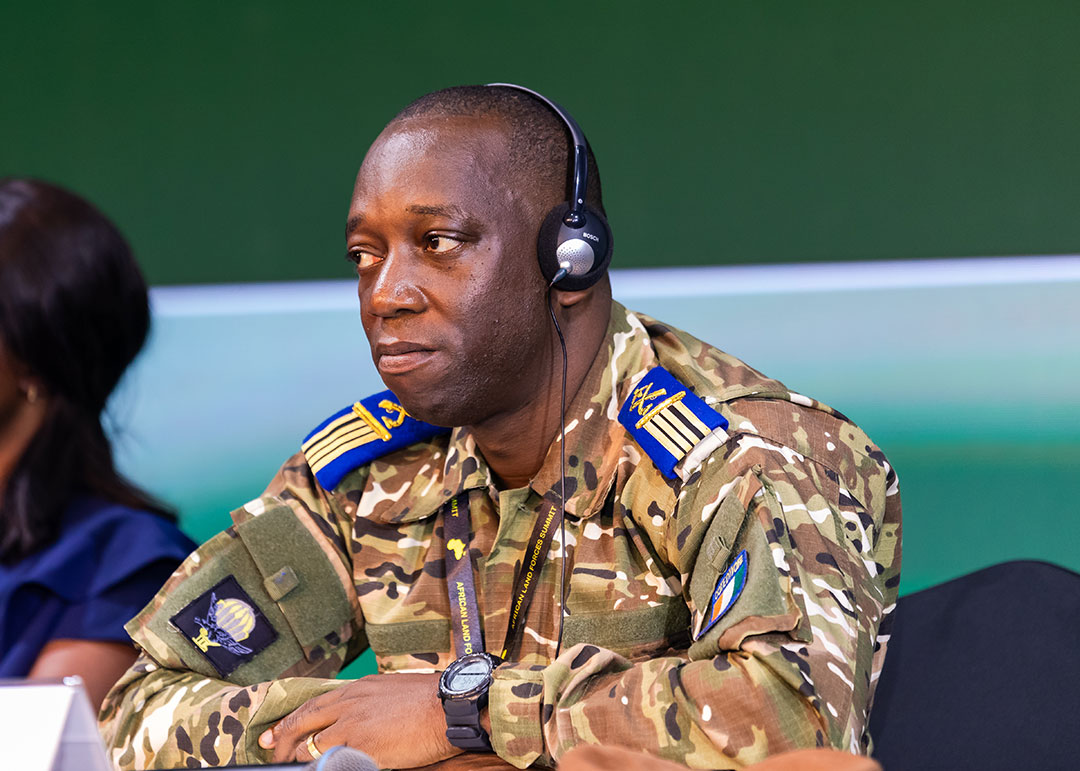
“Terrorists are pervasive on the web, and this necessitates many, many up-to-date tools and having enough actors on our end to monitor all of these tools,” Maj. Guéable Hervé Zeni, chief of the Cyber Defense Office of the Armed Forces of Côte d’Ivoire, told a recent webinar hosted by the Africa Center for Strategic Studies.
The webinar focused on the best ways for African nations to combat terrorism online.
Zeni and his team of technology experts pay close attention to, among other things, online chatter involving known terrorists to predict potential terror attacks across West Africa.
“We’re very much trying to monitor these activities in order to anticipate the activities these terrorists may take in our country or in neighboring countries,” Zeni said.
Côte d’Ivoire shares borders with Burkina Faso and Mali, which lead the world in terrorist violence. Like its neighbors along the northern Gulf of Guinea, Côte d’Ivoire has focused much of its recent attention on preventing groups such as al-Qaida affiliate Jama’at Nusrat al-Islam wal-Muslimin (JNIM) from spreading into its country.
Zeni and his staff serve as an advanced warning system and share what they learn with other government agencies across the region.
“The network is very important, especially when you’re fighting terrorism online,” Zeni said. “We rely on various partners with whom we interact to create a response.”
That list of partners often includes the technology companies that operate social media sites, mobile money exchanges and other tools terrorists use to communicate.
Online companies are invested in rooting out terrorist activity on their platforms, said Erin Saltman, senior director for the Global Internet Forum to Counter Terrorism (GIFCT).
However, the variety of sizes and capacities of internet companies makes it difficult to catch every bad actor, she said. One weak spot is the capacity to monitor activity in indigenous languages. Nearly 70 languages are spoken in Côte d’Ivoire. Nigeria has 200.
“No one person or tech company knows everything,” Saltman said. “That’s an area where you’re going to see a lot of advancement in the next few years.”
Further complicating matters, terror groups such as Boko Haram have begun using otherwise innocuous online games as recruiting tools to target young people, Saltman said.
By working with African counterterrorism teams, tech companies can flag suspicious activity for local security forces. They also can investigate — and in some cases disrupt — activity that counterterrorism teams identify as potential threats.
Disruptions can range from blocking people who repeatedly try to create online accounts to taking down entire networks of suspected terrorists by using AI to identify their shared interests.
The relationship between African counterterrorism teams and technology companies can hit roadblocks over proprietary technology or privacy.
“Sometimes these platforms refuse to share the identity of individuals,” Zeni said. “This is a challenge. Sometimes these platforms are not cooperating with us, the Ivoirian government and judicial system.”
There are many obstacles to sharing online counterterrorism information between countries, Zeni said.
Zeni added that the fight against terrorists online requires continual training for the teams doing the work. “We try to accentuate the training of our staff,” Zeni said. “It is not the technology that takes priority, but the thinking.”