

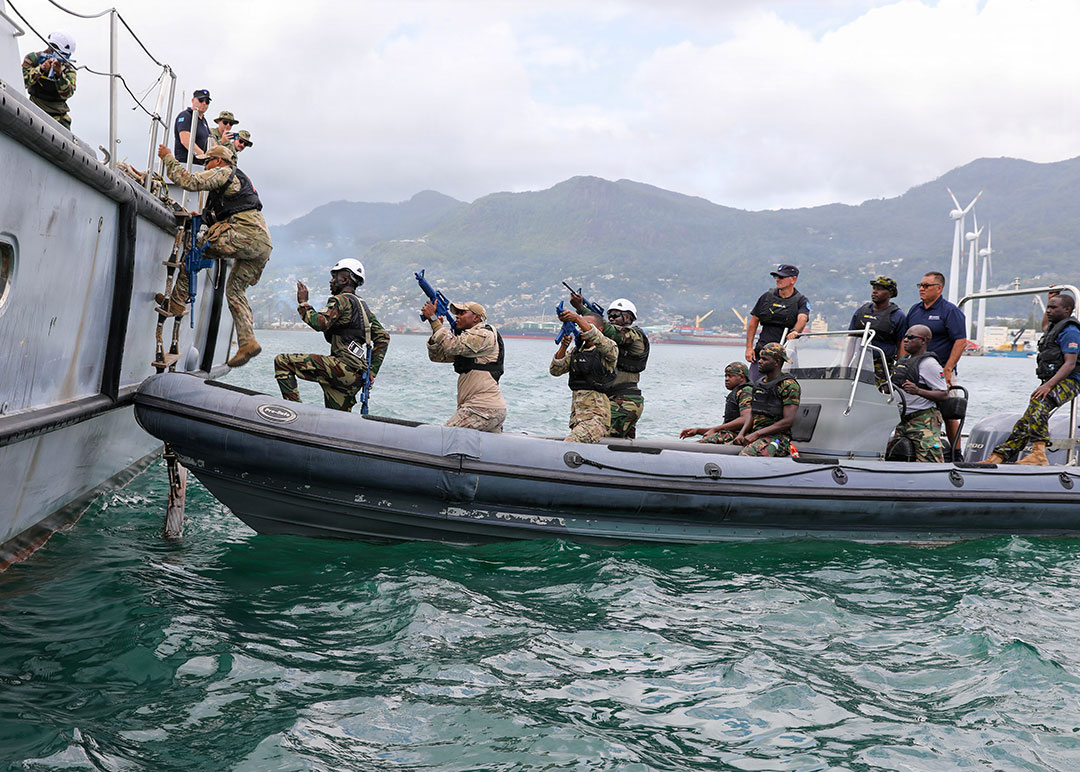
Monitoring vast expanses of sea requires cooperation and technological tools. During the Cutlass Express 2026 (CE26) maritime security exercise, East African nations and international partners received training on several technological platforms meant to increase their maritime domain awareness while reinforcing longstanding partnerships.
Among the technologies utilized was Lightfish a 12-foot, solar-powered unmanned surface vehicle — an interceptor drone — with a modular payload designed for long-endurance missions. The U.S. Navy launched it from a Seychelles Coast Guard ship during the exercise.
“We are making history at Cutlass Express 2026 by demonstrating our enhanced warfighting skills through our robotic and unmanned capabilities alongside our maritime partners,” said Lt. Bryna Loranger, operations officer of the U.S. Navy 6th Fleet’s Commander Task Force 66.
CE26 was conducted in Mauritius, Seychelles and other parts of the western Indian Ocean from February 2 to February 12. It was hosted by Mauritius, sponsored by U.S. Africa Command (AFRICOM) and led by the U.S. Navy 6th Fleet. This year marked the 16th iteration of the exercise.
Participants also trained on the SmartMast and SeaVision platforms, which enable small patrol craft to detect and report potential maritime crimes and quickly convey that information to national and regional maritime operations centers (MOCs) that coordinate real-time information sharing across national boundaries. This helps partner nations build the situational awareness needed to identify traffickers, disrupt criminal networks and combat illegal fishing.
SmartMast includes a maritime situational awareness network for vessel tracking; a multifunctional, solar-powered lighting unit; and a portable telescopic mast for defense and surveillance.
SeaVision lets users track commercial vessels globally with data from automatic identification system transponders. It helps countries share maritime information and intelligence, improve operations, and detect vessels not transmitting a transponder signal, which often is a sign of illegal activity.
The exercise also aimed to enhance the ability of regional maritime forces to confront sea crimes by improving compatibility and collaboration, strengthening maritime domain awareness, building tactical interdiction skills, and streamlining information sharing among maritime operations centers (MOCs).
Capt. Samuel Cecile, signal and maritime domain awareness officer with the Seychelles Coast Guard, said training withpartners is important because securing the region’s waters “takes real coordination and trust.”
“Exercises like this give us the opportunity to strengthen our teamwork, improve how we operate side by side and better understand each other’s capabilities,” Cecile said. “The experience we gain during this training directly improves our readiness and helps ensure that all partners in the West Indian Ocean are better prepared to respond to modern challenges together.”
The exercise brought together about 500 personnel from 19 nations, including Comoros, Djibouti, Egypt, France, Georgia, India, Kenya, Madagascar, Malawi, Morocco, Mozambique, Senegal, Somalia, Tanzania, Tunisia and the United Kingdom. The central theme focused on the use of practical, adaptable technologies that enhance awareness in remote maritime regions.
Other activities included advanced visit, board, search and seizure drills; command post information‑sharing scenarios that replicate real‑world operations; and medical training.
“As Exercise Cutlass Express concludes, it reinforces the value of enduring partnerships that span four continents and demonstrates the collective commitment to maritime security,” Lt. Gen. John Brennan, AFRICOM deputy commander, said in a news release. “Training together builds trust, strengthens coordination and enhances our shared ability to address maritime challenges in the Western Indian Ocean. USAFRICOM is committed to constantly improving this African partner-led and allied-enabled exercise in the future, as we look forward to Cutlass Express 2027.”