
Shortly after the Sudanese Armed Forces (SAF) drove the rival Rapid Support Forces (RSF) out of Wad Madani earlier this year, bodies began appearing in regional agricultural canals.
Some were naked, others dressed in civilian clothes. Some had their hands bound. Many had been shot in the head. Witnesses told investigators that SAF fighters had moved through the area declaring individuals to be collaborators as they went.
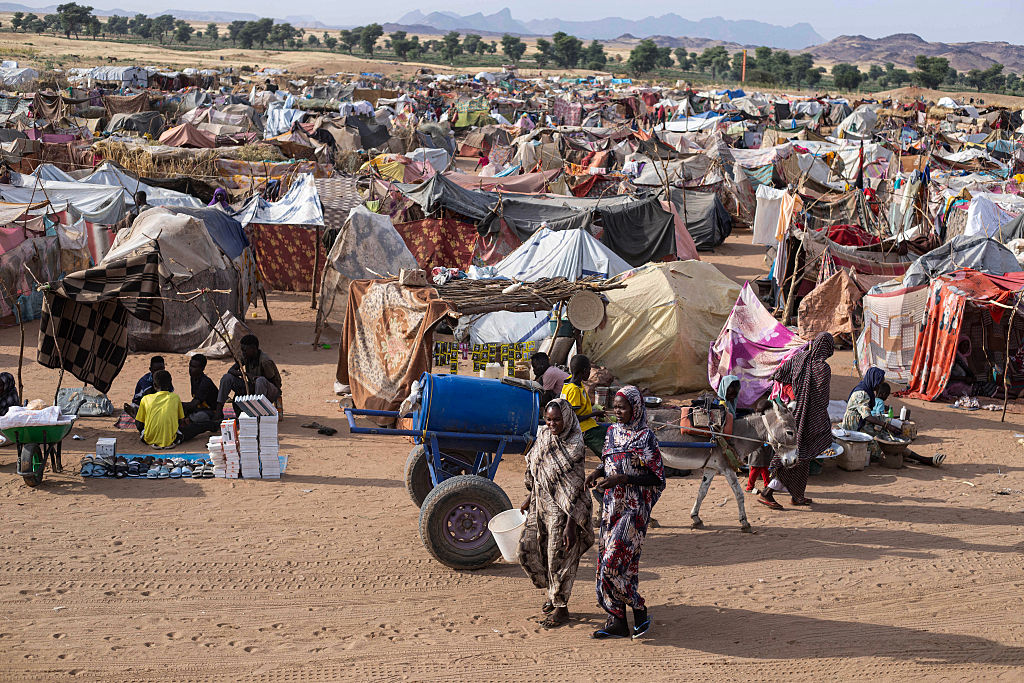
On the other side of the country, in the RSF-dominated Darfur region, starvation and thirst kill displaced non-Arab civilians daily in one of the world’s worst humanitarian crises.
Deep into its second year, Sudan’s civil war grinds on with each side declaring that the conflict will end only with the total victory of one side or the other. As a result, each side has turned to genocidal tactics to achieve that goal, according to international investigators.
Mona Rishmawi, co-author of a report about Sudan to the United Nations Human Rights Council, described the situation in a September 2025 statement:
“You kill, [you provide] no food, no water, you don’t allow food production. You don’t allow access to food, to markets … and you don’t allow access to humanitarian aid. What you do want is to kill the population … So, the effect of this is really the crime against humanity … of extermination.”
Although the report stopped short of declaring genocide, council Chairman Mohamed Chande Othman said both the SAF and RSF had committed atrocities. The list includes, among other things, forced marriage of young girls, sexual violations of men and boys, and witnesses’ descriptions of RSF detention sites as slaughterhouses.
The unbridled death and destruction sweeping Sudan echo events in pre-independence South Sudan and Darfur. During the first six months of the current conflict in 2023, the RSF and its allies systematically set out to remove ethnic Masalit people from el-Geneina, the capital of West Darfur, according to Human Rights Watch.
The RSF conquest of el-Fasher, the capital of North Darfur, at the end of October 2025 was one of the most recent examples of genocidal tactics. After the SAF’s retreat, RSF fighters killed an estimated 7,000 civilians still in the city. More civilians, many of them women and children, were killed or attacked as they fled.
The bodies floating in agricultural canals in al-Jazira State suggest that the SAF also uses genocidal tactics, analysts say.
Satellite images taken in May 2025 revealed dozens of bodies as canal waters receded in the dry season. Many of those were in Bika, just a few meters from the bridge where SAF leader Gen. Abdel Fattah al-Burhan declared victory after his troops drove the RSF out of Wad Madani.
Forensic analyses showed that the bodies were of non-Arab people from the Darfur region or from South Sudan, according to a CNN report.
“Anyone who appeared to be Nuba, from western Sudan or from the south was immediately shot,” an SAF officer who spoke on the condition of anonymity told the network.
Video taken from Telegram and included in the CNN report shows SAF soldiers standing among the bodies of at least 50 apparently unarmed young men, all of them in civilian clothing and many barefoot. Many appear to have fresh pools of blood beneath them and gunshot wounds to the head. A pair of crutches lay across one of the bodies.
As the SAF consolidated its control of al-Jazira State, it turned its attention to the Kanabi people, non-Arabs descended from Darfuris and South Sudanese who live in communities across the state. Between October 2024 and May 2025, the SAF and allied militias attacked 39 Kanabi communities in al-Jazira and another 18 in Sennar State.
Witnesses told CNN that SAF-allied fighters burned houses and shot at civilians in Kanabi communities and told Kanabi residents that they wanted all non-Arabs to leave.
Suliman Baldo, director of the Sudan Transparency and Policy Tracker, told CNN that such language becomes a kind of permission to target the Kanabi and other non-Arab groups.
“They consider southerners, or people with African features, as second-class citizens — and therefore disposable,” Baldo told CNN.
As the SAF and RSF remain dedicated to nothing short of total victory, their reliance on genocidal tactics will leave both with legitimacy issues after the conflict ends, according to Alberto Fernandez, vice president of the Middle East Media Research Institute.
“While both still dream of ultimate victory,” Fernandez wrote recently, “both groups seem to have backed themselves into a corner.”