
Three Chinese nationals had 10 gold bars and $400,000 in cash in January 2025 when they were arrested in the eastern Democratic Republic of the Congo and charged with crimes related to illegal mining.
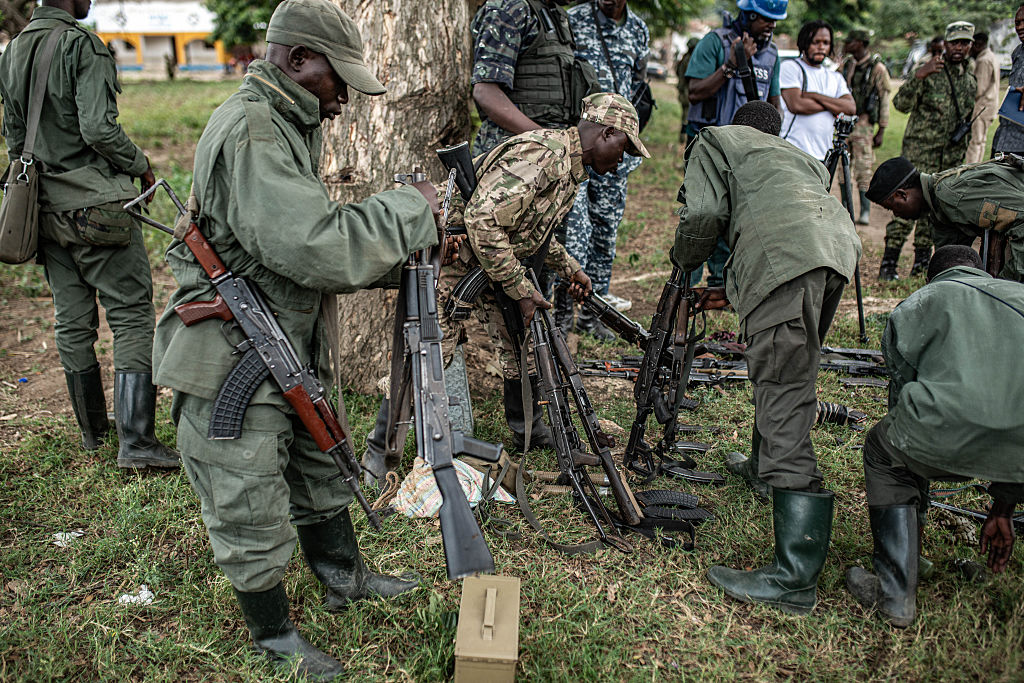
They were later convicted in Bukavu of money laundering and the illegal purchase and possession of mineral substances. They were fined $600,000, sentenced to seven years in prison and will be banned from the DRC upon their release. Their convictions confirmed that Chinese illicit financiers operate in DRC conflict zones, where the M23 rebel group fights Congolese forces, attacks civilians, and smuggles looted minerals through Rwanda and Uganda.
The M23, which gained significant swaths of eastern DRC territory in 2025, also is extensively outfitted with Chinese weapons, as noted by analyst Adam Rousselle in a story for The Jamestown Foundation think tank. However, he said, that does not mean the Chinese government is arming the M23.
“The Chinese sell vast quantities of weapons to both Rwanda and Uganda [both of which border the DRC] and, given what rebels are pilfering out of mines in the region — such as cobalt, gold, coltan — China is the natural endpoint [of the minerals],” Rousselle, editor-in-chief at Between the Lines Research, said on a China-Global South Project (CGSP) podcast. “We don’t have a causal link, saying, ‘The M23 is moving [minerals] to Rwanda, then they’re sending it out directly to China,’ but there’s enough of a global gravitational pull in that direction that says China’s the endpoint.”
In 2022, about 435 metric tons of gold was smuggled out of Africa, 93% of it bound for the United Arab Emirates (UAE). According to Rousselle, Chinese buyers were active at both ends of the supply chain. Chinese-linked syndicates also dominate rosewood and other timber exports from Central and East Africa and the Sahel, often sourcing directly from conflict zones.
“These gold and timber corridors easily provide the financial and logistical backbone for broader illicit trade, establishing flows of capital and transport capacity that could be redirected toward arms procurement or militant financing,” Rousselle wrote for The Jamestown Foundation.
In May, Amnesty International verified the presence of Chinese-manufactured weapons in Khartoum and Darfur, Sudan, despite a United Nations arms embargo on the war-torn country. These weapons were imported through the UAE. In this instance, Rousselle said he viewed China as more of a “leaky bucket” than a “malevolent force.”
“They’re leaking money, and they’re leaking goods into conflicts in a way that’s illegal,” he said on the CGSP podcast. “We know for sure that the export of Chinese weapons to these conflicts is illegal. We know that China is the largest legitimate supplier of weapons to Africa.”
On the podcast, C. Géraud Neema, CGSP’s Africa editor, said he believes the Chinese government should help local law enforcement stem the flow of weapons into war zones.
“The more you have Chinese nationals being present, the more you see Chinese weapons circulating in those areas, the more it becomes a reputational issue, and they’re going to have to act on that,” Neema said. “They can’t just sit on the sidelines and say, ‘It’s not me, it’s them.’ At some point, they’re going to have to take a stance.”
Rousselle’s Jamestown reporting also showed that Chinese illicit finance networks have embedded themselves into West African stablecoin rails. Stablecoin is a type of cryptocurrency. In July 2025, two Chinese nationals were convicted in Nigeria of fraud and money laundering. In 2024, almost 150 Chinese nationals were accused of participating in coordinated crypto fraud and laundering schemes by Nigeria’s Economic and Financial Crimes Commission.
Rousselle said there is “a lot we don’t know” about the links between Chinese nationals involved in illicit financial flows through African conflict economies.
“I want to say clearly that there’s no evidence that the Chinese government is involved in this,” he said on the podcast. “There’s no evidence, specifically, that we even have a coordinated effort across these conflict zones between the criminal actors involved. What I have found is a preponderance of evidence to indicate that actors from China are facilitating these conflicts in a way that is opportunistic and ultimately fueling them.”