
As Sahel-based terrorist groups continue to look southward to expand their territory, resources, recruitment base and illicit trafficking, officials are urging West Africa’s coastal countries and their landlocked neighbors to work together.
Across porous borders, terrorist groups linked to al-Qaida and the Islamic State are finding a foothold in the northern regions of many of West Africa’s coastal countries.
“Established groups expand their reach,” United Nations Secretary-General António Guterres said in a November 18 speech to the Security Council. “Several coastal states are under threat. We face the risk of a disastrous domino effect across the entire region.”
The Sahel has been the world epicenter of terrorism for the last two years, according to the Global Terrorism Index. More than half of terrorism deaths worldwide occurred there in 2024. Military junta leaders in Burkina Faso, Mali and Niger have lost control of huge tracts of territory to groups like Jama’at Nusrat al-Islam wal Muslimeen (JNIM).
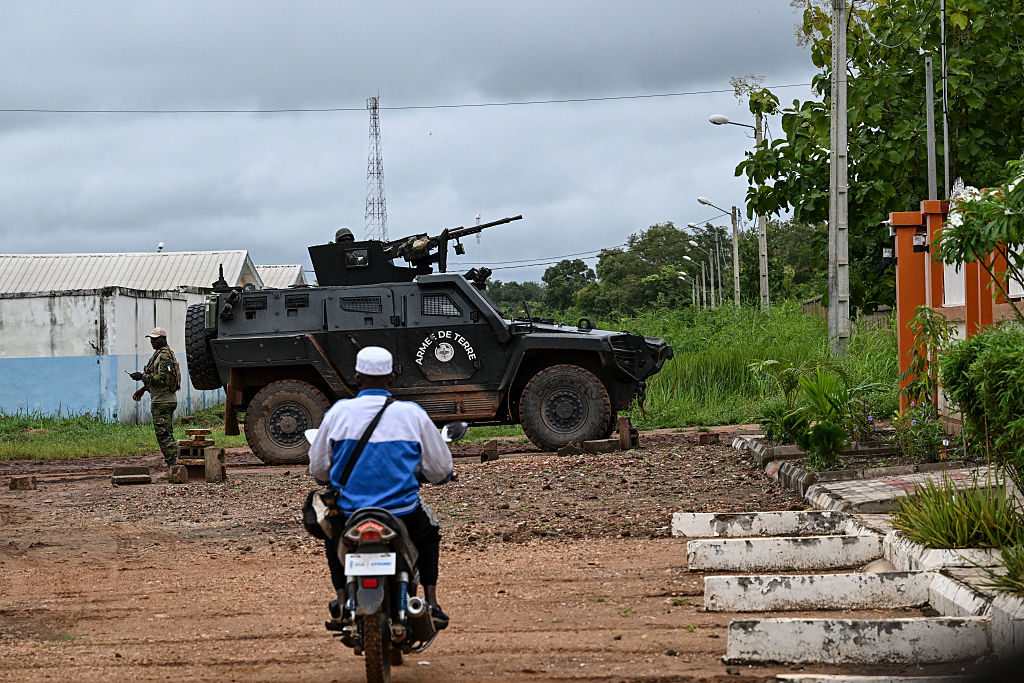
Attacks on civilians and military outposts in northern Benin are on the rise. In April, JNIM fighters killed at least 54 Beninese Soldiers along the shared border with Burkina Faso and Niger. Togo has seen its own surge of terror attacks by JNIM fighters based in Burkina Faso.
Terrorist groups have been drawn to the sparsely populated and underdeveloped areas just south of Burkina Faso’s and Mali’s borders. In these borderlands, unemployed young people make easier targets for recruiting, said Institute for Security Studies researcher Oluwole Ojewale.
“[They] continue to serve as a strategic hub for terrorist groups,” he told Deutsche Welle. “[They also] harbor strategic minerals and materials such as timber, which have become sources of terrorism financing across that corridor.”
Sierra Leonean President Julius Maada Bio, who also chairs the Economic Community of West African States (ECOWAS), called for the November U.N. briefing, entitled “Enhancing Regional Counterterrorism Cooperation in West Africa and the Sahel.”
He said the regional bloc continues to engage with Burkina Faso, Mali and Niger on the need for cooperation on counterterrorism. The three junta-led countries withdrew from ECOWAS last year to form a collective security arrangement called the Alliance of Sahel States, but terrorist violence continues to rise.
“[It’s] the reason why it has become an easy drive for those terrorist groups to actually percolate and spread their influence into the coastal states,” Ojewale said. “Cross-border intelligence, particularly between the central Sahel states of Burkina Faso, Niger and Mali, with the rest of West Africa has become really minimal and grossly insufficient to curb cross-border infiltration of terrorist groups.”
Some individual coastal countries have taken their own initiative to bolster security in their northern regions. Benin deployed some 3,000 Soldiers along its border with Burkina Faso and forged a bilateral security deal with Nigeria to strengthen border security.
Guterres, however, remains focused on reuniting West Africa. In the fight against increasingly powerful terrorist groups, he said, landlocked Sahelian countries and their coastal neighbors are on the same side.
“This regional crisis demands a regional response, one that is unified, coherent and consensus-based,” he said. “With countries leaving ECOWAS, now is the time for dialogue and collaboration among all countries to strengthen the security and political cooperation architecture in the region.”
James Barnett, a research fellow at the Hudson Institute, said resources and logistics are not enough to stem the spillover of terrorism. Despite their differences, countries need to coordinate efforts.
“There’s been a lot of mistrust in the region, I think, mistrust even between some of those states,” he told DW. “That’s something the countries are still working on — building adequate trust and the political will to work together.”
Barnett also called for whole-of-society initiatives alongside military responses. He cited Côte d’Ivoire as a good example, where the government has rolled out a host of social projects to improve unemployment and poverty while fostering trust between the military and communities.
“The state is there to more than just sporadically police the region,” Barrett said. “Instead, it’s a way of trying to gain a degree of buy-in by addressing socioeconomic concerns and be a partner in more than just the security fronts, but also in actually responding to community needs.”
Guterres also advocated for a development strategy in West Africa to address the underlying conditions that allow extremism to take root.
“Terrorists thrive where the social contract is broken,” he said. “When families are trapped into poverty and young people have no access to education or work, extremism gains ground.
“When governance fails, where development stalls, where public services break down, where human rights are violated, where communities are marginalized, where citizens no longer have faith in their institutions — terrorists are finding ways to exploit people’s grievances.”