

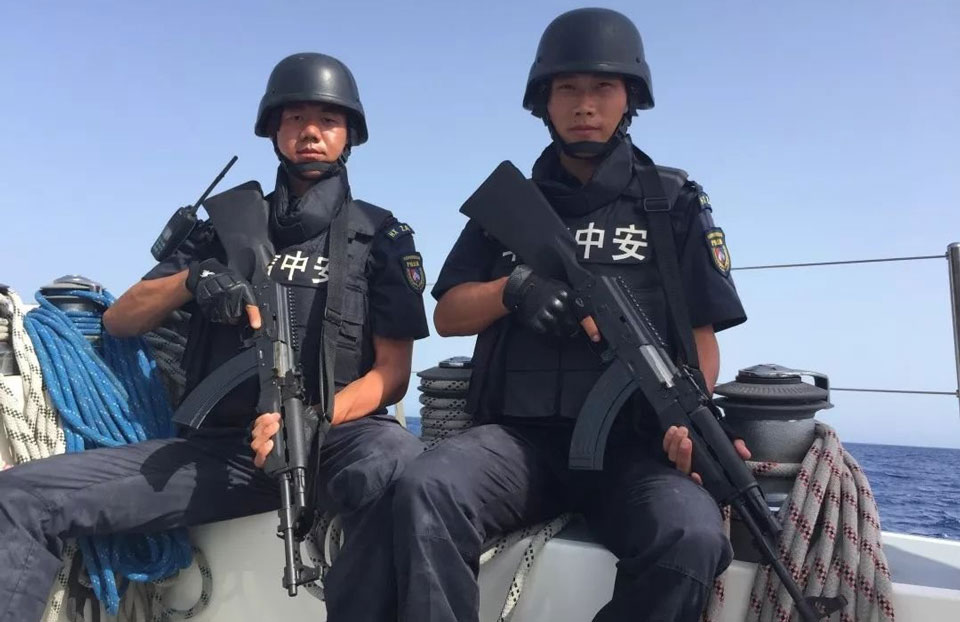
Chinese private security companies operate in at least 14 African countries, including Djibouti, Ethiopia, Egypt, Kenya and Somalia, where Beijing’s activities in East African coastal waters are coming under greater scrutiny.
Critics have condemned China’s aggressive gray-zone tactics for years, accusing the government of using the private security companies, also known as PSCs, to opaquely conduct state business, including coercive actions that fall just short of open warfare. Such gray-zone tactics now are used in African waters in the Indian Ocean, which China seeks to control.
Aritra Banerjee, a defense and strategic affairs journalist who co-authored a book on India’s Navy, says these private maritime security companies are not just commercial entities — they are extensions of China’s national strategy.
“Private security companies can operate in legal gray areas, especially in waters with fragmented jurisdiction,” he wrote in a November 18 article in Indian newspaper The Sunday Guardian. “Their presence complicates maritime governance, blurs lines between commercial and military activity and introduces a new actor not bound by the same transparency expectations as navies.
“This arrangement fits neatly with China’s doctrine of ‘military-civil fusion,’ where state and commercial entities support national security objectives jointly.”
Researchers say that most Chinese PSCs were created by former military and police personnel and are controlled by government agencies. Their main clients are large state-owned corporations.
They provide defensive services such as site security, personnel protection and risk assessments, as opposed to private military companies (PMCs), which conduct offensive operations and combat support. This distinction allows Beijing to skirt its noninterference doctrine, as the Chinese government explicitly forbids PMCs while permitting PSCs.
“The term ‘private security company’ is misleading and inaccurate in the Chinese context,” researcher Paul Nantulya wrote for the Africa Center for Strategic Studies in 2021. “As a party state, China requires all enterprises to obey party directives, hence the catchphrase, ‘as the state advances, the private sector retreats.’”
China owns at least 51% of its PSCs. Hua Xin Zhong An (HXZA) is one of the only companies that has government authorization for armed maritime escorts, which has resulted in a near monopoly on security for the country’s largest international shipping and container companies. HXZA has another rare government authorization: Its sea marshals can use lethal force in self-defense.
HXZA mentions “party building” and has a “political work” section on its website, which states that “the company has set up the post of general political commissar, the posts of political and ideological work instructors in each division of the Security Management Department, and the backbone of ideological work in the grass-roots squads (teams).”
China’s People’s Liberation Army (PLA) Support Base, established in Djibouti in July 2017, houses between 1,000 and 2,000 personnel and provides logistics for PSC maritime operations in East African waters, intelligence collection platforms, and coordination with PLA Navy anti-piracy missions.
With ongoing concerns about who these Chinese PSCs are serving, Banerjee urged African governments to consider the long-term consequences of employing or collaborating with them.
“Private maritime security is useful, but not when it becomes a backdoor for foreign influence,” he wrote. “Transparency, licensing and monitoring frameworks must evolve to prevent misuse.
“China’s new privateers are not pirates, but they navigate the same waters with far more strategic purpose. Their rise suggests a new phase in the Indian Ocean’s security landscape — one in which influence comes cloaked in commerce, and power sails under a different flag.”