

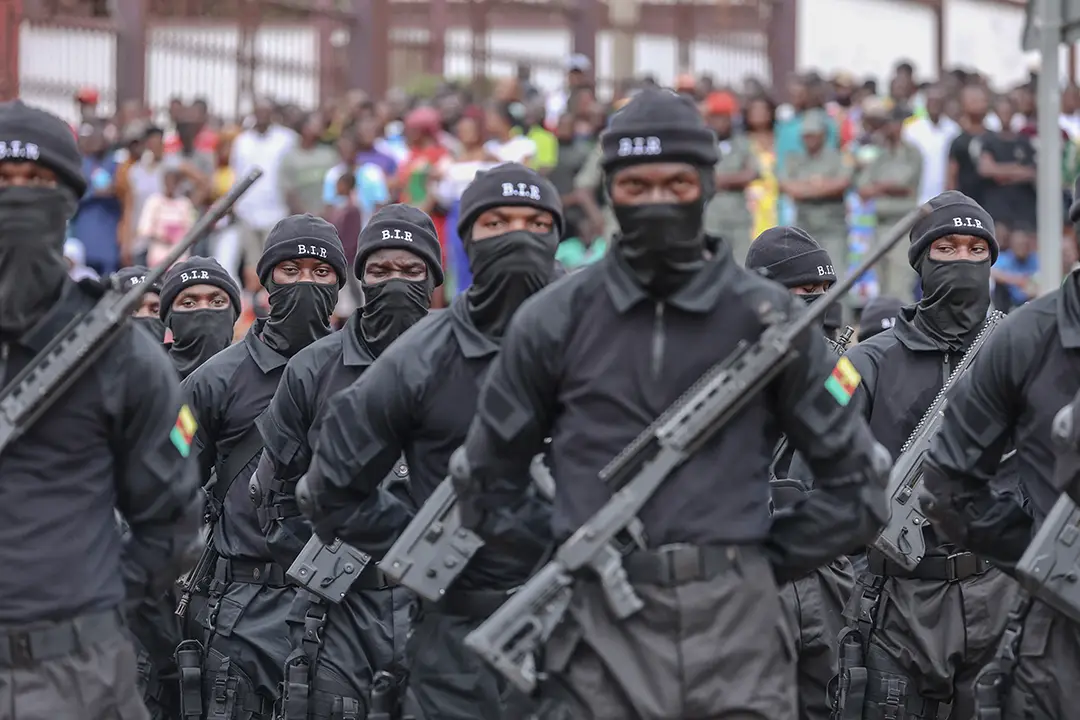
Cameroon has announced the formation a new unit of its elite Rapid Intervention Battalion (BIR) to focus on violent extremism surrounding Lake Chad. Cameroon’s Defense Minister Joseph Beti Assomo inaugurated the new unit in September.
BIR Lake Chad’s main goal is to disrupt armed groups’ logistical networks and prevent Islamic State West Africa Province (ISWAP) from expanding its foothold in northeast Nigeria into northern Cameroon, where a series of attacks in the northern towns of Bargaram, Darak N and Hilé-Alifa forced more than 11,300 residents from their homes in September. ISWAP and Boko Haram are the most active terror groups in the Lake Chad Basin.
“BIR Lake Chad signals a shift from defence to rapid reaction against incursions,” wrote Raoul Sumo Tayo, a senior researcher with the Institute for Security Studies’ (ISS) Central Africa Observatory. “But this transition also requires suitable naval resources to counter groups that have harnessed covert approaches, using papyrus tei-tei rafts combined with audacity, surprise and brutal attacks.” The handmade rafts are made by lashing together bundled reeds. They can move silently through water.
The new force seeks to establish a permanent presence in areas where jihadists have taxed locals to form economic and logistical hubs for terrorist activity, according to the Institute.
Officials established military bases at Bargaram and Hilé-Alifa to house the new force. The Hilé-Alifa base features a large barracks for rapid intervention battalions. The base has dormitories, a battalion command post, a company command post, kitchens, fuel tank, garage, police station, gym and medical center, according to Raoul Sumo Tayo, a senior researcher with the ISS’s Central Africa Observatory.
Bargaram has new dormitories, a company command post and an infirmary. Battalion Brig. Gen. François Pelene has said the new unit will be augmented by companies in Blangoua and Darak.
“While the new force may enhance immediate protection for civilians, its effectiveness hinges on achieving genuine territorial control and collaboration with neighbouring countries’ defence and security forces,” Tayo wrote.
With the addition of BIR Lake Chad, Cameroon now has four distinct military units engaged in counterterrorism efforts while numerous Cameroonian units operate under the Multinational Joint Task Force 1st Sector. Tayo said Cameroon’s primary intelligence agency, the Directorate General for External Research, police and gendarmerie, could also improve the battalion’s efforts.
However, “a significant hurdle is coordinating efforts among the various actors involved in countering terrorism,” Tayo wrote. “The lack of a unified command structure makes it hard to concentrate efforts and economise on forces.”
Remote and poorly resourced outposts are considered soft targets for terror attacks. ISWAP, particularly, has a history of attacking such bases. For more than a year, the group has tormented communities and military positions in Cameroon’s northern Darak district. A February attack on Darak Island displaced 2,000 people.
Researchers Célestin Delanga and Abélégué Alliance Fidèle say ISWAP’s expansion in Cameroon covers three districts: Darak, Hilé Alifa and Fotokol.
“With its many opportunities for cross-border trade, the whole area is strategically important to local and national economies,” they wrote for the Institute.
There is also weak state presence in the area and ISWAP spreads its propaganda at community gatherings.
“In January, the insurgents announced that Darak was part of their dawla (state) and that no military personnel were welcome,” Delanga and Fidèle wrote. “They ordered people to address them as ‘Dan mallam’ (‘sons of the Prophet’). Their efforts to persuade residents to accept their presence include playing on the community’s shared beliefs and values, such as Islam.”
Delanga reported in August that Boko Haram also is extending its reach in Cameroon by appointing an increasing number of Cameroonian fighters to senior positions. The commanders provide the group with access to local resources and information on targets for extortion and attacks.
“These leaders are able to influence internal decision making and ground operations in Cameroon,” Delanga wrote. “With their first-hand knowledge of the local context, they can plan and coordinate attacks on their home ground, recruit fighters and ensure logistical support from Cameroon.”
Under these leaders, there were 714 reported attacks last year and 227 between January and June 2026, according to the Institute.