

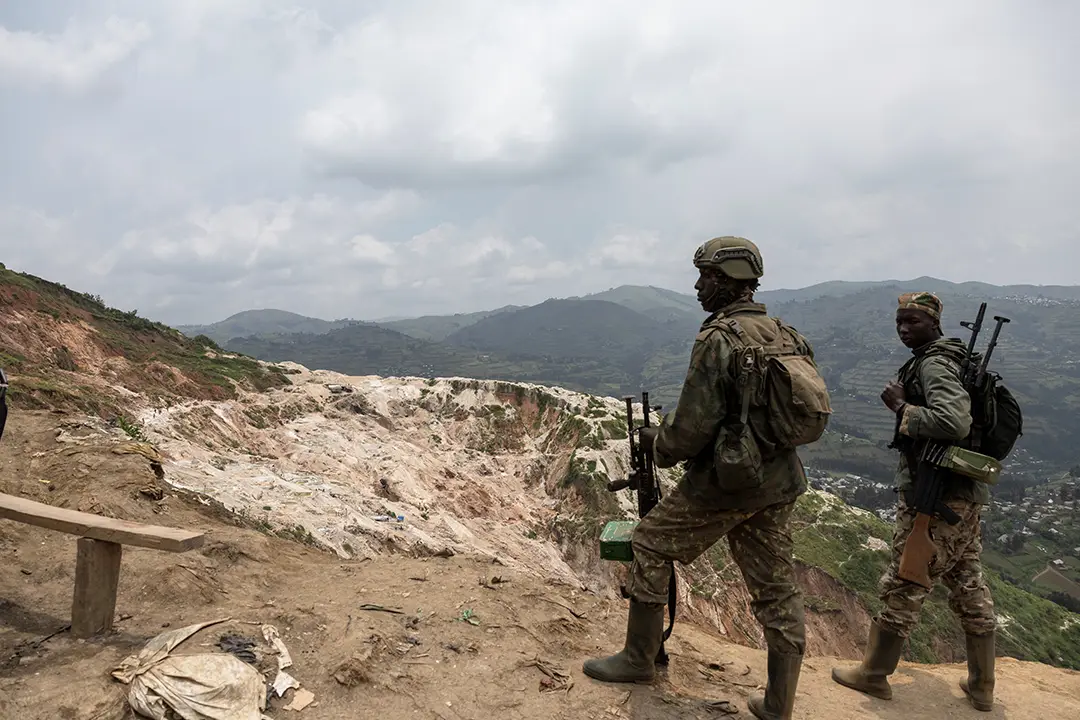
While expanding and occupying Congolese territory in recent years, the M23 rebel group has established a parallel administration, generating revenue through a sprawling network of mineral extraction and taxation.
For the citizens in eastern Democratic Republic of the Congo — from whom the M23 collects taxes on businesses, households, healthcare, transportation, agricultural harvests, even beer — the occupation is devastating.
“The M23 spoke of liberation, but economically the situation is even worse than before,” a shop owner in Goma told The New Humanitarian website for a September 14 article. “The airport is closed, there are no banks, businesses have shut, people have no money to buy … we are just surviving.”
In its occupied territories, M23 controls police departments, utilities and local government offices. An unnamed senior M23 leader estimated that the group collects around $10 million a month, according to an April 2026 report by New York University’s Center on International Cooperation.
Zobel Behalal, a researcher with the Global Initiative against Transnational Organized Crime and a former member of the United Nations panel of experts on the DRC, has visited towns and mining sites in the east for 15 years. He told The New Humanitarian that the rebels have “methodically consolidated a de facto, deeply illegal, parallel administration.”
Much of the group’s funding comes from taxes. In M23-controlled areas, motorcycle taxis and truck drivers carrying goods between towns pay fees at checkpoints. Rebels collect taxes from shops, vendors, warehouses and informal traders.
Cross-border trade into and out of Rwanda and Uganda involves taxes on fuel, timber, charcoal, agricultural goods and manufactured products. One transporter told the U.N. experts that M23 taxed his charcoal at about 25% of its total value.
Goma-based economist Pascal Ndyanabo said businesses have been forced to pay fees to register with the M23, which has been unwilling to negotiate or accept tax payments by installment.
“The biggest difference is that, previously, it was possible to negotiate or stagger payments,” he told The New Humanitarian. “Today, if you can’t pay, who will you complain to?”
Through its tax authority, the Directorate General of Finances, M23 has tried to tax humanitarian organizations and aid groups with fees on salaries, rent, travel documents and supplies. One official estimated that taxes on their organization alone could be millions of dollars.
In the Masisi health zone, M23 has forced medical and administrative staff to pay 2% of their salary as a “contribution” to facility operations.
“The way this tax is enforced borders on organized extortion,” advocacy organization Friends of the Congo wrote in a September 15 blog post. “All employees, without exception — from the medical director down to the security guard — are required to make an advance payment covering a three-month period.”
In Goma, the M23-appointed governor ended the Congolese government’s free education policy and imposed school fees of $3 to $15 per student, according to Deutsche Welle.
“That money could be used to buy food or shoes for my son,” single mother Chantal Nabintu told France 24. “Unfortunately, he may not be able to finish the year because I can’t afford it. It’s beyond my means.”
Of all the sectors M23 oversees, however, mining is by far the most lucrative. By September 2025, the rebels had seized 45 sites, including gold mines in South Kivu and the world’s biggest coltan mine in Rubaya, North Kivu. Coltan is an essential mineral for manufacturing electronic equipment. M23 collected at least $800,000 in monthly taxes on miners and traders who export more than 120 metric tons of coltan a month. The miners’ salaries reportedly were doubled to encourage them not to flee.
In the town and at the mining sites, armed rebel fighters ensure that coltan is only sold to M23-authorized operators. “Offenders” are arrested and detained in the town of Mushaki, an hour away.
Competition for natural resources has characterized decades of conflict in eastern DRC, Kinshasa-based economist Dady Saleh said.
“Let there be no mistake. The wars we have been experiencing for 30 years in the eastern region of the country are, above all, economic in nature,” he told Al Jazeera. “The DRC’s natural resources have been plundered for decades, both before and after independence. Today, that plundering has intensified and increasingly takes place through proxy actors.”