

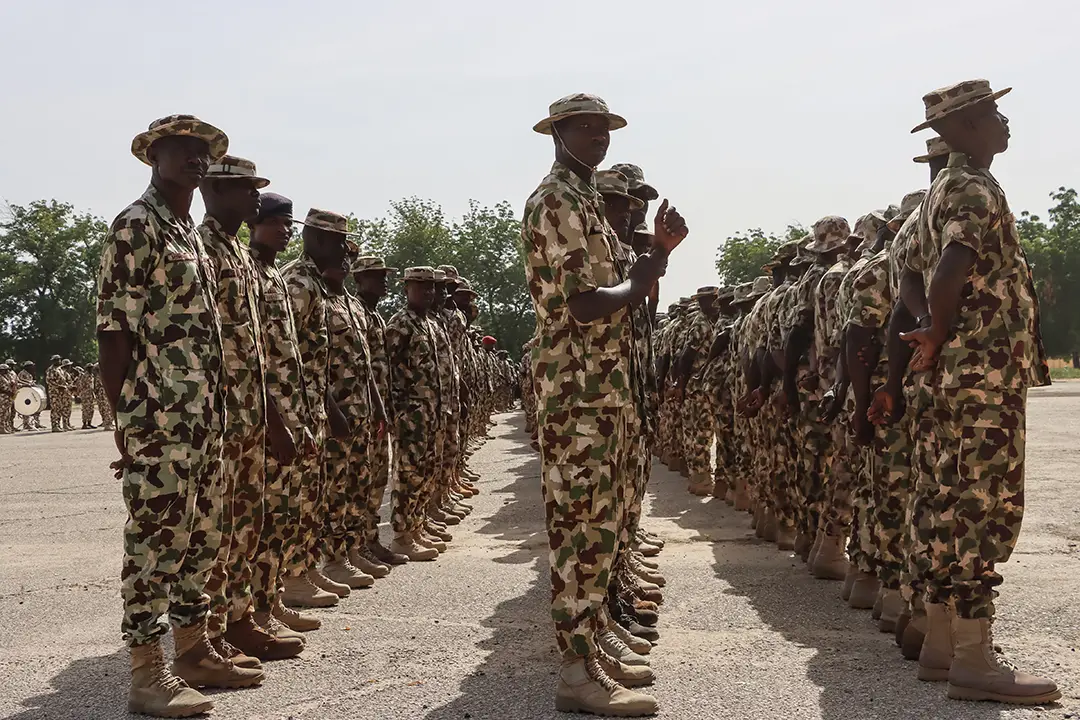
The most populous country on the African continent faces challenges including porous borders, illicit trafficking, highly organized terrorist groups and banditry. Not surprisingly, leaders concerned with insecurity have celebrated plans for a major expansion of the military.
“We wholeheartedly welcome this development,” the Nigeria Governors’ Forum said in a July 24 statement praising the creation of four new Army divisions and the recruitment of 28,000 additional Soldiers and 50,000 police officers.
Part of a five-year Strategic Defence Operations Plan, the Army also is building facilities in Osun and Ebonyi states that can accommodate 6,000 recruits at a time, while the government is investing in weapons and equipment modernization and improved operational readiness.
But experts question whether additional troops will translate into long-term gains without fundamental security sector reform.
Former Director of Army Public Relations and retired Brig. Gen. Sani Kukasheka Usman said expanding the Army was overdue considering the size of the country, its population and the evolving threats it faces.
“The Nigerian Army has consistently expanded its capacity over time,” he told Arise News for a July article. “The establishment of additional training depots in Oshogbo [in Osun State] and Amasiri, Ebonyi State, makes it only logical that this growth should be matched by a corresponding expansion in the Army’s order of battle. This is a welcome development that will undoubtedly strengthen the Army’s operational capability.”
But Usman warned that expanding the force will require important logistical and administrative considerations.
“While the recruitment of 28,000 additional personnel is commendable, careful attention must be paid to the costs of training, kitting, accommodation and sustainment,” he said. “Many serving soldiers deployed across various theatres of operation are still awaiting adequate accommodation, while the construction of barracks, procurement of equipment, training and armament will require substantial investment.”
Matthew Page, a Chatham House associate fellow in the Africa Program, agreed that the expansion of Nigeria’s armed forces has been long overdue, citing recent estimates of around 100,000 active personnel in a country of more than 240 million people.
“Stationing more soldiers outside of their traditional garrisons, especially in rural areas, would help protect vulnerable civilian targets and make it easier for the army to locate and eliminate remote safe havens used by bandit gangs and insurgent groups,” he wrote in an August report. “Meanwhile, a greater military presence along Nigeria’s porous borders could improve operational coordination and intelligence sharing with army units in neighboring Benin, Cameroon, Chad and Niger.”
But, Page said, President Bola Tinubu’s bigger Army won’t necessarily be better.
“Tinubu’s expansion plan does not address many of the army’s institutional challenges; a list that includes lacklustre leadership, poor operational planning, inadequate training, equipment shortfalls, endemic corruption and a dire human rights record,” he wrote, adding that “it also remains to be seen whether the creation of new divisions, brigades and battalions will increase the army’s operational capacity, or just make it even more top heavy.”
Along with expanding and investing, Page said Nigerian leaders should look to reform and “consolidate Nigeria’s sprawling security apparatus which now consists of an alphabet soup of security agencies that perform poorly and compete more than they cooperate.”
Consolidation also could make room in the budget for the constitutional establishment of state police, which passed all 32 state assembly houses on November 16.
“If trained and resourced effectively, state forces could work with the federal police to relieve the army of routine internal security duties, freeing troops up to tackle some of Nigeria’s toughest security challenges,” Page wrote.Nigeria, Army, terrorism, insurgency, kidnapping, SSR