

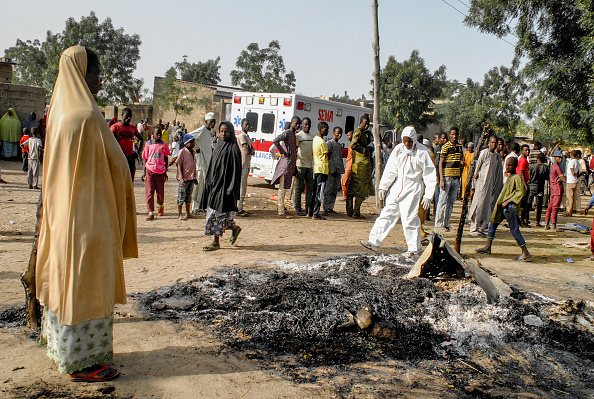
Boko Haram’s first female suicide bomber killed herself and a Nigerian Soldier in 2014 at a barracks in Gombe State. Since then, Boko Haram has deployed more female suicide bombers than any other terror group in history, conducting a form of asymmetric warfare that analysts say has a deep psychological impact on communities.
The attacks have killed thousands of civilians in Nigeria and hundreds of female bombers.
“Notably, many of these attacks involve coercion, with abducted women and girls forced into suicide missions, often without their full awareness,” analyst Usman Anwar wrote in The Diplomatic Insight. “This represents a significant departure from earlier cases where ideological commitment or personal motivation played a central role.”
Boko Haram is not alone in using female bombers. Its offshoot, Islamic State West Africa Province (ISWAP), began using female suicide bombers in 2015. In 2019, Somalia’s al-Shabaab recruited a female municipal employee to kill the mayor of Mogadishu in a suicide bombing. In 2025, a woman with Islamic State Central Africa Province attempted a bombing while riding a motorcycle taxi on the outskirts of Kampala, Uganda.
“By weaponizing women and young girls, traditionally viewed as non-combatants, Boko Haram disrupts cultural expectations in ways that reverberate within affected communities,” Victoria Maldonado wrote for Georgetown University’s Security Studies Review. “This tactic undermines the perception of safety within traditionally feminine spaces, such as homes, schools, and markets, turning places of refuge into sites of potential violence.”
Historically, men have dominated the planning and execution of terrorist attacks. By deploying female bombers, terror groups exploit social norms that cause security forces to view women with less suspicion. Terror groups take advantage of this by directing women to hide explosives in their robes or beneath their hijabs.
“This trend not only challenges security frameworks but also raises profound ethical dilemmas about agency and coercion in violent extremism,” Maldonado wrote. “The incorporation of women into terrorist activities complicates the narrative of victim and perpetrator.”
While some women commit suicide bombings voluntarily, many are forced to do so against their will, she added. Sexual and mental abuse are often used to break down women psychologically and destroy their social standing so that suicide becomes an avenue to escape the shame.
Analysts are divided on the significance of the recent surge in female suicide bombers. Some see it as the last option of terror groups employing “shock value” as they face significant losses on the battlefield. Others see suicide bombings as an indicator of a group’s strength, such as ISWAP’s growing presence in the Lake Chad Basin.
The threat of female suicide bombers puts security forces into an untenable position: If they allow the bomber to slip through undetected, people die. If they kill a suspected bomber, they create a propaganda incident for the group that sent her, according to analysts.
Female bombers can also be used to shame men reluctant to commit to such actions, according to Anwar.
“This aligns with the concept of the ‘propaganda of the deed,’ where the symbolic impact of an attack is as important as its physical consequences,” Anwar wrote.
Security experts may be able to use advances in surveillance and artificial intelligence to detect female suicide bombers early, reducing the risk to civilians and avoiding the propaganda victory terrorists seek, Anwar added.
“Militant groups are likely to adapt by exploiting new vulnerabilities, particularly those rooted in social and cultural norms,” he wrote. “The continued evolution of this phenomenon underscores the adaptive nature of non-state actors in asymmetric warfare.”