

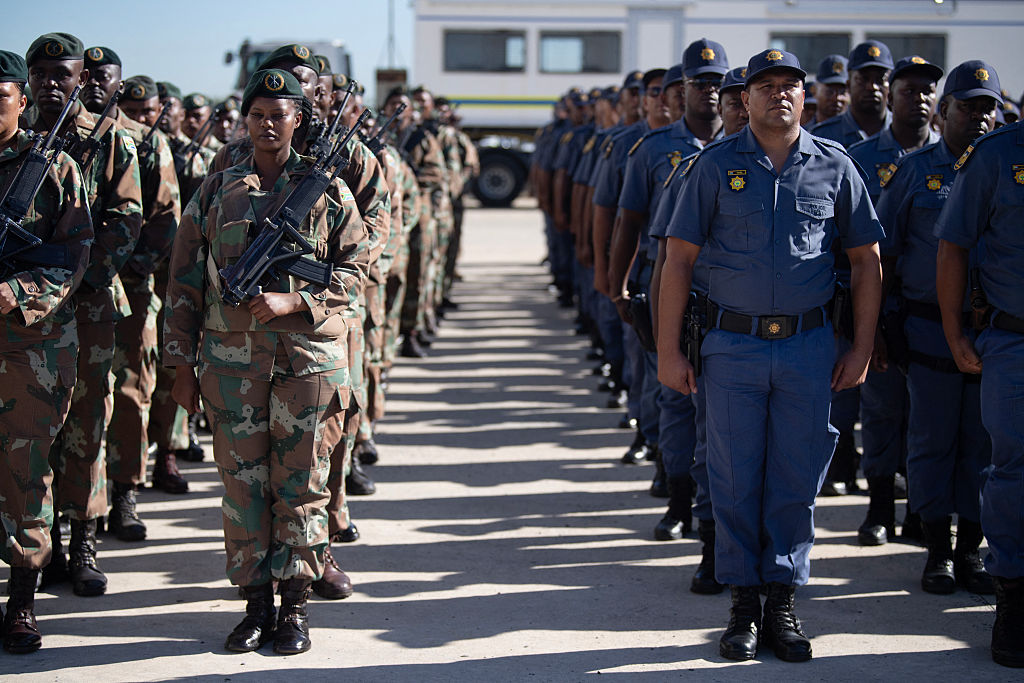
Facing rising crime, South African President Cyril Ramaphosa authorized a sweeping domestic deployment of military forces to support police operations in five provinces.
He called the South African National Defence Force (SANDF) a “force multiplier” in assisting the South African Police Service (SAPS) with Operation Prosper, which seeks to combat gang violence, extortion syndicates and illegal mining in the Eastern Cape, Free State, Gauteng, North West and Western Cape provinces.
“We are getting the police and the army to work together to handle the challenges our people are facing,” Ramaphosa told parliament on March 13. “The SANDF deployment is necessary to complement the efforts of the SAPS in tackling these crimes and bringing stability to our communities.”
An initial group of 550 Soldiers deployed for three months on January 30 to several parts of Gauteng province, including Johannesburg. Resident Leola Davies described her Johannesburg suburb, Eldorado Park, as a “hellhole.”
“Sodom and Gomorra have nothing on this place,” the 74-year-old pensioner told the BBC for an April 1 article. “I stay indoors all day because I just don’t want to be the next victim. Things are getting worse.”
A second, larger contingent of 2,200 troops began a one-year deployment on April 1 to help with operations in the Eastern Cape, Free State, Gauteng, North West and Western Cape provinces. The initial deployment reportedly cost $4.9 million, while the main deployment will cost just over $50 million for the next year.
Gang violence is a major problem in South Africa, which has one of the world’s highest murder rates. According to the most recent crime statistics, from October through December 2025, about 71 people were killed each day.
“We are losing between 26,000 and 30,000 people to murder every year. That is a crisis that cannot be ignored,” Portfolio Committee on Defence and Military Veterans Chairperson Dakota Legoete said on February 25.
Brig. Gen. Martin Gopane, director of SANDF’s Joint Operations Division, said the deployment will tackle “complex organized crime threats.” The operation’s success will depend on actionable intelligence, specifically in identifying and locating leaders of organized criminal groups rather than focusing on low-level operatives.
“We are not looking for a man on the ground but we’re looking for the kingpins so that we can go identify him, know him — I know where he is, I pounce onto him,” he said in a March 27 briefing before parliament.
Ramaphosa has said the deployment already has brought some much-needed stability and is rebuilding trust within communities and law enforcement. In the Western Cape, police spokesperson Brig. Novela Potelwa said Operation Prosper the effectiveness of SANDF troops will only increase over time.
“We undertake to act decisively on all intelligence shared with the integrated forces,” she told reporters on April 7. “At the same time, a review of the crime landscape indicates that much still needs to be done to stabilize these problematic areas.”
Andy Mashaile, a South African security strategist and retired Interpol ambassador, said SANDF and the Police Service must continue to strengthen intelligence gathering, and the government should maintain oversight to avoid any friction between institutions.
“There is no other way that you will win this war on crime and criminality and transnational organized crime, without intelligence-led operations,” he told Deutsche Welle.
Some security experts have cautioned that deploying the military in this manner must be done carefully. Criminologist Guy Lamb said Soldiers are trained for combat and “not designed to engage in policing.”
“There’s danger that they will escalate situations or respond very aggressively in … tense situations,” he told the BBC.
SANDF’s deployment during the COVID-19 pandemic was intended to help enforce nightly curfews and other restrictions, but harsh criticism followed reports of Soldiers using excessive force, unlawfully detaining and harassing civilians.
Lamb called for a dedicated plan to address the drivers of crime in these communities so crime does not resume once the SANDF leaves.
Others have said that the goal should be a short-term stabilization of the affected areas so SAPS can regain control.
“If the deployment is well planned and carried out with proper controls and discipline, it could provide people with a little breathing space, and buy some time for the police to start implementing the plans they say they have,” wrote Mike Pothier, program manager for the Southern African Catholic Bishops’ Conference Parliamentary Liaison Office in an article for defenceWeb. “If that happens, then perhaps the deployment could be considered worthwhile despite the many concerns.”