
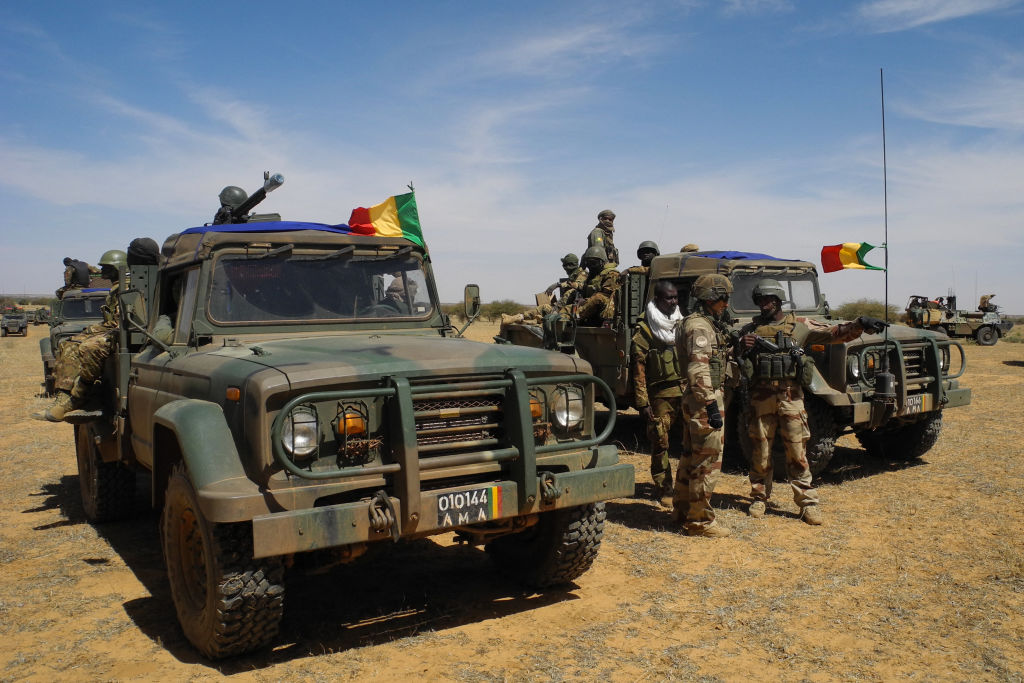
The Alliance of Sahel States’ new Unified Force (AES Unified Force) seeks to strengthen counterterrorism efforts in Burkina Faso, Mali and Niger — an embattled region where past coordinated efforts have failed.
Launched in December 2025 by the three countries’ ruling military juntas, the Unified Force faces profound challenges posed by the al-Qaida-affiliated Jama’at Nusrat al-Islam wal-Muslimin (JNIM), Islamic State Sahel province (ISSP), among other terror groups and armed militias. The force increased from 5,000 to 6,000 troops in February, amid rising violence against civilians in the three countries.
“We are aware that the [terrorists] benefit from material, financial, weapons and very high-tech intelligence support,” Gen. Abdourahamane Tchiani, leader of Niger’s military junta, said at the time on Nigerien state television. He added that force was also reorganized “so that it can face any eventuality.”
The G5 Sahel Joint Force was the most recent effort by the central Sahel states to establish a joint security mechanism. The G5 force, which included troops from Burkina Faso, Mali, Mauritania, Niger and Chad, was established in July 2017. It faced critical challenges, including funding shortages, logistical constraints and limited operational capacity, before it disbanded in December 2023.
While some analysts warn that the AES Unified Force may face similar issues, others, such as Leylatou Saidou Daouraand Rahinatou Leïla Salia with the Institute for Security Studies note key differences between the forces. The G5 Sahel Joint Force was heavily dependent on outside funding sources for support and conducting joint military operations, which limited the Sahelian countries’ autonomy. The AES states’ force uses money from Burkina Faso’s Patriotic Support Fund, Niger’s Solidarity Fund for the Safeguarding of the Homeland, and Mali’s Support Fund for Basic Infrastructure and Social Development Projects. The countries are also working to prevent the force from becoming overly dependent on a single external country for support.
As noted by Daoura and Salia, G5 force battalions were confined to designated geographic sectors, with pursuit rights limited to a 100-kilometer radius on either side of national borders. The AES force intends to operate across all three countries.
“Headquarters has full operational authority over the troops, allowing it to deploy and move troops without prior approval from national general staffs — a major structural constraint for the G5 Sahel,” the analysts wrote.
Unlike its predecessor, the AES force may be strengthened by member states’ determination to preserve sovereignty and from strong political alignment and close coordination among the three governments, according to Daoura and Salia. They say the force will likely try to replicate the efforts of a 2025 tripartite operation in the Liptako Gourma area, where the three countries’ borders meet. Several fighters affiliated with the IS were killed and four arrested in Niger’s Tillabéri region during Operation Yereko 2 in March 2025.
The AES force’s “effectiveness will depend on its ability to cooperate with the armies of neighbouring states — many of which also face threats of violent extremism and crime networks,” Daoura and Salia wrote. “Channels for the illicit supply and smuggling of operational resources (weapons, motorcycles, fuel, drones, etc.) to armed groups cross many borders in the region.”
Violence in Burkina Faso, Mali and Niger has increased since coming under military control between 2022 and 2023, exacerbating already dire humanitarian conditions. Now, terrorists are increasing pressure on the capitals of all three countries.
On January 29, the ISSP attacked the airport in Niger’s capital, Niamey, where the alliance is headquartered. According to the Armed Conflict Location & Event Data project, the attack was the terror group’s first use of drones in Niger. JNIM has imposed a months-long fuel blockade on the Malian capital of Bamako.
Burkina Faso was ranked the country most affected by terrorism globally by the latest Global Terrorism Index. Since Capt. Ibrahim Traoré seized power in Burkina Faso in 2022, terrorists have killed an estimated 87% more civilians than in the preceding three years and operate with relative freedom in up to 80% of the country. Government-aligned forces reportedly have killed up to 132% more civilians than in the preceding three years, the Atlantic Council reported in February.