

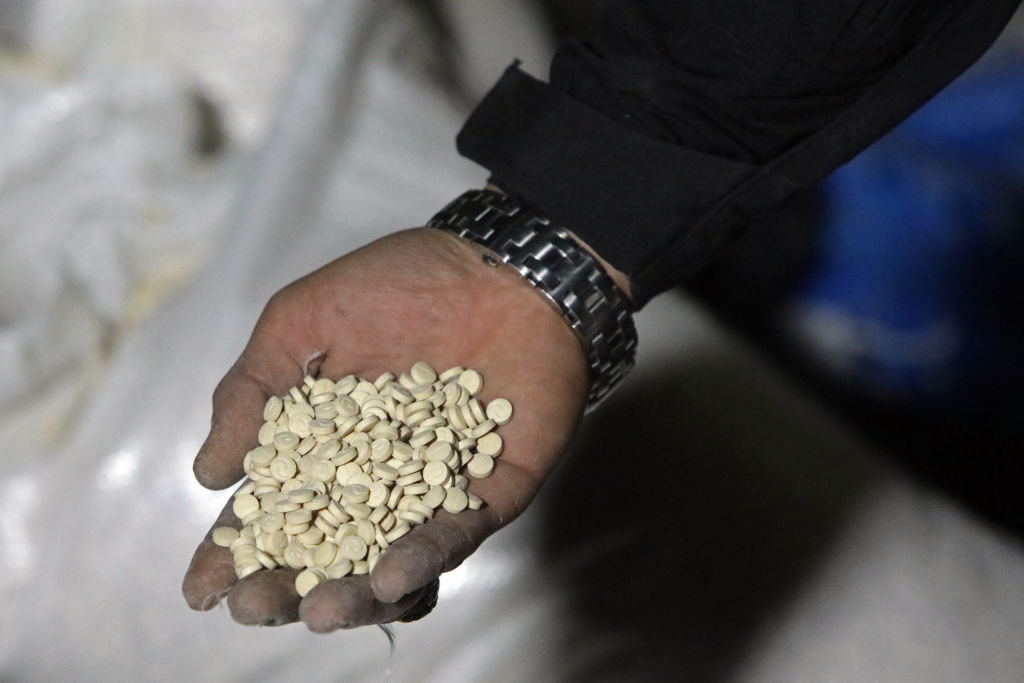
Since Sudan’s civil war erupted in April 2023, the production of synthetic drugs such as Captagon, a highly addictive, amphetamine-like stimulant, has drastically increased.
Once considered a transit corridor for illicit drugs, Sudan’s emergence as a manufacturer of Captagon coincided with the 2024 fall of Bashar al-Assad’s regime in Syria, where about 80% of the world’s supply of the drug was once produced.
A report by the New Lines Institute for Strategy and Policy shows that Sudanese Captagon manufacturers have increased their production capacity. In June 2023, Sudan’s General Administration for Drug Control seized a manufacturing site in the Blue Nile region that could produce around 7,200 pills per hour. In February 2025, Sudanese authorities dismantled a production facility in a northern Khartoum suburb that was able to produce 100,000 pills per hour. That laboratory’s equipment was similar to those found in Syrian Captagon busts.
The Sudanese Armed Forces (SAF) last year uncovered several Captagon facilities after reclaiming Khartoum from the rival paramilitary Rapid Support Forces (RSF).
“For armed actors, particularly the RSF, which previously controlled areas where major laboratories were discovered, synthetic drug manufacturing represents a logical extension of existing illicit revenue portfolios that include gold smuggling, cross-border trade, and checkpoint taxation,” the Sudan Transparency and Policy Tracker (STPT) reported.
Captagon users may experience hallucinations, aggression and addiction issues. It is said to be popular in war zones and has been described as “chemical courage” for giving combatants focus, energy and endurance. Most drug users in Sudan are young people with high usage also reported among RSF and SAF fighters, according to the STPT. The drug is made with fenethylline, a synthetic amphetamine-type stimulant that is illegal in many countries. Captagon and other synthetic drugs in Sudan are typically produced in contested areas with no unified authority, enabling illicit activities by armed groups.
“Synthetic drug production and trafficking offers an attractive opportunity for those groups, given its relatively simple production process that requires little scientific expertise, cheap and easily accessible chemical inputs, a low-profile manufacturing process that helps dodge interdiction, and high yield of pills,” analysts Caroline Rose and Rafaella Lipschitz wrote for the New Lines Institute for Strategy and Policy. “The war has strained the resources of Nonstate militias and state-sponsored paramilitary groups, prompting them to seek new ways to generate income.”
Captagon and other illicit drugs, including cannabis, crystal methamphetamine and heroin, are imported and exported from Sudan via the Red Sea and through the porous borders of the Central African Republic, Chad and Libya. Production of synthetic drugs typically requires limited land, minimal labor and relatively small facilities, allowing armed groups to produce large quantities quickly.
Synthetic drug production is “based on precursor chemicals, pill presses, laboratories, and protection from armed groups,” researcher Tsega’ab Amare wrote for the Ethiopian Horn Review. “In an environment where central state authority is weak or nonexistent, these conditions can be met with remarkable speed. Sudan’s civil war has created the ideal conditions for a laboratory-based narcotics frontier.”
Due to traumatic wartime and migration experiences, family separation and other factors, drug use is reportedly high in Sudanese displacement camps. Rafeeda Abubakr, her husband and son Muaz recently returned home to Khartoum from a displacement camp in White Nile State. At the camp, Muaz befriended a group of young men and became addicted to “ice,” a methamphetamine variant.
Once a cheerful civil engineering student at the University of Sudan, Muaz’s addiction made him ill-tempered and driven to seclusion. Throughout Sudan, access to medical care has been severely limited by attacks on hospitals and medical centers. In Khartoum, Rafeeda found the Al-Tijani Al-Mahi Hospital for Psychiatric and Neurological Diseases. The hospital was set to be demolished in 2024 due to damage sustained in the war but was rebuilt by volunteers.
“We heard the hospital had reopened and launched an initiative for war patients, people with trauma and addiction,” Rafeeda told Al Jazeera. “Since November, we have been coming every two weeks. The treatment is free, and I can feel my son is improving a little. That has brought me some relief.”
While antidrug efforts have been impaired by the war, Sudan in January recorded one of its largest-ever drug busts when antismuggling operations seized nearly half a ton of narcotics after a pursuit on the Red Sea. The haul included 384 kilograms of crystal methamphetamine, 27 kilograms of heroin, 42 bags of liquid narcotics and 15 bags of khat, a stimulant derived from a flowering evergreen shrub grown in East Africa and on The Arabian Peninsula.