

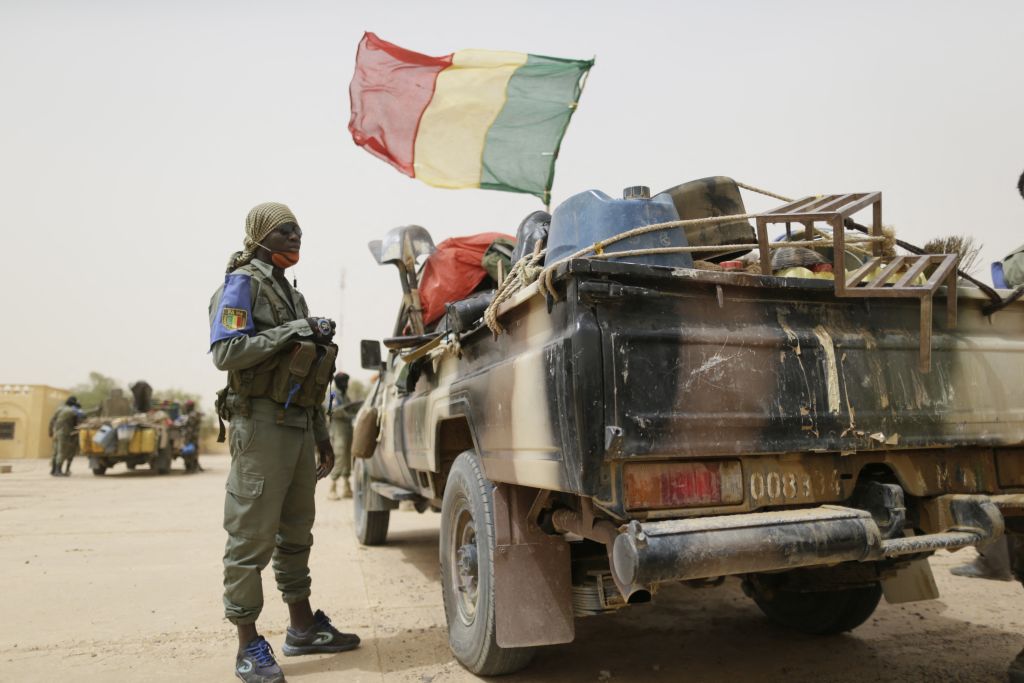
About a dozen Malian soldiers and Russian mercenaries died in a recent ambush by terrorists near the city of Nampala near Mali’s border with Mauritania.
Al-Qaida-aligned Jama’at Nusrat al-Islam wal-Muslimin (JNIM) took credit for the attack near the community of Louguel in early March that killed at least 11 people, including three mercenaries with Russia’s Africa Corps. The ambush followed the deaths of seven Malian civilians killed by the Malian Armed Forces and Africa Corps a few days earlier.
According to reports, soldiers and mercenaries encountered a group of unarmed Malian civilians on March 6 driving from Fassala, Mauritania, to a weekly fair in Tenenkou, Mali. The group was living in Mauritania, where more than 100,000 Malians have sought refuge from the violence sweeping their country. The soldiers and mercenaries stopped the vehicle in the Ahl El Kory area close to the Mauritania border.
A survivor of the encounter told Radio France Internationale that seven passengers fled the vehicle. Six were shot at close range by Malian and Russian forces. A seventh had their throat slit. The bodies were left where they fell.
The survivor reported that the seven people killed were members of the Fulani ethnic group, a population that has been targeted by Africa Corps and its predecessor, the Wagner Group, as presumed terrorists.
The Louguel attack followed a February incident in which military and mercenary forces killed four civilians in the Ankobo and Boundou-Boundou communities near Nampala. JNIM’s Nampala ambush was “a reaction to abuses against civilians in the area and possibly to some JNIM fighters killed,” Heni Nsaibia, a researcher on the Sahel for the Armed Conflict Location & Event Data, told RFI.
JNIM’s retaliatory attacks against the Malian Army and Africa Corps mercenaries are escalating the violence and human rights violations along Mali’s border with Mauritania. In late March, Malian soldiers crossed the border into Mauritania’s Hodh el-Gharbi, where they arrested and killed five civilians near the community of Yélimané.
Malian authorities claimed the action was part of a counterterrorism operation. Mauritanian authorities have accused Mali and the Russian mercenaries repeatedly of targeting their citizens as terrorists.
JNIM has presented itself in propaganda as the defender of Fulanis across the Sahel. While JNIM has Fulani members and recruits people from that community, Fulanis are often the victims of JNIM’s abuse in areas outside government control.
Fulanis were the primary target of the 2022 Moura massacre during with Malian soldiers and Wagner Group mercenaries executed more than 300 unarmed men at a market in central Mali. Since then, Malian and Russian forces have executed or disappeared hundreds of Fulanis in dozens of incidents across the country, according to Human Rights Watch.
“Mali’s military junta is ultimately responsible for the summary killings and enforced disappearances by the army and allied fighters,” Ilaria Allegrozzi, senior Sahel researcher at Human Rights Watch, said in a statement. “The junta needs to end the abuses, make the whereabouts of those detained known, investigate and hold those responsible to account.”