

With an exclusive economic zone estimated at 160,000 square kilometers, the financial health of the Comoros Islands is linked to the water. However, all eyes were on the sky on January 23, when a contingent from the United States Navy arrived on two MV-22 Ospreys and a KC-130 Hercules transport aircraft for an exchange of military expertise.
Comorian Minister of Defense Youssoufa Mohamed Ali and Brig. Gen. Youssouf Idjihadi, chief of the Defense Staff of the National Development Army, were on hand in the capital, Moroni, to meet with U.S. Brig. Gen. Matthew W. Brown, commander of the Combined Joint Task Force-Horn of Africa, based in Djibouti.
Ali declared that the U.S. Navy’s visit was of major strategic significance “in a regional context marked by the rise of transnational threats and the growing importance of maritime security in the southern Indian Ocean.”
He praised the military exchange’s focus on interoperability and underscored his country’s growing partnership with the U.S., saying that the four-day collaboration will help raise the skill level of the Comorian military.
“This exercise, based on the sharing of expertise, experiences and know-how, reflects the common desire of our two countries to strengthen their military cooperation and interoperability in a professional and structured framework,” he said to local media. “The skills acquired will sustainably strengthen the operational effectiveness of our forces, their ability to anticipate and their ability to fulfill the missions entrusted to them in the service of the nation.”
The two contingents gathered at Itsoundzou Training Center, the primary base for Comorian Soldiers, 15 kilometers from Moroni. The exchange focused on identifying the different systems operated by Comorian and U.S. units so that they can improve interoperability in common maritime security goals such as counternarcotics, countertrafficking, counterillegal migration and Comorian participation in multilateral security efforts on and around the continent.
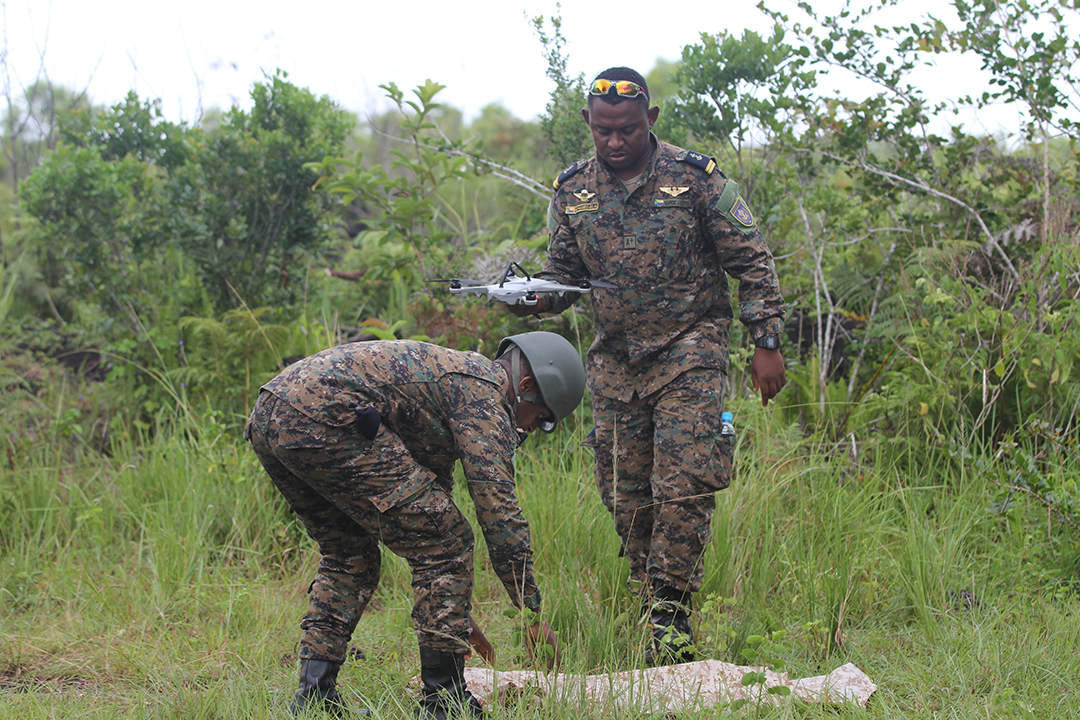
Demonstrations included tactical combat casualty care, tactical drone operations, mortars, snipers, machine-gun firing, medical evacuations and aerial communications. Simulated intervention exercises occupied a significant portion of the four-day training session, which involved units of the Comorian National Gendarmerie, the Comorian Coast Guard and the General Directorate of Civil Security.
“We are very pleased to be here to express our willingness to work with the Comorian forces on several aspects related to maritime security and the fight against trafficking,” Brown said. “This willingness is not new. We have been working on this subject for years. But this time, we are taking another step in this willingness to work with all countries in the region to better address the various threats.”
Lt. Cmdr. Sephora Fortune, head of the U.S. military group in Madagascar and the Comoros, led the U.S. forces’ demonstrations and praised the partnership with Comoros, which focuses on combating drug, arms and human trafficking, and illegal fishing.
“Illegal maritime activities, including irregular migration and illegal fishing, weaken economies, fuel insecurity and threaten sovereignty,” she said. “They fuel criminal networks, destabilize coastal communities and erode public trust in governance.”
Ali said he was pleased with high-level discussions in Moroni on the prospects for military cooperation between Comoros and the U.S. Talks also addressed the strategic and operational role of Comorian forces in securing the southern Indian Ocean.
“The Union of the Comoros reaffirms its commitment to strengthen international cooperation, based on mutual respect, the sharing of expertise, and the building of sustainable capacities in the service of peace and security in the Indian Ocean,” he said.
“Discussions focused on assessing the priority needs of the Comorian defense and security forces, particularly in maritime surveillance, securing maritime borders and strengthening operational capacities adapted to the realities on the ground. We hope that this cooperation will continue and be further strengthened in the service of peace, security and the stability of our country and the region.”