

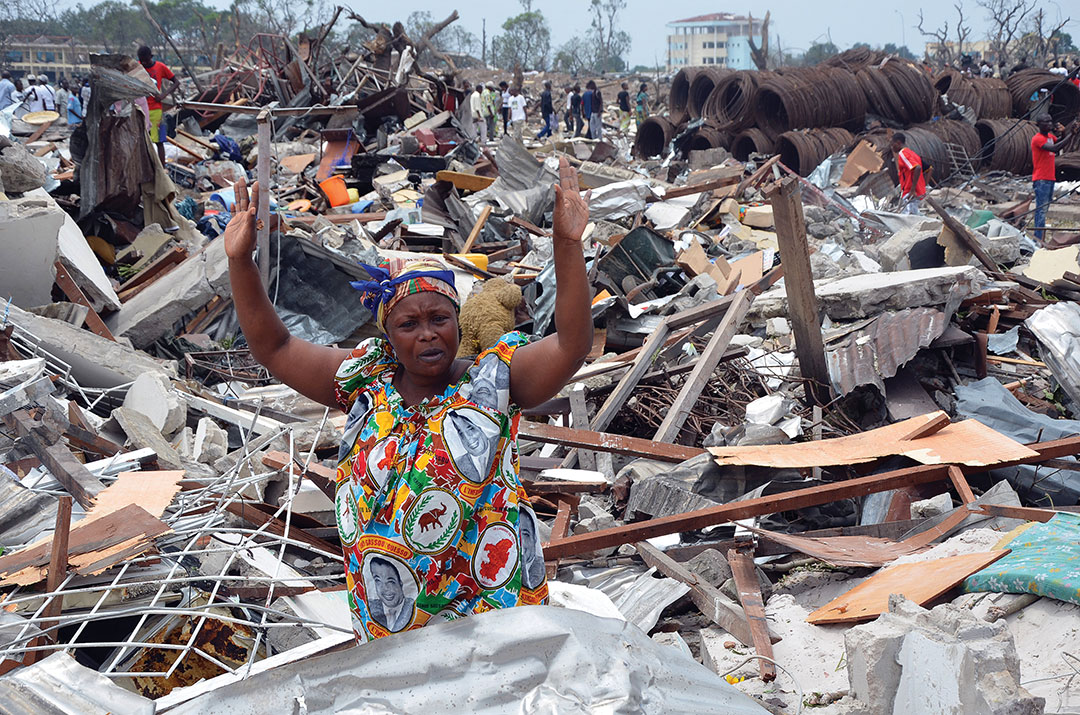
Just before the sun began its evening retreat in the skies over Lagos, Nigeria, on January 27, 2002, a fire broke out in a city market near Isolo and Onigbongo districts, north of the urban center.
The blaze soon grew and spread to the adjacent Ikeja Military Cantonment, the city’s largest such facility. Heat and flames ignited ammunition in the encampment’s weapons storage depot. As bullets popped, some feared yet another military coup was unfolding.
Then the explosions started. Bombs and artillery rounds detonated, sending shells and mortars into thousands of homes, raining fire, shrapnel, destruction, and death on thousands of terrified and unwitting civilians.
Thunderous blasts shook the ground up to 32 kilometers away. Windows shattered up to 16 kilometers from Ikeja. But panic was the most destructive force unleashed that day. As tens of thousands tried to flee, hundreds became trapped at the edge of the Oke Afa and Pako canals. Many leaped into the water. Swelling crowds pushed in hundreds more.
After midnight, the explosions stopped. As dawn broke, fishermen and rescuers trawled the canals for bodies, hauling them in with poles and dragging them ashore. Kazeem Kasali, leader of a fishermen’s rescue team, told The Guardian newspaper that he personally recovered 84 bodies. His team pulled out more than 300.
“I am looking for my children. I have been here since the morning,” Shola Odun, a printer, told Agence France-Presse (AFP) the day after the disaster. “They have been pulling the bodies out of here since first thing. They are taking them away. I am looking for my children, my relatives, there are more than 580 bodies. One man here lost six of his children. He found them. He is dying.”
 Prevalent and Preventable
As the sun crept back and the final flames had breathed their last, more than 1,000 people — many of them children — had perished in what remains the deadliest weapons depot disaster on record. Thousands more were injured, and more than 12,000 were displaced, according to the International Federation of Red Cross and Red Crescent Societies.
Lagos residents immediately decried what they perceived as negligence by the military. Then-Brig. Gen. George Emdin, commanding officer of the Ikeja garrison at the time, issued a televised apology the night of the disaster.
“On behalf of the military, we are sorry,” he said, according to a BBC report. “This is an old ammunition depot with high-calibre bombs … some efforts were being made in the recent past to try to improve the storage facility. But this accident happened before the high authorities could do what was needed.”
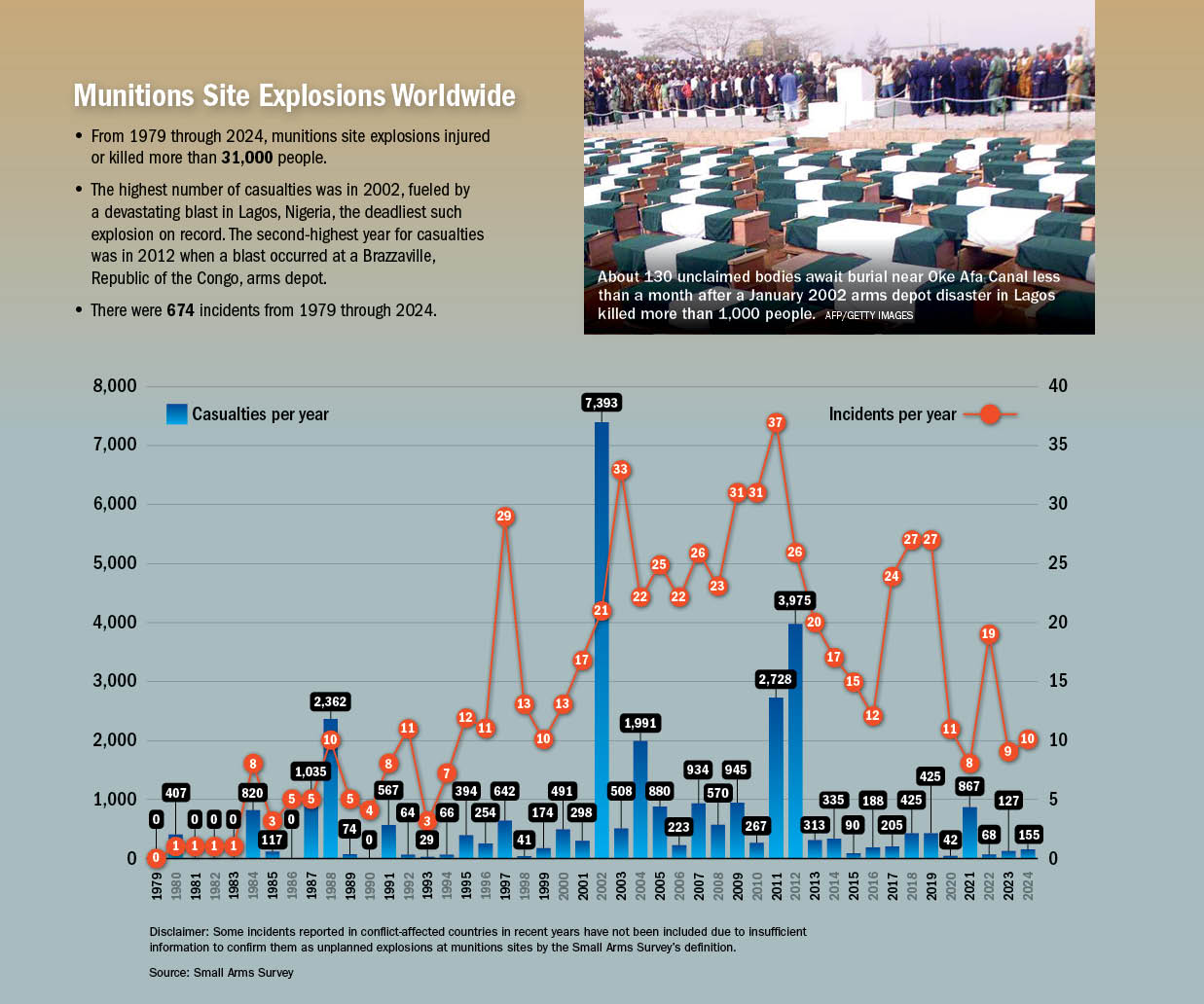
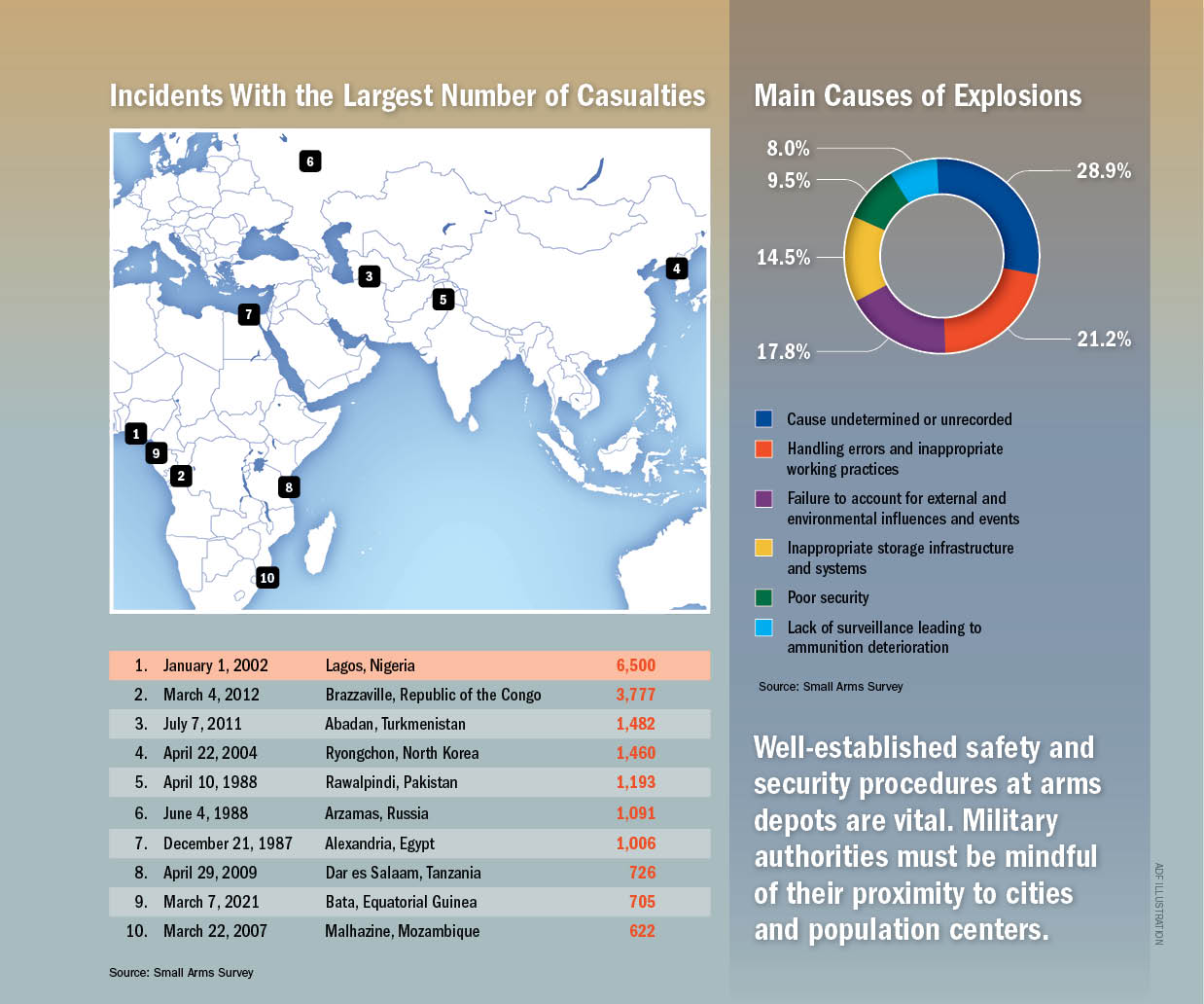
The Lagos incident was not the first or last of its kind in Africa or the world. According to the Small Arms Survey, “unplanned explosions at munition sites” have killed or injured 31,489 people worldwide from January 1979 through December 2024. Of the 674 explosions in that period, six of the top 10 with the most casualties were in Africa, including the top two incidents, the Survey reports. The Lagos incident made 2002 the most dangerous year in the time span. The second-highest number of casualties came 10 years later when explosions rocked a depot in Brazzaville, Republic of the Congo.
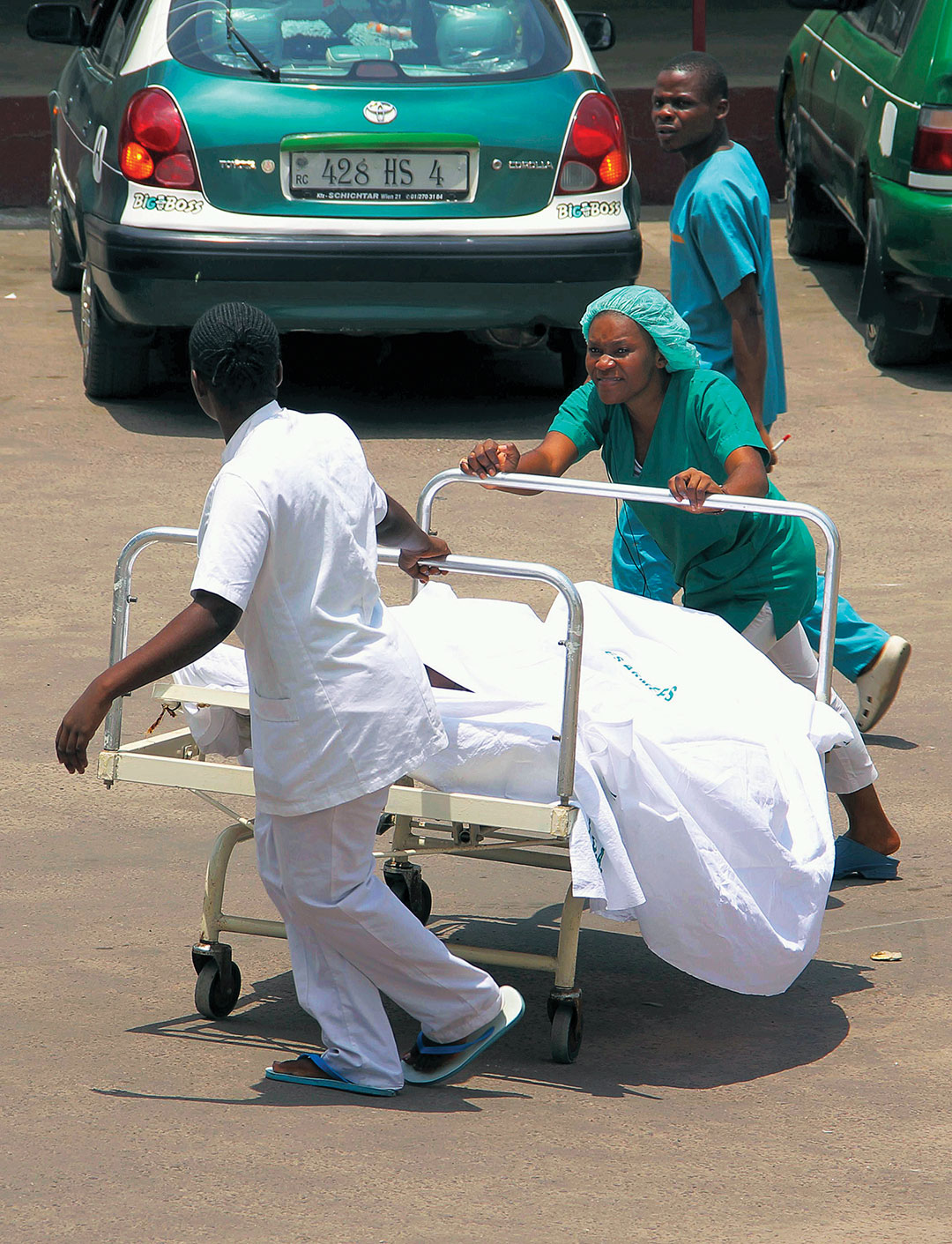
That March 4, 2012, blast killed about 300 people in the Mpila residential area, injured more than 2,300 others and left 17,000 homeless, according to AFP. Authorities charged 32 soldiers in the incident, convicting six and acquitting 26. A corporal was sentenced to 15 years of hard labor for willfully setting fire to the depot.
The most recent such incident in Africa happened June 18, 2024, when an arms depot outside N’Djamena, Chad, exploded, killing nine and injuring 46 others.
Handling errors and inappropriate work practices caused a fifth of these incidents, according to the Small Arms Survey. Other significant causes included failure to account for external and environmental influences, improper storage, armaments deterioration, and poor security.
Experts say well-established safety and security procedures at arms depots are vital. Military authorities must be mindful of their proximity to cities and population centers. Likewise, the depots must be adequately built, fortified, and secured inside and out to prevent theft, trespassing and fire.
SECURING WEAPONS DEPOTS
Stockpile control is an important part of weapons and ammunition management. It can reduce the amount of illicit weaponry getting into the hands of terrorists and prevent unplanned explosions. However, it also is the one category that produced the most persistent challenges among 12 African nations surveyed for a 2024 United Nations Institute for Disarmament Research (UNIDIR) report.
The UNIDIR report lists Benin, Côte d’Ivoire and Somalia as having made progress in stockpile management. Benin in 2022 was strengthening physical infrastructure for weapons and ammunition storage. Côte d’Ivoire in 2023 held a workshop to validate training on the subject for its military training schools.
Somalia in 2023 audited infrastructure, assessed needs, and looked at security and accountability measures. It finished building an ammunition storage site in Jazeera in February 2023. By April 2024, UNIDIR reported, Somalia had audited and assessed 228 storage facilities. It also categorized and planned storage based on weapons’ desirability to terrorists, a particularly important process as security forces battle al-Shabaab.
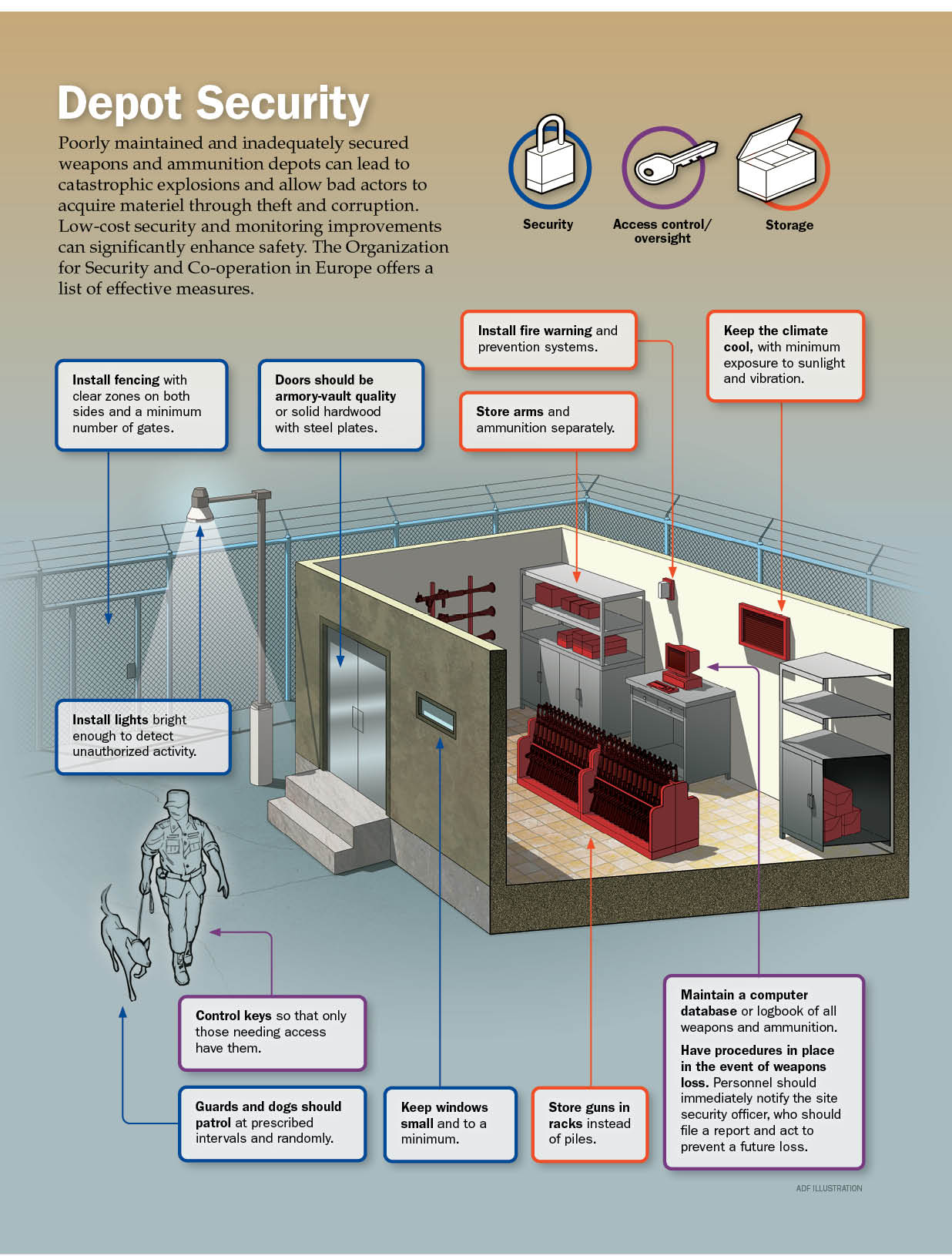 A list of relatively simple measures can help militaries secure weapons storage depots against environmental and human threats. The Organization for Security and Co-operation in Europe (OSCE) sets forth a list of things that will make weapons and ammunition storage depots accessible to Soldiers and safe to nearby civilians.
Buildings should be appropriately fortified and secured to allow only authorized access. Armory vault doors or solid hardwood doors covered with steel plates should include jambs and frames and be securely anchored. Padlocks and hasps are essential. Windows and other openings should be minimal and always be closed and locked. All openings should include intruder detection devices.
External lighting should be sufficient to deter and help detect unauthorized access in and around the site. Guards should patrol the property at regular intervals and make random checks. Guards can used trained dogs to help with their patrols. Checks should be conducted during on- and off-duty hours.
Fences are essential. They should be placed around the entire perimeter and have clear zones on each side. Gates should be kept to a minimum. Keys should be issued only to those requiring access for official work, and all keys should be registered and inventoried periodically. Limiting access can reduce losses due to theft or corruption, such as soldiers selling arms to bad actors.
Officials also must carefully manage weapons and ammunition storage to prevent unplanned explosions. OSCE guidelines recommend storing weapons and ammunition in separate buildings. If that’s not possible, they should be placed in separate rooms or containers or separated by barriers such as sandbags. Stored ammunition can range from rifle and pistol rounds to grenades, mortar shells, detonators, and other high-capacity shells. Each should be stored together according to type. Detonators should be separated from all types of ammunition.
Artillery and ammunition can be sensitive to heat and temperature changes. Storage depots should be permanent, fire-resistant structures with adequate ventilation that keeps temperatures below 40 degrees Celsius. When munitions are obsolete or unwanted, the U.N. recommends disposal through destruction.
“Effective stockpile management ensures the operational readiness of national security forces, prevents the theft or the diversion of state-owned weapons and ammunition, and enables the timely identification and disposal of obsolete and surplus materiel,” according to the UNIDIR report.