
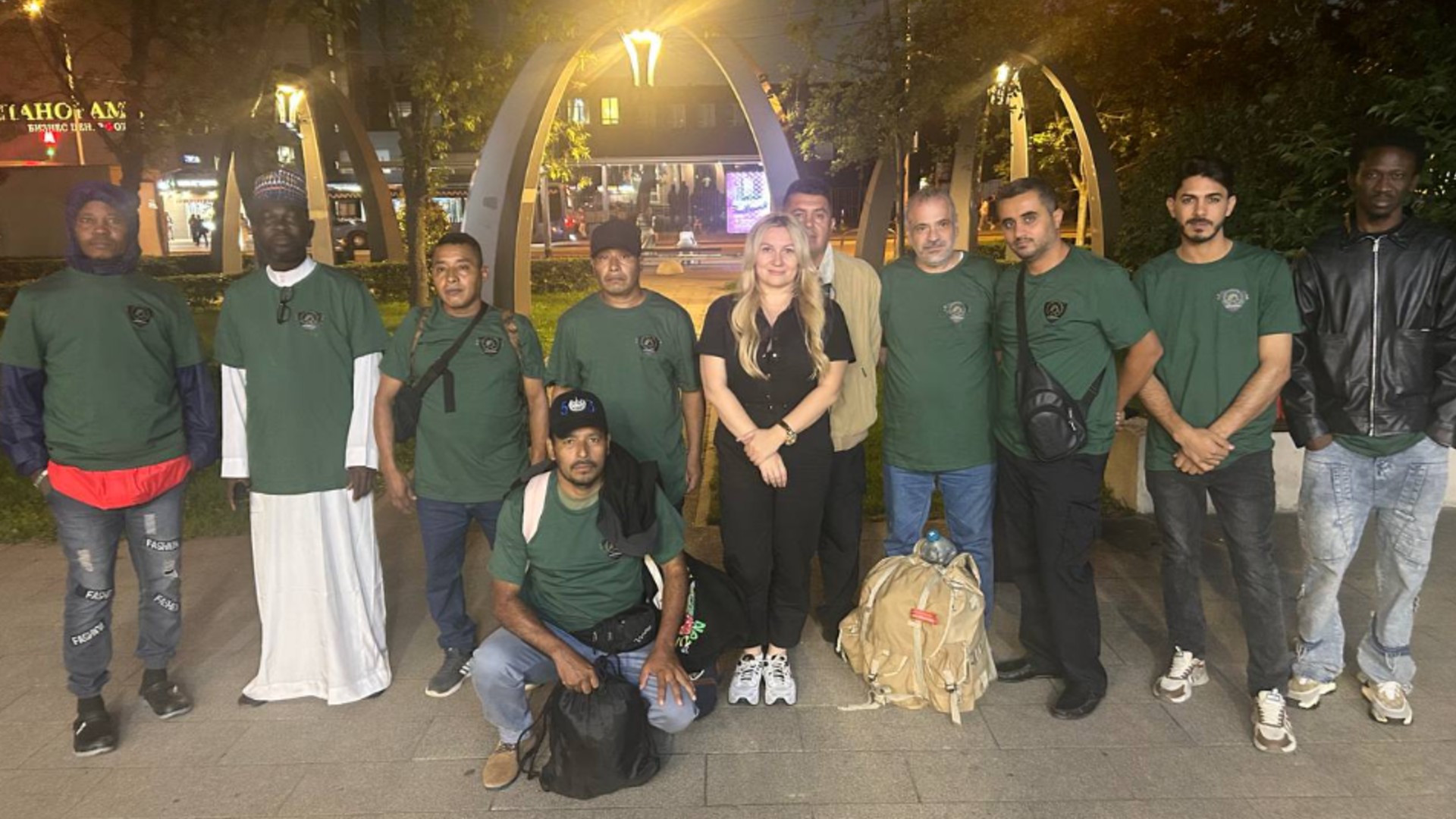
Before Russia invaded Ukraine in 2022, Polina Alexandrovna Azarnykh ran a Facebook group helping Arab students go to Moscow to study. Now the former teacher has a much deadlier job — deceiving and coercing Africans into fighting for Russia on the frontlines in Ukraine.
“She works to secure volunteers into the Russian army,” journalist Rayan Maarouf told the BBC. “She started a group on Telegram, promoting herself. She publishes updates on how to join the Russian Army. … She has connections in each country through which she recruits people.”
The Russian Ministry of Defense has used informal recruiters around the world as contractors since the start of its invasion. Azarnykh operates in the Bryansk region, which borders northern Ukraine. Some of her recruits told the BBC that she receives $300 from Russian regional authorities for every man who signs a military contract. One said that she solicited $3,000 of his $5,000 signing bonus to place him in a noncombat role. But after 10 days of basic training, he was sent to the front line anyway.
“We don’t know the language,” another recruit told the BBC. “We can’t understand anything they tell us. This woman is a con artist and a liar.”
Called “Friend of Russia,” Azarnykh’s Telegram channel has grown from about 1,100 subscribers in September 2024 to about 21,000 this year. She often encourages readers to apply to join the Russian military by sending her an image of their passport. She then posts invitation documents with a name or list of names.
As part of a yearlong investigation published on January 12, the BBC identified more than 490 invitations that Azarnykh posted in 2025 to men from countries including Côte d’Ivoire, Egypt, Morocco and Nigeria. Foreign fighters sign contracts issued by the Ministry of Defense. Many recruiters like Azarnykh falsely advertise that the contract only lasts one year, but in September 2022, Russian President Vladimir Putin declared that all soldiers must serve until the war ends. The contracts renew automatically.
“You all understood that you were going to war,” Azarnykh said in an August 2024 video posted to her Telegram channel. “So why are you complaining? You thought that you could get a Russian passport, do nothing and live in a five-star hotel? This does not happen, guys. Nothing happens for free.”
The BBC spoke with 12 families whose sons were recruited by Azarnykh. All of them are either dead or missing.
“Unfortunately, the Russians use everything they have against us,” Oleksii, a commander in Ukraine’s 157th Brigade, told the BBC in an interview near the front lines of the embattled Donetsk region. “They sign recruits illegally, by deceiving or promising Russian citizenship.”
The 157th Brigade’s Commander of Battalion Artem Lubnevski painted a darker picture for the BBC: “Their fates will be the same. It’s either captivity or death.”
Denis Muniu, a security and foreign policy analyst, said the Ministry of Defense’s recruiting networks first targeted students already in Russia, threatening to deport or imprison them if they didn’t join. The Kremlin soon cast its net around the world, seeking students and unemployed young people for infantry roles and former security personnel who could be deployed with minimal training.
“It’s a very strategic way of recruiting these people,” Muniu told British newspaper The Guardian.
The number of Egyptian students in Russia has increased steadily since the war began, from 2,300 in 2018 to 16,000 in 2023, according to Russia’s Ministry of Education. At least 25 Egyptian recruits have been killed, according to a September 2024 investigation by news website Masrawy, and anger has been rising at home with each story of young men injured, killed, captured or missing.
Nourhan al Sheikh, a professor of international relations at Cairo University, noted that any Egyptian who serves in a foreign military faces life in prison upon returning home. One of his students, Amar Muhammad, went to Russia to further his education but ended up fighting with the Russian Army. He was captured and has been detained as a prisoner of war by Ukrainian forces for more than a year.
“He could be imprisoned forever,” al Sheikh told France 24 in late 2025. “You are a mercenary, like a terrorist. If he ever comes back, he will be arrested in Egypt.”
In February 2025, the Egyptian government imposed a security clearance requirement for citizens planning to travel to Russia. The Ministry of the Interior also declared that it would revoke Egyptian nationality of anyone who fought for Russia.
“The Russians have always had this custom of recruiting mercenaries to do their dirty jobs, because they don’t want to have problems with their own domestic public opinion,” al Sheikh said. “If those guys die, who cares?”