

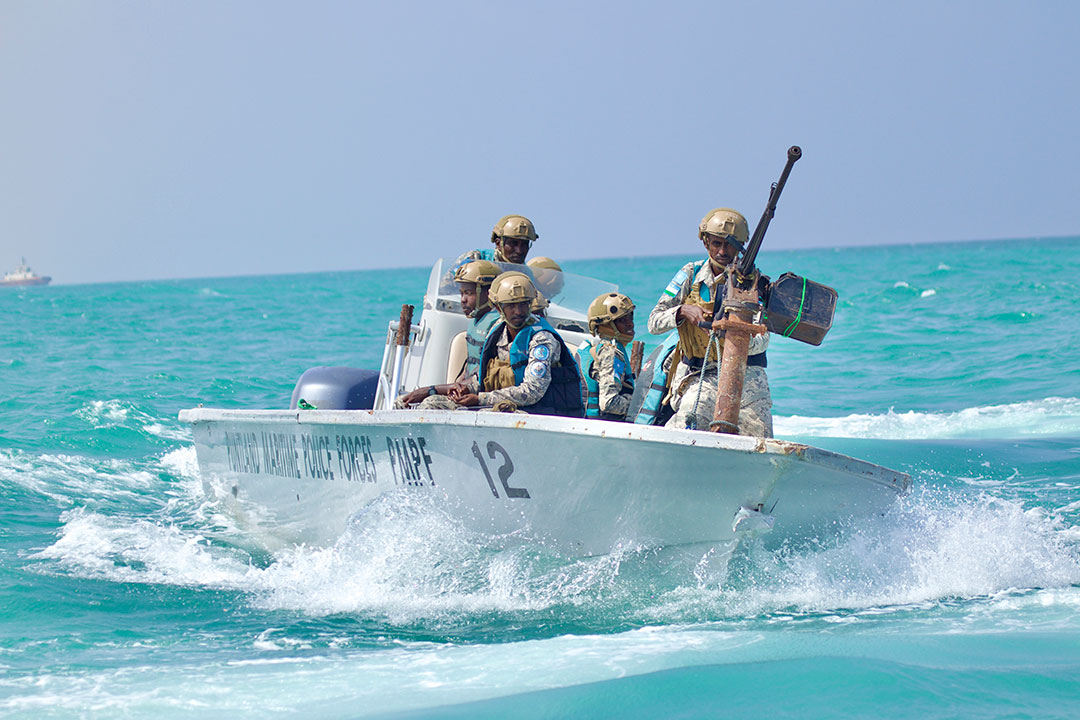
Authorities in semiautonomous Puntland State are warning that collaborations between Somali pirate groups and the Iran-backed Houthi rebels in Yemen represent a major threat to maritime security in the Horn of Africa.
The growing relationship between the Houthis and Somalia’s al-Qaida affiliate, al-Shabaab, includes ties to piracy and has resulted in pirate groups using more sophisticated weaponry and technology acquired from the Houthis.
Mohamed Musa Abulle, deputy director of intelligence for the Puntland Maritime Police Force (PMPF), said that some Somali pirate groups have acquired state-of-the-art GPS satellite devices and weapons from Houthi militants and people aligned with the rebel group in Yemen.
“This GPS device allows pirates to accurately track the routes of commercial vessels,” he told Somali reporters, adding that security agencies believe some of the pirates received military training in Yemen. “The new technology has made it much easier for them to plan attacks far from the Somali coastline.”
The PMPF announced on December 12 that it had intercepted a small boat attempting to smuggle chemicals used to make explosives and materials used to manufacture improvised explosive devices. They arrested five Somalis and two Yemeni nationals on board the boat, which was traveling off the coast of the fishing village of Eyl in the Nugaal region.
The Houthis, supported by Iran’s Revolutionary Guard Corps, are expanding their sphere of influence beyond the Middle East and into Africa, where they sells weapons to al-Shabaab and the Islamic State group in Somalia (IS-Somalia Province).
In a 2025 report, the United Nations Analytical Support and Sanctions Monitoring Team described the relationship between the Houthis and terrorist groups in Somalia as “transactional or opportunistic and not ideological.”
“Al-Shabaab held at least two meetings in Somalia with Houthi representatives in July and September 2024, in which they requested advanced weapons and training,” the report stated. “In return, al-Shabaab was to increase piracy activities within the Gulf of Aden and off the coast of Somalia, targeting cargo ships and disrupting vessel movement as well as collecting ransom from the captured vessels. During this period, al-Shabaab was reported to have received some small arms and light weapons and technical expertise from the Houthis.”
In the early 2000s, piracy flourished in Eyl, a port town in Puntland, which became known as “Harunta Burcadda,” the Pirate Capital. Small groups audaciously targeted hulking container ships and oil tankers, forcing shipping companies to avoid the Horn of Africa.
Between 2005 and 2012, pirate groups earned between $339 million and $413 million, according to World Bank estimates. The European Union’s counterpiracy mission Operation Atalanta recorded 26 pirate attacks between 2013 and 2019 and then no attacks from 2020 to 2022. But piracy off the Somali coast resumed with six attacks in 2023 and surged to 22 in 2024.
International navies have increased patrols in Somali waters, and the PMPF has evolved into a well-trained and experienced counterterrorism unit. It collaborates with Operation Atalanta but more frequently deploys many of its troops inland with Puntland’s security forces, which are engaged in a large-scale offensive against IS-Somalia Province in the Cal Miskaad mountains.
Maritime security researchers Timothy Walker and Halkano Wario expressed concern for overstretched security forces in Puntland and the Gulf of Aden.
“Persistent gaps in multinational naval coverage are worrying,” they wrote in a November 2025 article for the South Africa-based Institute for Security Studies. “Pirates have also taken advantage of the broader maritime instability caused by Houthi attacks in the Red Sea. Overstretched naval deployments and a focus by major maritime powers on Red Sea security have left parts of the Western Indian Ocean vulnerable.”
The researchers also said Somali pirate groups have expanded their organizational and operational capacity, as demonstrated in recent attacks.
“A suspected Somali pirate group showed its ability to operate far offshore using hijacked fishing vessels as motherships,” they wrote. “Another group has now been doing the same. On November 3, assailants opened fire as they attempted to board the chemical tanker Stolt Sagaland in international waters well over 300 nautical miles off Somalia’s coast. Private security onboard repelled the attack.”
Three days later, pirates fired rocket‐propelled grenades and small arms before boarding the Hellas Aphrodite. The crew took refuge in the citadel, a safe room, and retained control until an EU warship reached the tanker the next day.