
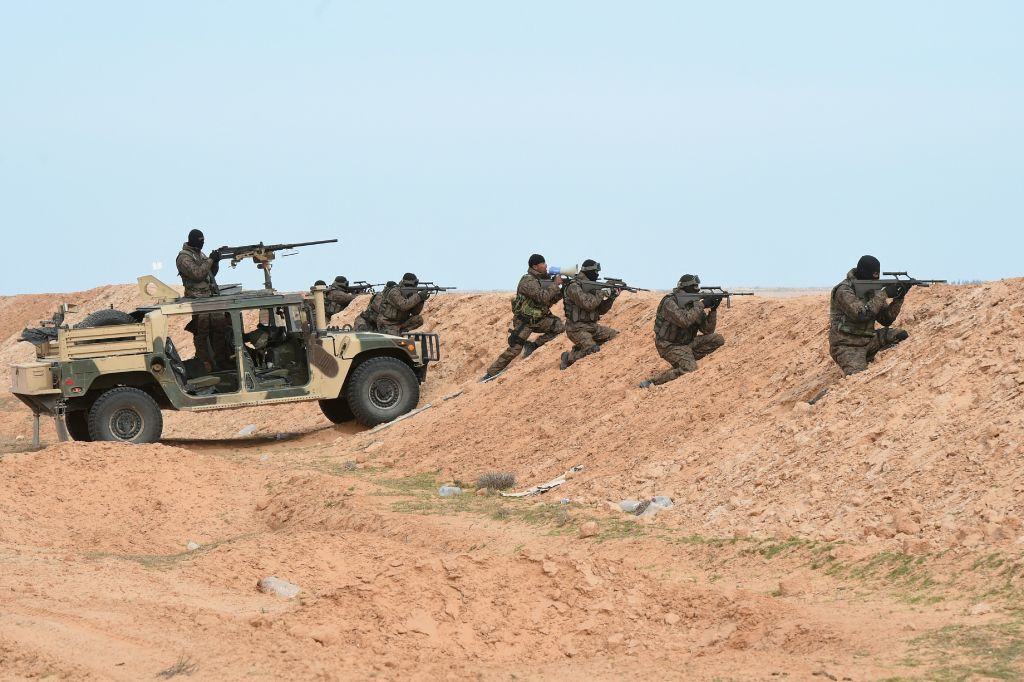
Tunisia has received counterterrorism equipment worth $1.4 million from the United States government, a move thatbolsters the countries’ security partnership.
The items were delivered in mid-December under the U.S. Anti-Terrorism Assistance Program (ATA), which provides counterterrorism training and equipment grants to law enforcement, helps partners address security challenges, defend against threats to national and regional stability, and deters terrorist operations. The U.S. Embassy in Tunisia did not specify the exact nature of the equipment.
“The enduring US-Tunisia security partnership strengthens the safety and security of both countries and advances regional stability,” the embassy said.
In 2025, Tunisia received two 34-meter, Island-class patrol boats from the U.S., which help forces secure the country’s 1,148-kilometer coastline, facing smuggling, organized crime and terrorism threats. It was also reported in 2025 that Tunisia was set to buy an undisclosed number of 20-meter Archangel patrol boats from the U.S. at an estimated total cost of $110 million. The purchase will include GPS, navigation and communications systems, and training. Tunisia co-hosted African Lion 2025 alongside U.S. Army Southern European Task Force, Africa.
In September 2024, officials announced plans for the U.S. to build a regional naval training center in Bizerte, Tunisia, to improve maritime training and boost security cooperation in the Mediterranean. The facility will offer advanced training in maritime navigation, amphibious operations and maritime security.. It will feature state-of-the-art amenities, including close-combat instruction facilities, a shooting range, an obstacle course and training tower.
No Major Attacks Since 2023
Tunisia has not experienced a major terror attack since May 2023, when a gunman killed two worshippers and three security officers at the el Ghriba Synagogue, Africa’s oldest synagogue on the Tunisian island of Djerba.
Since that attack, Tunisian security forces have thwarted attacks before they happen, according to Tunisian security expert Mohsen Chokri, who wrote on LinkedIn that the country’s security challenges exist mostly in border regions within 16 kilometers of Algeria and Libya.
Chokri highlighted the Mount Chaambi National Park in Kasserine, on the Algeria border, as a specific area of concern, as well as the remote southern desert near Remada, also on the Algeria border. Areas where large crowds gather, especially during holidays or commemorations, also pose security challenges.
Chokri described Tunisia’s security challenges as “fundamentally geographic.”
“Libya remains destabilized,” Chokri wrote. “That directly affects the southern border. Algeria manages its own security tensions. The Sahel region faces ongoing militant activity. Tunisia sits in this neighborhood. Geography isn’t destiny, but it’s a factor. What Tunisia has managed successfully: preventing dramatic incidents despite these pressures. Preventing cross-border infiltration at scale. Maintaining operational security forces without descending into armed conflict. This matters.”
The work of Tunisia’s security forces, according to Chokri, has allowed life to function normally in populated areas, including Tunis, the capital, and major cities such as Gafsa, Sfax, Sousse and Tozeur.
“I walk through Tunis, Sfax, and coastal towns regularly. Life is unremarkable. People work, study, socialize, travel,” Chokri wrote. “Yes, there are security checkpoints at city entrances — this has been normal since 2015. You show your ID, you move forward. It takes 30 seconds.”
Chokri also regarded coastal tourism areas, major roads and highways, business districts, commercial centers, public institutions, and government areas as generally safe.
A state of emergency has been in place in Tunisia since 2015, when a series of terror attacks rocked the country. The state of emergency gives security forces expanded operational authority, which is observable in the high visibility of security personnel, occasionally longer questioning at border checkpoints, and improved monitoring of religious institutions, government buildings and tourism infrastructure.
“None of this is abnormal given the regional context,” Chokri wrote. “It’s protective infrastructure.”