

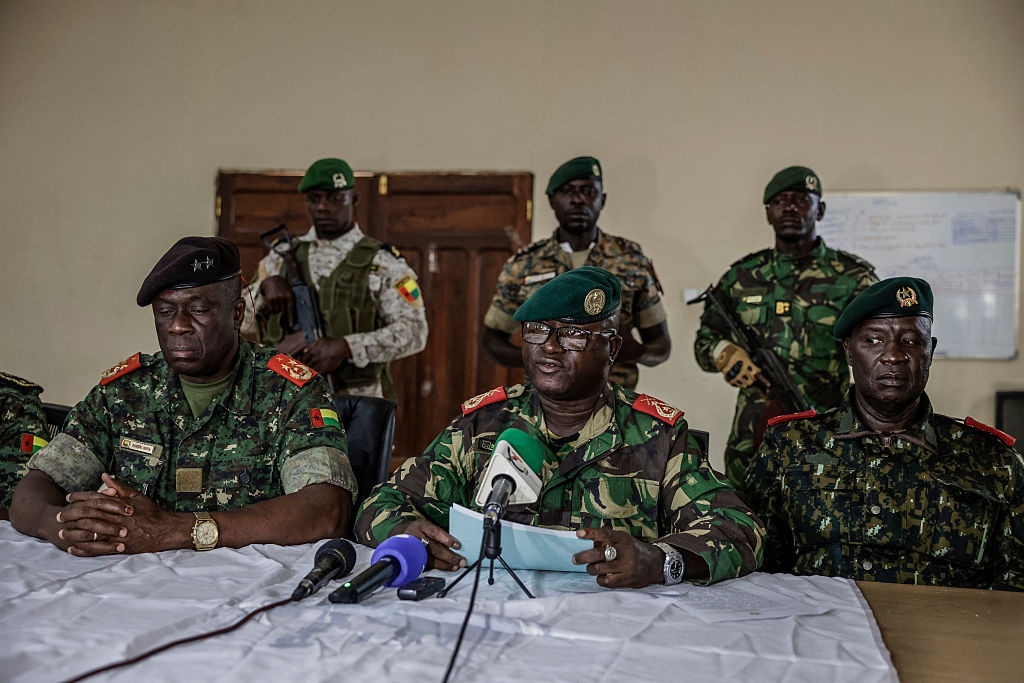
As 2025 ended, military leaders deposed elected governments in Guinea-Bissau and Madagascar. A putsch attempt in Benin failed after regional security forces and the Nigerian Air Force intervened.
Those coups and the Benin attempt came after a series of military coups in Burkina Faso, Chad, Gabon, Guinea, Mali, Niger and Sudan. A 2024 attempt failed in the Democratic Republic of the Congo.
Analysts say Africa appears to be living through a coup epidemic as 11 countries have experienced military takeovers since 2020, driven largely by discontent with economic insecurity and political instability.
“Many African governments, whether they are democratic or not, have great difficulty meeting citizens’ expectations, especially for improvements in their daily lives,” coup researcher Ernest Harsch wrote in Kenya’s The Star newspaper.
Weak societies, even democratic ones, frequently exclude many citizens from active political and economic engagement, creating a government run by unaccountable elites, according to Harsch.
Discontent can create an environment primed for a military coup, particularly if a neighboring country’s government is overthrown, researchers Salah Ben Hammou and Jonathan Powell wrote in The Conversation.
Local support and international indifference can encourage would-be coup plotters to act, according to Hammou and Powell.
The African Union has adopted a policy of suspending countries after coups. It also demands that putschists not stand for election — a demand that is being increasingly ignored across the continent.
Polling company Afrobarometer found that two-thirds of Africans across 39 countries surveyed support democracy over other forms of government.
However, there are a growing number of survey respondents who see military takeovers as a way to purge regimes that ignore public grievances, enable corruption and game the democratic electoral system to stay in power.
The quick response by Benin’s president to the attempted coup shows the benefit of intervening against coups early, according to Beverly Ochieng, a Senegal-based researcher at the Center for Strategic and International Studies.
“It’s really about how well both the government and the regional community are able to put measures in place and even just the proactiveness, because this is probably the first coup that has been successfully defused, just at the point when it was happening,” Ochieng told German news service Deutsche Welle (DW).
Leaders can defuse potential coups by addressing underlying causes of discontent, Jakkie Cilliers, founder and former head of South Africa’s Institute for Strategic Studies, told DW. However, those changes must benefit a nation’s entire population economically and through access to education, basic goods and human rights, he added.
Recent history has shown that coups rarely improve security, the economy or political goals. Public support has fallen as juntas in Burkina Faso, Mali and Niger have failed to defeat terrorism that inspired the coups in the first place.
As conditions fail to improve, junta leaders have delayed elections and turned to repression and propaganda to buttress their regimes, putting themselves at risk of further coups.
“The promise of the coups in West Africa has not really delivered as we all expected,” Cilliers recently told DW. “These problems are deep-seated. They are structural. And there’s no short-term solution to them.”