

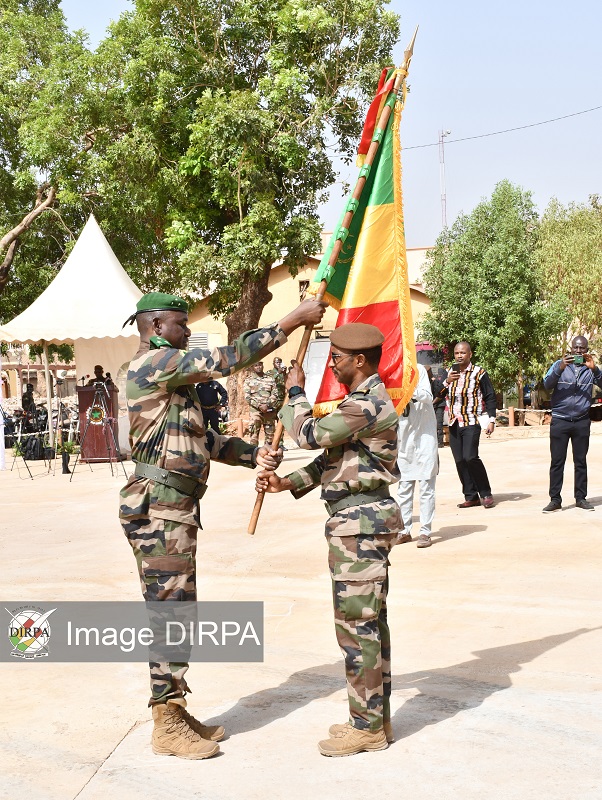
Shortly after Jama’at Nusrat al-Islam wal-Muslimin (JNIM) terrorists imposed a Bamako fuel blockade in September 2025, Mali’s junta leader chose a senior National Guard officer to lead the fight against the group.
Gen. Assimi Goïta appointed Brig. Gen. Famouké Camara, 47, to head the autonomous Operation Fuka Kènè, which means “clearing” in Bambara. It is the centerpiece of Goïta’s strategy to win the so-called fuel war, according to The Africa Report magazine.
Camara integrates military strategy and logistics to improve convoy protection, which aligns with Mali’s military-first counterterrorism approach, the magazine reports. His appointment also marks a shift toward unified oversight for high-stakes defensive operations and is intended to restore public confidence in the junta’s often-criticized counterterrorism operations.
Russian mercenaries, first known as the Wagner Group and now called Africa Corps, support Mali’s military, but JNIM recently has gained significant territory. Some analysts warn that the fall of Bamako might be imminent.
A close associate of Camara’s told the magazine that the military leader has a “solid, intact and scandal-free” reputation. “He is someone who rarely talks about himself,” the associate said. “Very reserved, though sociable.”
Camara faces a tall task. According to the United Kingdom’s Bloomsbury Intelligence and Security Institute, JNIM has disrupted overland transport routes and cut fuel deliveries by about 80% through often-deadly attacks on fuel convoys coming from Côte d’Ivoire, Guinea, Mauritania and Senegal.
JNIM resumed attacks on two fuel convoys on December 6 and December 10 along the Bougouni route, which carries 57% of Mali’s fuel from Côte d’Ivoire, according to the Critical Threats Project at the American Enterprise Institute. Fuel shortages along the route complicate electricity generation, food transport and humanitarian operations. However, a Malian security source told Jeune Afrique magazine that there have been positive results since Camara took over Operation Fuka Kènè.
“For more than a month, we have been getting fuel to Bamako without major incident and we have neutralized several terrorists, both on the Mali-Senegal corridor and on the Mali-Côte d’Ivoire corridor,” the source said.
Camara hails from Gonsolo, a village in the heart of Mandé, the historic cradle of the Mali Empire. He attended the Prytanée militaire de Kati, Mali’s elite military preparatory school, and the École militaire interarmes de Koulikoro, the country’s main officer training academy, according to The Africa Report.
He continued his training at the École Supérieure Internationale de Guerre, a war college in Cameroon, and at the École de Guerre, France’s elite military staff college.
His academic learning is complemented by significant battlefield experience in high-risk areas. In the early 2000s, he served in Abeïbara, in the Kidal region, and in Léré, in the Timbuktu region, when both areas experienced rising insecurity, according to The Africa Report. As a senior officer, he regularly traveled to combat front lines to assess conditions, encourage his men and show his support. In August 2025, he addressed soldiers during a mission to Kourémalé, on Mali’s border with Guinea.
“I came to stay with the troops, to tell the men to keep tightening their belts,” Camara said, according to The Africa Report. “We are going to fight for our ancestors, for ourselves and for our descendants. This is a mission we have set ourselves and we will carry it out, at the cost of our lives if need be.”
Malian authorities regularly called on Camara to lead complex operations before Goïta took power. During the 2002 Africa Cup of Nations in Bamako, he was in charge of an intervention group responsible for securing the tournament. In 2012, he joined the Malian delegation tasked with drawing up the concept of operations for the African-led International Support Mission in Mali, which later became the United Nations Multidimensional Integrated Stabilization Mission in Mali, known as MINUSMA.
Camara spent part of his career within the Sécurité d’État, Mali’s internal state security service. In 2017 and 2018, he headed operations and counterterrorism at the Direction Générale de la Sécurité d’État, the external intelligence and state security directorate.
“At the head of this unit at the core of Mali’s intelligence apparatus, he oversaw security monitoring, inter-agency coordination and several discreet operations against jihadist networks,” a source within Mali’s security apparatus told The Africa Report.