

Members of the Rapid Support Forces (RSF) paramilitary force didn’t hide their violent acts after capturing the capital of North Darfur state in western Sudan — some even recorded them.
In October, the RSF built a massive sand berm around El-Fasher, the last city in Darfur held by the Sudanese Armed Forces (SAF) and its allies. At sunrise on October 26, the RSF captured the town and launched attacks on civilians. Surrounded by bodies and burning vehicles, RSF fighters took videos of themselves laughing, smiling and executing unarmed civilians.
“Look at all this work. Look at this genocide,” one said in a video that circulated on social media. “They will all die like this.”
In the initial aftermath, humanitarian workers estimated the death toll at more than 2,500 people. But Darfur Governor Minni Minnawi on November 20 told reporters that the RSF killed 27,000 in three days. Since the civil war began in April 2023, more than 150,000 people have been killed and about 12 million have been forced from their homes.
While the main RSF force tore through El-Fasher, a separate group of fighters took control about 8 kilometers from the city, where they brutally executed a number of unarmed captives. Videos verified by media and research organizations showed dozens of dead civilians in a trench running along the berm. Humanitarian agencies say they have received credible reports of atrocities, including summary executions, attacks on civilians along escape routes, house-to-house raids and sexual violence against women and girls.
“We knew this was coming because this is part of a pattern of violence that we have seen the RSF commit before,” Sudanese political analyst Kholood Khair told Al Jazeera. “We have seen them commit genocides on this scale and against the same group of people for the past 20 years.”
Hanaa El Tijani, a member of Sudan’s Youth Network for Civil Monitoring, described the RSF takeover as “an unprecedented explosion of violence and grave violations against civilians,” Radio Dabanga reported. She said the network documented the “mass killings of hundreds of civilians, in addition to the execution of dozens of patients and medical staff inside the Saudi Hospital, which was the last functioning health facility in the city.”
The RSF “targeted doctors and health workers inside hospitals, and carried out widespread raids on homes and mosques, in addition to documented cases of gang rape,” stressing that these actions constitute “a systematic pattern of mass killing and ethnic cleansing against non-Arab communities in the city.”
The United Nations human rights council gave unanimous backing to a new independent investigation into the El-Fasher massacre.
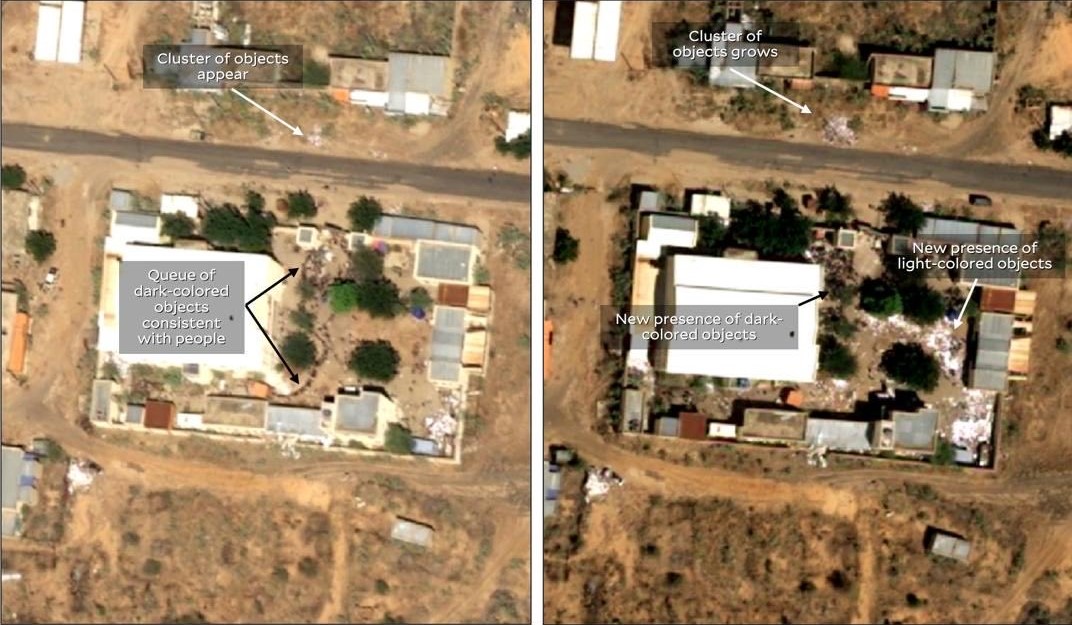
“Our wake-up calls were not heeded,” U.N. human rights chief Volker Türk said during an emergency meeting on November 14. “Bloodstains on the ground in El-Fasher have been photographed from space.”
Satellite images taken on October 26 appeared to confirm RSF executions on the streets of El-Fasher, according to a report published by the Yale Humanitarian Research Lab (HRL).
“[It is] highly likely that most civilians who were alive in El-Fasher prior to October 26, 2025, have been killed, have died, are detained, are in hiding, have fled or are otherwise unable to move freely,” the November 21 report stated. “The lack of market activity further corroborates HRL’s finding that there are no current patterns of life visible that are consistent with civilian presence and freedom of movement in El-Fasher.”
HRL Executive Director Nathaniel Raymond described the violence in El-Fasher as unprecedented.
“We are only at the beginning of a wave of violence,” he told British newspaper The Guardian. “I have never seen a level of violence against an area like we are seeing now. This is only comparable with a Rwandan-style killing in the first 24 hours.”
Sheldon Yett, a member of the UNICEF humanitarian mission in Sudan, said his organization has given care to thousands of civilians who fled to neighboring villages and the Tawila refugee camp.
“The displaced people who arrive here are completely exhausted and without resources,” he told France 24. “For months, there has been no food, medicine or water in El-Fasher. The besieged civilians were eating animal food.
“Reports indicate the RSF demands large sums of money to allow people to flee the city. Therefore, those who were able to escape the city are the ones who could afford to pay to leave. The most vulnerable populations are the ones who stayed behind.”